Tag Archives: dam

The Most Dangerous Dam

Sensors installed by American army engineers in December 2015 show widening fissures in the fragile gypsum base underneath the Mosul dam,  though no one can predict when a breach might occur….The Iraqi government has now contracted with the Trevi Group, an Italian firm, which it hopes will offer a more advanced and permanent method of plugging cavities in the stone base than the constant maintenance it has required for the past 30 years. That maintenance came to an abrupt halt after IS seized the dam in August 2014, and has continued only intermittently after it was seized back three weeks later. Essential equipment went missing then, and half its staff decided not to return to work.

One study says that if the dam collapses, Mosul would be submerged within hours. Another warns that half a million Iraqis could be killed by floodwaters, and more than a million forced from their homes. Disease and looting as the floodwaters raced through Baiji, Tikrit, Samarra and even parts of Baghdad would complete that dreadful scenario.

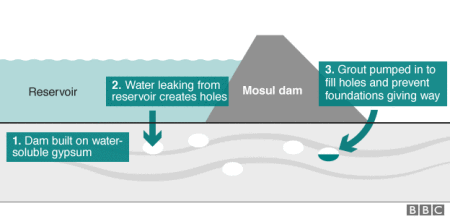
The dam was built by an Italian-German consortium and started operating in 1986. Because of the high proportion of gypsum in the area, the construction included a grouting tunnel to allow almost constant injection of cement and drilling mud into crevices in the base that are widened by the water flowing through them. America’s Army Corps of Engineers warned in 2005 that the “extraordinary engineering measures” needed to maintain its structural integrity made the structure potentially the most dangerous in the world.*** But taking the dam out of commission is not an attractive option. Emptying the reservoir would leave Iraqis seriously short of drinking and unpolluted irrigation water in the summer.

Excerpts from The Mosul dam: A watery time-bomb, Economist, Feb. 13, 2016, at 42

***  The dam was constructed on a foundation of water soluble gypsum!!! More than 50,000 tonnes  of material have been injected into the dam since leaks began forming shortly after the reservoir was filled in 1986, and 24 machines currently continuously pump grout into the dam base. Between 1992 and 1998 four sinkholes formed downstream of the dam and a fifth sinkhole developed east of the dam in February 2003 which was filled several times. In August 2005 another sinkhole developed to the east (Wikipedia).
Water Conflicts: Tajikistan versus Uzbekistan

Rogun is both a town [in Tajikistan], some 100km (60 miles) from the capital, Dushanbe, and a long-stalled dream: to build the world’s tallest hydropower dam.  Dirt-poor but water-rich, Tajikistan hopes to sell electricity to Afghanistan and South Asia. In theory, the dam, 335 metres high, could save the country from poverty and isolation, doubling Tajikistan’s power-generating capacity. But the project seems quixotic, if not outright delusional: it would cost up to $6 billion (GDP in 2012 was about $7.6 billion); Uzbekistan, a big neighbour, is fiercely opposed; and the investment climate is clouded by corruption.

Plans for the dam were drawn up long before the collapse of the Soviet Union, but were revived in the early 2000s as Tajikistan recovered from civil war. Each winter energy shortages shave an estimated 3% off GDP. Rogun will solve all problems, state propaganda and many Tajiks say.

But international donors struggle to trust Mr Rakhmon [Tajikistan’s president]. Two-fifths of Tajikistan’s electricity is diverted to a state-run aluminium smelter, TALCO. Each year, TALCO produces hundreds of millions of dollars in profits that are routed to a shell company in the British Virgin Islands. Mr Rakhmon personally oversees TALCO. Why does he not use that cash for his dam?

Central Asia’s energy and water resources were once run from Moscow. In summer upstream republics such as Tajikistan and neighbouring Kyrgyzstan released water from their dams to generate electricity and help irrigate downstream republics, such as Uzbekistan. So Tajikistan already boasts the world’s highest dam, the 300-metre Nurek, built in the 1970s. In winter Uzbekistan delivered gas. That deal broke down after independence. Mr Rakhmon and Uzbekistan’s Islam Karimov do not get along. It is the custom among autocrats in these parts.

Uzbekistan thinks Rogun would parch its cotton crop and give Tajikistan political leverage. In protest, Uzbekistan has halted gas sales to Tajikistan and blocked shipments of construction materials for Rogun. Mr Karimov has warned the dispute could lead to war.

Into this morass has waded the World Bank, sponsoring two three-year assessments of the project on condition that construction is suspended. When completed, probably later this year, the studies are expected to judge the project itself feasible, but to present nine other options—of differing heights and turbine capacities—that may offer better value.  But questioning the dam’s height does not go down well with Mr Rakhmon. In 2004 Russia offered to get RusAL, an aluminium giant, to build Rogun. But after RusAL said the dam should be 50 metres lower (and perhaps tried to muscle into TALCO), the president told them to leave…

Tajikistan cannot build Rogun alone. A brain drain has left it woefully ill-equipped to handle such a project. One of Rogun’s chief engineers, asked to confirm a few statistics, consults Wikipedia. The only realistic patrons for the project are outsiders who might be able to stomach the corruption, such as Russia or China. But neither wants to anger Uzbekistan, Central Asia’s most populous country, with its largest army.

Hydropower in Tajikistan: Folie de grandeur, Economist, July 27, 2013, at 36