Tag Archives: export controls

Who is Afraid of China? the United States Army

China plans to ease the flow of rare earths and other restricted materials to the U.S. by designing a system that will exclude companies with ties to the U.S. military while fast-tracking export approvals for other firms…The “validated end-user” system, or VEU, would enable Chinese leader Xi Jinping to follow through on a pledge to President Trump to facilitate the export of such materials while ensuring that they don’t end up with U.S. military suppliers, a core concern for China…  The VEU mechanism that Beijing is considering is modeled on U.S. laws and procedures, as is much of Beijing’s export-control architecture.

Under the American version of the VEU system, which has been active since 2007, certain Chinese companies are cleared to buy sensitive goods under a general authorization—essentially a simplified export-approval mechanism—instead of needing individual licenses for each purchase. This makes it easier to import controlled goods such as chemicals or chip-making equipment, but requires companies to put up with U.S. government inspections of their facilities, among other steps, to verify compliance with the program…

Companies in the U.S. and Europe have complained of reduced access to rare-earth magnets from China. Though China has periodically agreed to relax magnet restrictions, Chinese rare-earth magnet exports to the U.S. declined 29% in September 2025 from the month before

Excerpt from Jon Emont et al, China Hatches Plan to Keep U.S. Military From Getting Its Rare-Earth Magnets, WSJ, Nov. 10, 20215

Nationalizing a Crown Jewel: the case of Nexperia

U.S. officials’ warning to their Dutch counterparts was stark: If they wanted a Netherlands-based chip maker to avoid being put on a trade blacklist, it would almost certainly have to remove its Chinese owner as CEO. “The fact that the company’s CEO is still that same Chinese owner is problematic,” American officials said in a June 2025 meeting on the topic. The Americans soon got their wish. In September 25, 2025, the Dutch economy ministry seized control of Nexperia from China’s Wingtech Technology. The next day, a Dutch court granted an emergency petition to suspend Wingtech founder Zhang Xuezheng as Nexperia’s CEO and put all but one of the semiconductor company’s shares under external management.

China quickly fired back at the seizure, ordering Wingtech in early October to suspend exports of Nexperia of chips that the company has long sent for packaging and testing in China…The Dutch economy minister said in a letter to parliament that he moved to seize control of Nexperia based on evidence that the CEO was moving quickly to shift production capacity, financial resources and intellectual property to China, not because of pressure from any other country… The Dutch government and Dutch and German executives of the company had tried for months to ringfence the company’s business from Chinese control to accommodate domestic concerns—and avoid being hit by the U.S. blacklist… Dutch officials told Nexperia that the coming expansion of U.S. trade restrictions could lead to restrictions on the business, unless measures were taken to limit the transfer of knowledge and capabilities to China.

In the past, Nexperia relied on its European factories and contract manufacturers in Taiwan to make chips for China. In 2020, Zhang set up a wafer factory in Shanghai. The business, called Wingskysemi, started production in 2023 and has become one of Nexperia’s key suppliers….

Excerpt from Sam Schechner et al, , How U.S. Pressured Netherlands to Oust CEO of Chinese-Owned Chip Maker, WSJ, Oct. 14, 2025

Nvidia CEO Has a Magic Needle

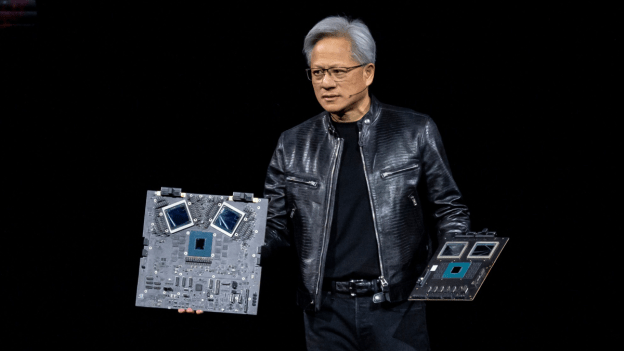
Nvidia’s market share in China fell to 50% from 95% over the past four years under U.S. restrictions, Huang, Nvidia’s CEO,  said in May 2025.  He visited China at least three times in 2025 to reassure Chinese tech executives and government officials that Nvidia was committed to the market…. Huang has met with top executives of Chinese cloud-computing leader Alibaba, smartphone and automaker Xiaomi and OpenAI challenger MiniMax.People in China’s tech industry said they appreciated Huang’s efforts to modify his chips so they could be sold in China. Engineers there nicknamed him “Magic Tailor” for his skill in designing chips to thread the needle of U.S. regulations.

Knowing the importance of the Chinese market to Nvidia, Beijing increased pressure on the company: China’s cybersecurity regulator recently summoned Nvidia representatives to discuss alleged security risks of the H20 chips, citing comments by U.S. lawmakers about the need for a bill to require tracking capabilities for advanced chips sold abroad….

Excerpt from Lingling Wei et al, With Billions at Risk, Nvidia CEO Buys His Way Out of the Trade Battle, WSJ, Aug. 11, 2025


The Cat-and-Mouse Game: US-China, Chip Giants

The U.S. on March 28 2025 added dozens of Chinese companies to a trade blacklist over national security concerns. American businesses seeking to sell technology to these companies will need approval from the government. Among those added were subsidiaries of Inspur Group, China’s largest server maker and a major customer for U.S. chip makers such as Nvidia, Intel and Advanced Micro Devices. Companies linked to China’s largest supercomputer maker, Sugon, were also added…

Nearly 80 companies were put on the Commerce Department’s blacklist, known as the entity list…including the U.S. server maker Aivres Systems that is wholly owned by Inspur Electronic. The latter is one-third owned by Inspur Group, according to corporate records. Aivres has been assembling high-end artificial-intelligence equipment for Nvidia. The AI-chip giant has said that Aivres will make servers using chips in the Blackwell family, Nvidia’s newest and most powerful processors.  Aivres advertises on its website that it sells servers and infrastructure powered by Blackwell chips, which are banned from sale into China…About two months after Inspur Group was added to the trade blacklist in March 2023, California-based Inspur Systems changed its name to Aivres Systems.

Excerpts from Liza Lin, Trump Takes Tough Approach to Choking Off China’s Access to U.S. Tech, WSJ, Mar. 26, 2025

The US-China Supercomputer Rivalry

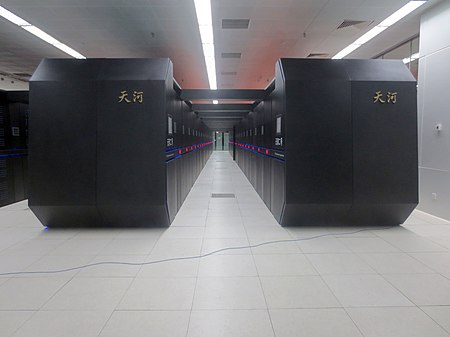
For decades, American and Chinese scientists collaborated on supercomputers, tennis-court-size machines essential to improving artificial intelligence, developing vaccines and predicting hurricanes. But Chinese scientists have become more secretive as the U.S. has tried to hinder China’s technological progress, and they have stopped participating altogether in a prominent international supercomputing forum.

The new secrecy also makes it harder for the U.S. government to answer a question it deems essential to national security: Does the U.S. or China have faster supercomputers? Some academics have taken it upon themselves to hunt for clues about China’s supercomputing progress, scrutinizing research papers and cornering Chinese peers at conferences.

Supercomputers have become central to the U.S.-China technological Cold War because the country with the faster supercomputers can also hold an advantage in developing nuclear weapons and other military technology. “If the other guy can use a supercomputer to simulate and develop a fighter jet or weapon 20% or even 1% better than yours in terms of range, speed and accuracy, it’s going to target you first, and then it’s checkmate,” said Jimmy Goodrich, a senior adviser for technology analysis to Rand Corp., a think tank.

The forum that China recently stopped participating in is called the Top500, which ranks the world’s 500 fastest supercomputers. While the latest ranking, released in June 2024, says the world’s three fastest computers are in the U.S., the reality is probably different. Officially, the fastest computer on the Top500 sits at the Energy Department-sponsored Oak Ridge National Laboratory, in Tennessee. Called Frontier, it is about the size of two tennis courts, cost $600 million to construct and has an electricity bill of about $20 million a year, said Dongarra, who also works at Oak Ridge. It uses tens of thousands of computer chips.

Dongarra doesn’t think Frontier is actually the world’s fastest supercomputer. Scientific papers suggest that certain Chinese machines are better. One has been referred to in state media as a prototype Tianhe-3, after a Chinese term for the Milky Way galaxy, while the other is a model in the Sunway series of supercomputers.

Excerpts from Stu Woo ,US China Rift Hits Supercomputer Ties, WSJ, July 24, 2024

Why China Lags Behind in Artificial Intelligence

China is two or three years behind America in building foundation models of AI. There are three reasons for this underperformance. The first concerns data. A centralized autocracy should be able to marshal lots of it—the government was, for instance, able to hand over troves of surveillance information on Chinese citizens to firms such as SenseTime or Megvii that, with the help of China’s leading computer-vision labs, then used it to develop top-notch facial-recognition systems.

That advantage has proved less formidable in the context of generative AIs, because foundation models are trained on the voluminous unstructured data of the web. American model-builders benefit from the fact that 56% of all websites are in English, whereas just 1.5% are written in Chinese, according to data from w3Techs, an internet-research site. As Yiqin Fu of Stanford University points out, the Chinese interact with the internet primarily through mobile super-apps like WeChat and Weibo. These are “walled gardens”, so much of their content is not indexed on search engines. This makes that content harder for ai models to suck up. Lack of data may explain why Wu Dao 2.0, a model unveiled in 2021 by the Beijing Academy of Artificial Intelligence, a state-backed outfit, failed to make a splash despite its possibly being computationally more complex than GPT-4.

The second reason for China’s lackluster generative achievements has to do with hardware. In 2022 America imposed export controls on technology that might give China a leg-up in AI. These cover the powerful microprocessors used in the cloud-computing data centrers where foundation models do their learning, and the chipmaking tools that could enable China to build such semiconductors on its own.

That hurt Chinese model-builders. An analysis of 26 big Chinese models by the Centre for the Governance of ai, a British think-tank, found that more than half depended on Nvidia, an American chip designer, for their processing power. Some reports suggest that SMIC, China’s biggest chipmaker, has produced prototypes just a generation or two behind TSMC, the Taiwanese industry leader that manufactures chips for Nvidia. But SMIC can probably mass-produce only chips which TSMC was churning out by the million three or four years ago.

Chinese AI firms are having trouble getting their hands on another American export: know-how. America remains a magnet for the world’s tech talent; two-thirds of ai experts in America who present papers at the main ai conference are foreign-born. Chinese engineers made up 27% of that select group in 2019. Many Chinese AI boffins studied or worked in America before bringing expertise back home. The covid-19 pandemic and rising Sino-American tensions are causing their numbers to dwindle. In the first half of 2022 America granted half as many visas to Chinese students as in the same period in 2019.

The triple shortage—of data, hardware and expertise—has been a hurdle for China. Whether it will hold Chinese ai ambitions back much longer is another matter.

Excerpts from Artificial Intelligence: Model Socialists, Economist,  May 13, 2023, at 49