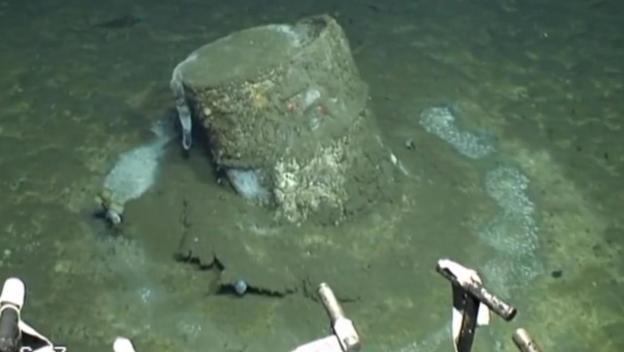
An expedition led by UC San Diego’s Scripps Institution of Oceanography mapped more than 36,000 acres of seafloor between Santa Catalina Island and the Los Angeles coast in a region previously found to contain high levels of the toxic chemical DDT in sediments and the ecosystem. The survey on Research Vessel (R/V) Sally Ride identified an excess of 27,000 targets with high confidence to be classified as a barrel, and an excess of 100,000 total debris objects on the seafloor.
“Unfortunately, the basin offshore Los Angeles had been a dumping ground for industrial waste for several decades, beginning in the 1930s. We found an extensive debris field in the wide area survey,” said Eric Terrill, chief scientist of the expedition and director of the Marine Physical Laboratory at Scripps Institution of Oceanography. The expedition that ran March 10-24, 2021 was developed in collaboration with NOAA’s Office of Marine and Aviation Operations…The project, part of ongoing collaboration with NOAA’s Uncrewed Systems Operations Center, tested autonomous underwater vehicle (AUV) technology to map the seafloor….Two AUVs, the REMUS 6000 capable of working up to depths of 6,000 meters (19,600 feet), and Bluefin , capable of depths up to 1,500 meters (4,900 feet), were deployed to work in tandem to map the seabed at a high resolution…
In 2011 and 2013, UC Santa Barbara professor David Valentine discovered concentrated accumulations of DDT in the sediments in the same region, and visually confirmed 60 barrels on the seafloor. Scientists are also finding high levels of DDT in marine mammals including dolphins and sea lions, with exposure to PCBs and DDT linked to the development of cancer in sea lions. Reporting on this issue by the Los Angeles Times noted that shipping logs from a disposal company supporting Montrose Chemical Corp. of California, a DDT-producing company, show that 2,000 barrels of DDT-laced sludge could have potentially been dumped each month from 1947 to 1961 into a designated dumpsite. In addition to Montrose, logs from other entities show that many other industrial companies in Southern California used this basin as a dumping ground until 1972, when the Marine Protection, Research and Sanctuaries Act, also known as the Ocean Dumping Act, was enacted…
There is a lot to be understood towards how DDT is impacting our environment and marine food webs, according to Scripps chemical oceanographer and professor of geosciences Lihini Aluwihare, who in 2015 co-authored a study that found high abundance of DDT and other man-made chemicals in the blubber of Bottlenose Dolphins that died of natural causes… “These results also raise questions about the continued exposure and potential impacts on marine mammal health, especially in light of how DDT has been shown to have multi-generational impacts in humans. How this vast quantity of DDT in sediments has been transformed by seafloor communities over time, and the pathways by which DDT and its degraded products enter the water column food web are questions that remain to be explored.”
Excerpts from SCRIPPS OCEANOGRAPHY COMPLETES SEAFLOOR SURVEY USING ROBOTICS, FINDS THOUSANDS OF POSSIBLE TARGETS OF INTEREST AT DUMPSITE OFF COAST OF LOS ANGELES, Apr. 26, 2021
 Law-In-Action