
Tag Archives: missile systems

Back from the Dead but Wobbling: Nuclear Deterrence

The Pentagon has revised the projected cost of refurbishing hundreds of nuclear missile silos to $141 billion, a $30 billion increase from an estimate provided in January. The U.S. Air Force project, known as Sentinel, includes replacing the Cold War-era intercontinental ballistic missiles inside the silos with newer models…Sentinel is part of a long-delayed nuclear-arms refresh that the Congressional Budget Office estimates will cost at least $1.5 trillion over the next 30 years…The missiles sitting inside some 450 silos are decades past their projected lifespan of 10 years. The underground silos require thousands of miles of new fiber-optic cabling. Underground command centers that control the missiles need to be rebuilt. Maintenance jobs that used to take two or three hours now take twice as long, and parts are more difficult to obtain, Air Force officials said.

“Its scale, scope and complexity are something we haven’t attempted as a nation for over 60 years,” Bill LaPlante, the Pentagon’s chief weapons buyer, told reporters in July 2024 as he cleared Sentinel to continue as a must-do program despite the surging costs. The Pentagon hired Northrop Grumman in 2020 to oversee the Sentinel program and do the initial engineering and design work. Northrop, aided by construction giant Bechtel, was the only bidder for the initial $13.3 billion contract after Boeing dropped out

Most of the people who did it the last time aren’t even around anymore. So re-creating all of this has turned out to be a huge problem,” said Madelyn Creedon, a former senior Energy Department and Pentagon official who chaired a congressionally mandated panel on future U.S. nuclear and conventional forces…

Excerpt from Doug Cameron U.S. Nuclear Missile Silos Need Modernizing, but Fixes Aren’t Coming Soon, WSJ, Aug. 26, 2024
A Hypersonic Death: The Race to Develop Hypersonic Weapons

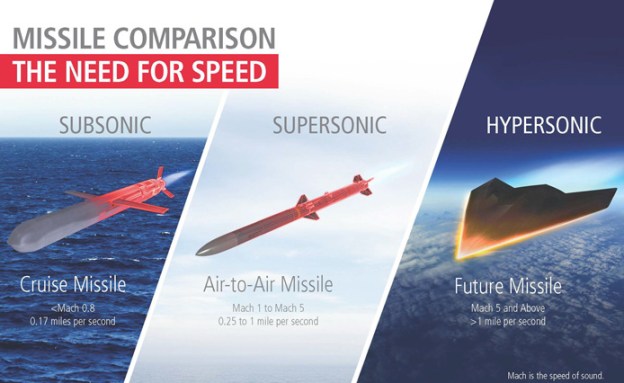
For decades, the U.S. military—and its adversaries—have coveted missiles that travel at hypersonic speed, generally defined as Mach 5 (5 times the speed of sound) or greater . Intercontinental ballistic missiles (ICBMs) meet that definition when they re-enter the atmosphere from space. But because they arc along a predictable ballistic path, like a bullet, they lack the element of surprise. In contrast, hypersonic weapons such as China’s waverider maneuver aerodynamically, enabling them to dodge defenses and keep an adversary guessing about the target.

The US Department of Defense (DOD) is leading a new charge, pouring more than $1 billion annually into hypersonic research. Competition from ambitious programs in China and Russia is a key motivator. Although hype and secrecy muddy the picture, all three nations appear to have made substantial progress in overcoming key obstacles, such as protecting hypersonic craft from savage frictional heating. Russia recently unveiled a weapon called the Kinzhal, said to reach Mach 10 under its own power, and another called Avangard that is boosted by a rocket to an astonishing Mach 27. China showed off a rocket-boosted hypersonic glide vehicle (HGV) of its own, the Dongfeng-17, in a recent military parade. The United States, meanwhile, is testing several hypersonic weapons. “It’s a race to the Moon sort of thing,” says Iain Boyd, an aerospace engineer at the University of Colorado, Boulder. “National pride is at stake.”

China’s military sees hypersonic weapons (as well as cyberwarfare and electromagnetic pulse strikes) as an “assassin’s mace”: a folklore term for a weapon that gives an advantage against a better-armed foe. If tensions were to spike over Taiwan or the South China Sea, for instance, China might be tempted to launch preemptive strikes with conventional hypersonic weapons that could cripple U.S. forces in the Pacific Ocean.For now, maneuverability at hypersonic speeds makes the weapons nearly impossible to shoot down—unstoppable…

At hypersonic speeds,  “You’re flying under extraordinary conditions”—extreme velocities, forces, and temperatures.  At hypersonic  speeds “temperatures start to get high enough to worry about… A vehicle’s survival requires resilient superalloys and ultra–high-temperature ceramics. And perhaps novel coolants…

Other nations are chasing the trio of leaders—or teaming up with them. Australia is collaborating with the United States on a Mach 8 HGV, and India with Russia on a Mach 7 Hypersonic Cruise Missile (HCM). France intends to field an HCM by 2022, and Japan is aiming for an HGV in 2026.

THE United States is largely defenseless against such weapons, at least for now, in part because it can’t track them…To remedy that shortcoming, the Pentagon plans to launch hundreds of small satellites with sensors capable of tracking heat sources an order of magnitude cooler than rocket boosters. The full Hypersonic and Ballistic Tracking Space Sensor network could be up and running by 2030, he adds. (The satellites would also be used to help guide U.S. hypersonic weapons.)  Once you have such sensors, “we can find a way to build the interceptors…Interceptors could destroy a hypersonic vehicle either by colliding with it or by detonating a warhead nearby. But Missile Defense Agency (MDA) is also exploring using directed energy: lasers, neutral particle beams, and microwaves or radio waves.

Richard StoneJan, National pride is at stake.’ Russia, China, United States race to build hypersonic weapons, Science, Jan 10, 2020