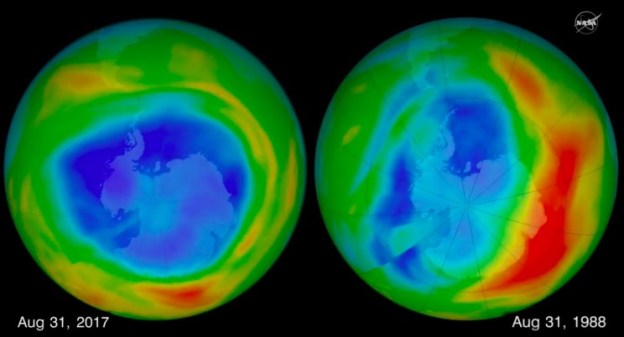
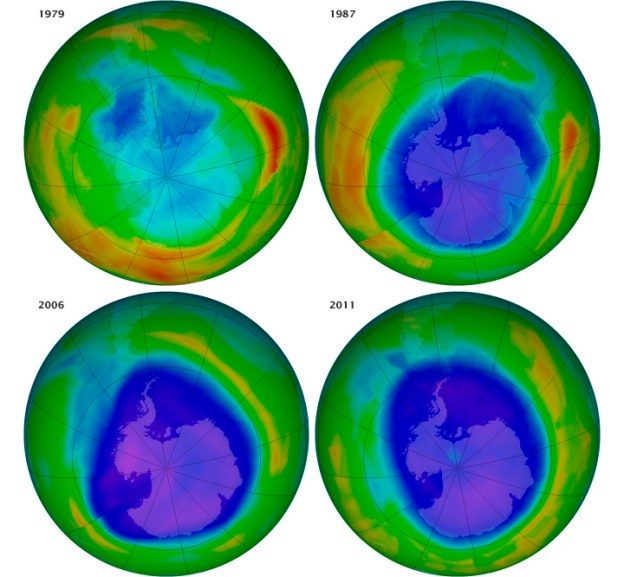
CFC-11 is also known as trichlorofluoromethane, and is one of a number of chloroflurocarbon (CFC) chemicals that were initially developed as refrigerants during the 1930s. However, it took many decades for scientists to discover that when CFCs break down in the atmosphere, they release chlorine atoms that are able to rapidly destroy the ozone layer which protects us from ultraviolet light. A gaping hole in the ozone layer over Antarctica was discovered in the mid 1980s. The international community agreed the Montreal Protocol in 1987, which banned most of the offending chemicals. Recent research suggests that the hole in the Northern Hemisphere could be fully fixed by the 2030s and Antarctica by the 2060s.
CFC-11 was the second most abundant CFCs and was initially seen to be declining as expected.However in 2018 a team of researchers monitoring the atmosphere found that the rate of decline had slowed by about 50% after 2012. Further detective work in China by the Environmental Investigation Agency in 2018 seemed to indicate that the country was indeed the source. They found that the illegal chemical was used in the majority of the polyurethane insulation produced by firms they contacted.One seller of CFC-11 estimated that 70% of China’s domestic sales used the illegal gas. The reason was quite simple – CFC-11 is better quality and much cheaper than the alternatives.
This new paper seems to confirm beyond any reasonable doubt that some 40-60% of the increase in emissions is coming from provinces in eastern China. Using what are termed “top-down” measurements from air monitoring stations in South Korea and Japan, the researchers were able to show that since 2012 CFC-11 has increased from production sites in eastern China.They calculated that there was a 110% rise in emissions from these parts of China for the years 2014-2017 compared to the period between 2008-2012.
“If we look at these extra emissions that we’ve identified from eastern China, it equates to about 35 million tonnes of CO2 being emitted into the atmosphere every year, that’s equivalent to about 10% of UK emissions, or similar to the whole of London.” The Chinese say they have already started to clamp down on production by what they term “rogue manufacturers”. In November 2018, several suspects were arrested in Henan province, in possession of 30 tonnes of CFC-11.
Excerpts from Matt McGrath, Ozone layer: Banned CFCs traced to China say scientists, BBC, May 22, 2019
 Law-In-Action