Tag Archives: solar power in space

Secrecy in Space

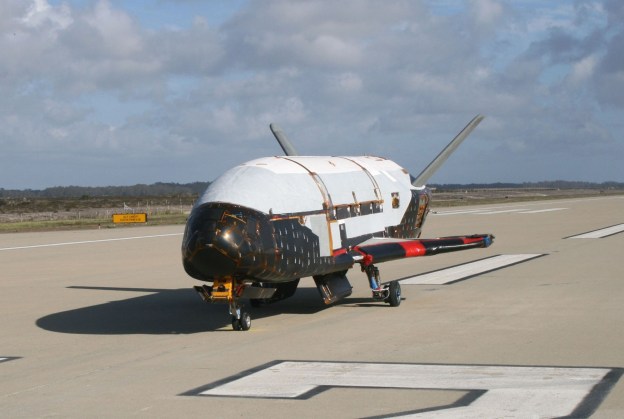
A Pentagon spaceplane called X-37B zoomed into orbit this week for its eighth mission. When it will come back is a secret. The uncrewed vehicle can spend months or years in space before it re-enters the atmosphere.. That combination of flexibility and endurance has made it a favorite tool for military officials looking to quickly deploy new technologies on the final frontier. A SpaceX rocket launched X-37B on August 21, 2025 from Florida’s Kennedy Space Center. Government and commercial engineers have spent years experimenting with lasers that allow satellites to share large amounts of data in space. The Pentagon is also testing tools like the inertial sensor, which could help improve navigation in situations where Global Positioning System signals aren’t available.

The spacecraft has spent the last five months on Earth after a 434-day mission that included tests of orbital maneuvers known as “aerobraking.” The move helps the vehicle use the drag from the planet’s atmosphere to change its orbit without using much fuel.  Military officials haven’t disclosed many details about the payloads that X-37B carries, but past missions included testing different materials in orbit and an experiment that transmitted solar energy to the ground. Its fifth flight released three small satellites that government officials didn’t acknowledge until they had fallen back to Earth. There’s a global strategic interest in saying what you’re putting in space,” said Jonathan McDowell, a researcher at the Harvard-Smithsonian Center for Astrophysics. If the U.S. hides its satellites, “then the Chinese are going to start doing it too, and that’s not in our interest.”

China now fields more than 1,000 satellites and has developed a range of radio jammers, antisatellite missiles and other weapons capable of targeting Pentagon assets, according to a U.S. Air Force document released in May 2025. It also operates a competing spaceplane, called Shenlong, that has flown several missions.]

Excerpt from Drew FitzGerald, The Pentagon’s Mysterious X-37B Space Plane Embarks on New Mission, WSJ, Aug. 22, 205

Space-based Solar Power: Endless Sunshine to a Fried Earth

In recent years, space agencies from all over the world have launched studies looking at the feasibility of constructing orbiting solar power plants. Such projects would be challenging to pull off, but as the world’s attempts to curb climate change continue to fail, such moonshot endeavors may become necessary.

Solar power plants in space, exposed to constant sunshine with no clouds or air limiting the efficiency of their photovoltaic arrays, could have a place in this future emissions-free infrastructure. But these structures, beaming energy to Earth in the form of microwaves, would be quite difficult to build and maintain…

A space solar power plant would have to be much larger than anything flown in space before. The orbiting solar power plant will have to be enormous, and not just to collect enough sunlight to make itself worthwhile. The main driver for the enormous size is not the amount of power but the need to focus the microwaves that will carry the energy through Earth’s atmosphere into a reasonably sized beam that could be received on the ground by a reasonably sized rectenna. These focusing antenna would have to be 1 mile (1.6 kilometers) or more wide, simply because of the “physics you are dealing with. Compare this with the International Space Station, at 357 feet (108 meters) long the largest space structure constructed in orbit to date…

In every case, building a space-based solar power plant would require hundreds of rocket launches (which would pollute the atmosphere depending on what type of rocket would be used), and advanced robotics systems capable of putting all the constituent modules together in space. This robotic construction is probably the biggest stumbling block to making this science fiction vision a reality.

Converting electricity into microwaves and back is currently awfully inefficient
Airbus, which recently conducted a small-scale demonstration converting electricity generated by photovoltaic panels into microwaves and beaming it wirelessly to a receiving station across a 118-foot (36 m) distance, says that one of the biggest obstacles for feasible space-based solar power is the efficiency of the conversion process… Some worry that microwave beams in space could be turned into weapons of mass destruction and used by evil actors to fry humans on the ground with invisible radiation.

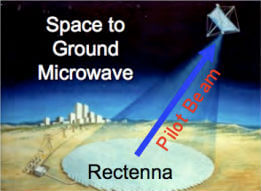
A spaced-space solar plant transmits energy collected from the sun to a rectenna on earth by using a laser microwave beam. Image from wikipediia

The vast orbiting structure of flat interweaving photovoltaic panels would be constantly battered by micrometeorites, running a risk of not only sustaining substantial damage during operations, but also of generating huge amounts of space debris in the process. For the lifecycle of the station, you have to design it in a way that it can be maintained and repaired continuously…

And what about the whole thing once it reaches the end of its life, perhaps after a few decades of power generation?  It is assumed that, by the time we may have space-based solar power plants, we are most likely going to see quite a bit of permanent infrastructure on the moon. Space tugs that don’t exist yet could then move the aged plant to the moon, where its materials could be recycled and repurposed for another use…We could also have some kind of recycling center on the moon to process some of the material..

Excerpts from Tereza Pultarovanal, Can space-based solar power really work? Here are the pros and cons, Space.com, Dec. 23, 2022