Tag Archives: space economy

What is the Purpose of Graveyards in Space

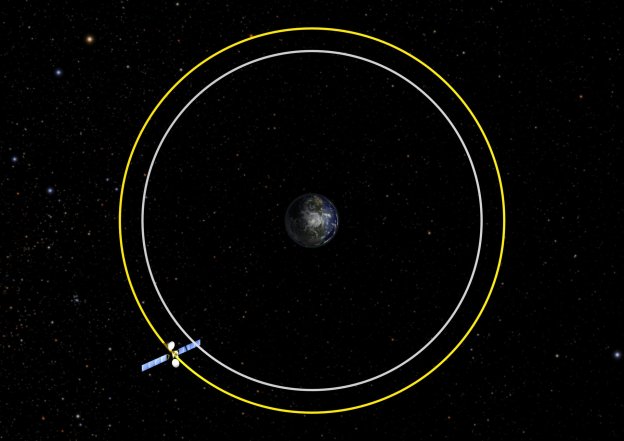
Launched in 1969, just a few months after humans first set foot on the Moon, Skynet-1A was put high above Africa’s east coast to relay communications for British forces. When the spacecraft ceased working a few years later, gravity might have been expected to pull it even further to the east, out over the Indian Ocean. But today, curiously, Skynet-1A is actually half a planet away, in a position 22,369 miles (36,000km) above the Americas. Orbital mechanics mean it’s unlikely the half-tonne military spacecraft simply drifted to its current location. Almost certainly, it was commanded to fire its thrusters in the mid-1970s to take it westwards. The question is who that was and with what authority and purpose?…

You might also reasonably ask why it still matters. After all, we’re talking about some discarded space junk from 50 years ago…No matter how Skynet-1A  got shifted to its present position, it was ultimately allowed to die in an awkward place when really it should have been put in an “orbital graveyard“. This refers to a region even higher in the sky where old space junk runs zero risk of running into active telecommunications satellites. Graveyarding is now standard practice, but back in the 1970s no-one gave much thought to space sustainability.

Attitudes have since changed because the space domain is getting congested and  collisions between defunct satellites  generate large amounts of space debris or space junk…”We need to avoid…super-spreader events. When these things explode or something collides with them, it generates thousands of pieces of debris that then become a hazard to something else that we care about.”

Excerpt from Jonathan Amos, Somebody moved UK’s oldest satellite, and no-one knows who or why, Science, Nov. 8, 2024

Who Will be the First to Colonize the Solar System?

A Chinese spacecraft touched down on grasslands in China’s Inner Mongolia region in June 2024, carrying the first-ever rock samples from the far side of the moon. A scientific breakthrough in itself, the success also advanced China’s plan to put astronauts on the moon by 2030 and build a lunar base by 2035. Such momentum is worrying American space officials and lawmakers, who have their own ambitions to build moon bases.

Unlike the original space race between the Americans and the Soviets, the goal of the U.S. and China isn’t just to make a short trip to the moon. It is to build permanent human outposts on its most strategic location, the lunar south pole. And as both nations gear up to build stations there one day, it is looking likely that tensions in orbit will mirror those on Earth.

Some U.S. officials fear China is planning a land grab. Chinese officials suspect the same of the Americans and are teaming up with Russia and other friendly nations for its south-pole outpost. The successful completion of the Chang’e 6 mission shows that, by one measure, China is ahead for now. Its lunar program has now soft-landed on the moon four times since 2013, the latest mission scooping up rocks near the south pole with robotic arms…

Meanwhile, after a decades-long moon-landing hiatus, two U.S. companies this year launched lunar-surface missions under NASA contracts. One lander tipped on its side after touching down. The other didn’t try to land because of technical problems. At least two more private missions, with funding from NASA, are slated to try to get to the moon later this year….All this is piling pressure upon the world’s most storied space agency. Through its Artemis exploration program, the National Aeronautics and Space Administration plans to conduct multiple landings in the coming years, develop a logistics station in lunar orbit and eventually build permanent camps on the moon’s surface. But Artemis has faced repeated delays and cost overruns while relying on a complex mix of government workers and private contractors…

“Unlike the U.S.-Soviet space race of the 20th century, this new round of competition centers on the water ice at the lunar south pole, with its extraction and use as a common goal,” wrote four scientists affiliated with China’s Academy of Sciences in a paper published in May. “The ability to collect and utilize lunar resources is a mark of national prestige and geopolitical influence. “We’re talking about colonizing the solar system,” said Greg Autry, a NASA official during the Trump administration.

Excerpts from Stu Woo, Historic Moon Mission Moves China Ahead in Space Race With U.S., WSJ, June 25, 2024

How Come Space is Full of Human Junk?

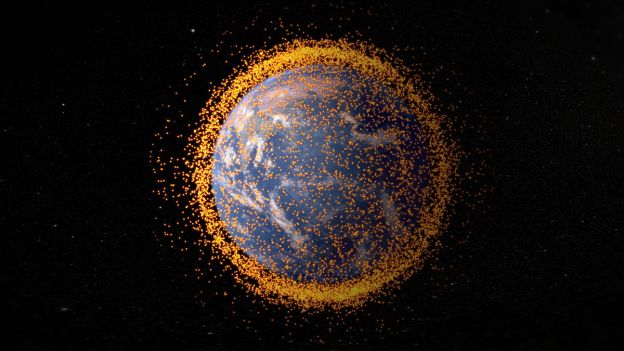
Getting rid of the deadly debris orbiting the Earth should become a priority for firms trying to do business there. If only they knew exactly where it is. The space race comes with a growing litter problem: U.S. officials expect the number of satellites to increase almost tenfold to 58,000 by 2030, many of them with lifespans not much longer than five years.

Space trash could potentially trigger devastating chain reactions, posing a significant threat to a space economy that is forecast by Morgan Stanley to generate $1 trillion in revenues by 2040. Only three big collisions have happened to date, but close calls are increasingly common. In November 2021, denizens of the International Space Station (ISS) had to take refuge in their capsules after a Russian antisatellite missile test created a cloud of wreckage.

In September 2022, the U.S. Federal Communications Commission ruled that operators of satellites in the “low Earth orbit,” or LEO—below 1,200 miles of altitude—will, in two years’ time, be required to remove them “as soon as practicable, and no more than five years following the end of their mission.” The National Aeronautics and Space Administration, or NASA, did ask for space junk to be disposed of within 25 years, but these were voluntary guidelines. NASA said in a 2021 report that compliance has averaged under 30% over the past decade. Yet 90% compliance would be required just to slow the pace at which dead satellites, rocket bodies and loose fragments are accumulating. There may be little choice but to mount a cleanup operation. The main questions are who will do it and how the junk will be found.

With only limited interest from big aerospace companies, startups have stepped up. Months after its inception in 2018, Switzerland’s ClearSpace signed a €86.2 million ($86.3 million) contract with the European Space Agency, or ESA, to eliminate remains of a Vega rocket by 2025. ClearSpace will use a robot to get hold of the debris and burn it in the atmosphere. Then there is Tokyo-based Astroscale, which has raised $300 million in venture capital since its inception nine years ago. This September, the U.K. Space Agency awarded £4 million, equivalent to $4.6 million, to both companies to remove defunct British satellites by 2026.

The LEO revolution unleashed by Elon Musk’s SpaceX, which has launched over 3,000 of its miniaturized Starlink satellites, may suddenly turn this into a viable commercial market. Officials are getting spooked by all the extra clutter. In orbits lower than 375 miles, re-entry into the Earth naturally happens after a few years, but these will be crowded by Starlink alone. Many players will need to go higher, and set up “deorbit” plans that regulators—and sustainability-minded investors—find solid.

That still leaves satellite operators and trash-removal firms with a fundamental problem: Their information on an object, including position, shape and mass, involves a lot of guesswork. Most observations come from ground radars, which firms access through government agencies like the U.S. Space Command. But this data is often several hours old and can miss the mark by miles, so satellites and stations can’t swerve out of the way of approaching debris with full confidence. For removal missions, this will mean accommodating extra fuel and allowing for the possibility that an object is spinning faster than estimated, making it impossible to grab.

And this is for pieces larger than 10 centimeters, which according to the ESA number above 30,000 and are the only ones visible from Earth. Mathematical models suggest there are a million additional fragments measuring between one and 10 centimeters, and 100 million even smaller than that, often traveling many times faster than a bullet. Yet the ISS’s “Whipple shield” can be pierced by anything larger than one centimeter…

[A]ny company aspiring to profit from the final frontier will need to better understand the risks of the terrain. The alternative is a true tragedy of the commons that ends a promising new space age before it has really begun.

Excerpts from Jon Sindreu, The Difficult Search for Dangerous Space Junk, WSJ, Nov. 14, 2022