Tag Archives: space global commons

Secrecy in Space

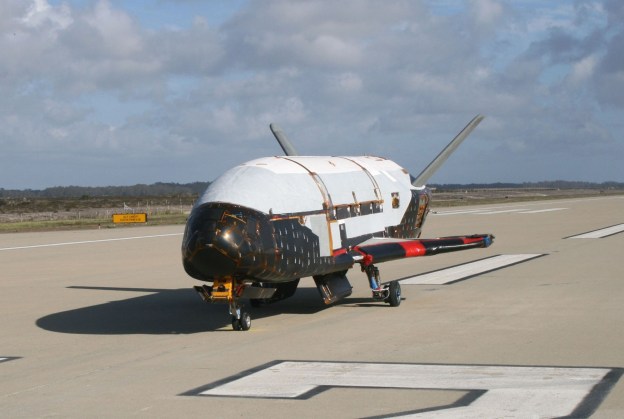
A Pentagon spaceplane called X-37B zoomed into orbit this week for its eighth mission. When it will come back is a secret. The uncrewed vehicle can spend months or years in space before it re-enters the atmosphere.. That combination of flexibility and endurance has made it a favorite tool for military officials looking to quickly deploy new technologies on the final frontier. A SpaceX rocket launched X-37B on August 21, 2025 from Florida’s Kennedy Space Center. Government and commercial engineers have spent years experimenting with lasers that allow satellites to share large amounts of data in space. The Pentagon is also testing tools like the inertial sensor, which could help improve navigation in situations where Global Positioning System signals aren’t available.

The spacecraft has spent the last five months on Earth after a 434-day mission that included tests of orbital maneuvers known as “aerobraking.” The move helps the vehicle use the drag from the planet’s atmosphere to change its orbit without using much fuel.  Military officials haven’t disclosed many details about the payloads that X-37B carries, but past missions included testing different materials in orbit and an experiment that transmitted solar energy to the ground. Its fifth flight released three small satellites that government officials didn’t acknowledge until they had fallen back to Earth. There’s a global strategic interest in saying what you’re putting in space,” said Jonathan McDowell, a researcher at the Harvard-Smithsonian Center for Astrophysics. If the U.S. hides its satellites, “then the Chinese are going to start doing it too, and that’s not in our interest.”

China now fields more than 1,000 satellites and has developed a range of radio jammers, antisatellite missiles and other weapons capable of targeting Pentagon assets, according to a U.S. Air Force document released in May 2025. It also operates a competing spaceplane, called Shenlong, that has flown several missions.]

Excerpt from Drew FitzGerald, The Pentagon’s Mysterious X-37B Space Plane Embarks on New Mission, WSJ, Aug. 22, 205
Who Will be the First to Colonize the Solar System?

A Chinese spacecraft touched down on grasslands in China’s Inner Mongolia region in June 2024, carrying the first-ever rock samples from the far side of the moon. A scientific breakthrough in itself, the success also advanced China’s plan to put astronauts on the moon by 2030 and build a lunar base by 2035. Such momentum is worrying American space officials and lawmakers, who have their own ambitions to build moon bases.

Unlike the original space race between the Americans and the Soviets, the goal of the U.S. and China isn’t just to make a short trip to the moon. It is to build permanent human outposts on its most strategic location, the lunar south pole. And as both nations gear up to build stations there one day, it is looking likely that tensions in orbit will mirror those on Earth.

Some U.S. officials fear China is planning a land grab. Chinese officials suspect the same of the Americans and are teaming up with Russia and other friendly nations for its south-pole outpost. The successful completion of the Chang’e 6 mission shows that, by one measure, China is ahead for now. Its lunar program has now soft-landed on the moon four times since 2013, the latest mission scooping up rocks near the south pole with robotic arms…

Meanwhile, after a decades-long moon-landing hiatus, two U.S. companies this year launched lunar-surface missions under NASA contracts. One lander tipped on its side after touching down. The other didn’t try to land because of technical problems. At least two more private missions, with funding from NASA, are slated to try to get to the moon later this year….All this is piling pressure upon the world’s most storied space agency. Through its Artemis exploration program, the National Aeronautics and Space Administration plans to conduct multiple landings in the coming years, develop a logistics station in lunar orbit and eventually build permanent camps on the moon’s surface. But Artemis has faced repeated delays and cost overruns while relying on a complex mix of government workers and private contractors…

“Unlike the U.S.-Soviet space race of the 20th century, this new round of competition centers on the water ice at the lunar south pole, with its extraction and use as a common goal,” wrote four scientists affiliated with China’s Academy of Sciences in a paper published in May. “The ability to collect and utilize lunar resources is a mark of national prestige and geopolitical influence. “We’re talking about colonizing the solar system,” said Greg Autry, a NASA official during the Trump administration.

Excerpts from Stu Woo, Historic Moon Mission Moves China Ahead in Space Race With U.S., WSJ, June 25, 2024

Stargazing as a Right and Colonization of Skies

Do people have a right to an unobstructed view of the heavens? For most of human history, such a question would have been considered nonsensical—but with the recent rise of satellite mega constellations, it’s now being asked again and again. Mega constellations are vast groups of spacecraft, numbering in the thousands, that could spark a multitrillion-dollar orbital industry and transform global connectivity and commerce. But the rise of mega constellations also threatens to clutter the night sky, disrupt the work of some astronomers and create space debris that harms people on Earth and in space alike. The mega constellation era began in May 2019, when Elon Musk’s firm SpaceX launched the first 60 satellites in its Starlink constellation… Today the constellation’s numbers have swelled to more than 3,000 and account for fully half of all active satellites in space.

Ramon Ryan has argued in the in the Vanderbilt Journal of Entertainment and Technology Law that the regulatory approval of these satellites by the U.S. Federal Communications Commission (FCC) may breach environmental law as part of the U.S. National Environmental Policy Act (NEPA) enacted in 1970. Specifically, he argued that the natural aesthetic of the night sky and the profession of astronomy may be protected under NEPA—but that the FCC has so far sidestepped NEPA’s oversight , thanks to a “categorical exclusion” the agency was granted in 1986 (when it simply wasn’t licensing that many satellites)….  

In November 2022, the US General Accounting Office (GAO) published a report that suggest that the FCC should revisit its categorical exclusion from NEPA and consider whether it should update its procedures in light of the rise of mega constellations. “We think they need to revisit [the categorical exclusion] because the situation is so different than it was in 1986,” says Andrew Von Ah, a director at the GAO…The White House Council on Environmental Quality (CEQ) recommends that agencies “revisit things like categorical exclusions once every seven years,” Von Ah says. But the FCC “hasn’t really done that since 1986.”

According to the report’s recommendations, the FCC should review whether mega constellations affect the environment…The findings showed there were concerns in a number of areas, not just the brightness of the satellites but also the collision risk they pose in space and the possible creation of space junk, the interference to radio astronomy caused by satellite radio transmissions and even the potential for satellites reentering the atmosphere to affect Earth’s climate or harm humans on the ground. ..

The day after the GAO report’s release, the FCC  announced the creation of a new bureau for its space activities, which will help the agency handle the applications for 64,000 new satellites it is presently considering…

Excerpts from  Jonathan O’Callaghan Satellite Constellations Could Harm the Environment, New Watchdog Report Says, Scientific American, November 24, 2022