Tag Archives: surveillance technology

Stormy mountain landscape with lightning and text 'AN EYE FOR AN EYE'

How An Eye for an Eye Looks Like: the Oct. 7, 2023 Attacks

A Israeli task force has developed a list with thousands of names of people who planned or joined the October 7 attack. The list is used to kill or capture all those people. Hundreds have been struck from the list, in one of the most personal and highly technical targeting campaigns in the history of warfare. The campaign continues amid the demands of the war with Iran and a cease-fire agreement in Gaza. No participant is deemed too insignificant—down to the man who drove a tractor through a border fence that day. Nearly two years after he breached the border, the tractor driver was identified, located and blown up in an airstrike as he walked a narrow urban street in Gaza, according to footage released by Israel’s military.

Militants who videotaped their Oct. 7 exploits on phones or GoPro cameras to share on social media, or those who phoned home to brag, learned too late the degree of Israel’s surveillance acumen and desire for retribution…Agents from military intelligence and Shin Bet, Israel’s internal security service, pore over militants’ videos posted on social media…Agents run the images through facial recognition programs to sift for names, and comb through intercepted phone calls. They view location data from cell tower logs and interrogate Gazan detainees to uncover who did what.

Excerpt from Dov Lieber, Inside Israel’s High-Tech Campaign to Kill or Capture Every Oct. 7 Attackers, WSJ, 2026

Armored steampunk truck with multiple cameras and lights on a rocky mountain road at night.

Who Empowers Mass Surveillance in the United States

In the United States, the rapid acceleration of AI in border-security technology hit a fever pitch over in 2025-26 bringing new competitors into the industry and offering a new vision of what surveillance and border enforcement looks like. The Trump administration has made border security and immigration enforcement its top priority, and vendors have been eager to secure funding and contracts before political winds shift. Paul Allen, president of Airship AI, a surveillance intelligence system, said the administration’s emphasis on securing the border has led companies serving other sectors to begin applying their technologies to border security.

Even Amazon.com is getting in on the border-security game, displaying a tricked-out pickup truck equipped with systems to provide mobile monitoring of people or border threats via drones or other inputs. Representatives said the truck is a prototype of what Amazon could offer DHS. They added that the vehicle hasn’t been deployed to the border yet. The company has a specialized email account set up to recruit DHS business.

Most of the technology on display was autonomous and AI-equipped….Representatives of WilliamsRDM—whose products include solar panels that power covert cameras while disguised as rocks and litter—said the power demands of AI-linked systems are increasing the need for their products.

The government has touted technology as a way to find and apprehend potential smugglers and immigrants who are in the U.S. illegally, saying it is more efficient than human power and, in some cases, less invasive than a physical border wall. Others have cried foul on what they see as dystopian Big Brother surveillance that is being rolled out with little public understanding and oversight.

Excerpt from Elizabeth Findell, Tump’s Border Spending Spurs Boom in AI-Infused Surveillance, WSJ, May 8, 2026

The Disempowering Effects of Experimentation on Humans

Whenever we go online, we might find ourselves part of an experiment — without knowing it. Digital platforms track what users do and how they respond to features. Increasingly, these tests are having real-world consequences for its participants.

In a paper published in the Journal Academy of Management, it was reported that platforms that offer paid tasks and jobs to freelancers (H. A. Rahman et al. Acad. Mgmt. J. 66, 1803–1830; 2023) are experimenting  with using different methods for scoring people’s work, as well as changing how their skills would be listed on their profile page and how they could interact with their contractors. These changes affected people’s ratings and the amount of work they received. Twenty years ago, such experimentation was transparent. Gig workers could opt in or out of tests. But today, these experiments are done covertly. Gig workers waive their rights when they create an account.

Being experimented on can be disconcerting and disempowering. Imagine that, every time you enter your office, it has been redesigned. So has how you are evaluated, and how you can speak with your superiors, but without your knowledge or consent. Such continual changes affect how you do and feel about your job.

Gig workers expressed that, after noticing frequent changes on the listing platforms that were made without their consent, they started to see themselves as laboratory rats rather than valued users. Because their messages were blocked by chatbots, they were unable to speak to the platform to complain or opt out of the changes. Frustration flared and apathy set in. Their income and well-being declined.

This is concerning, not only because of how it affects gig workers, but also because academics are increasingly becoming involved in designing digital experiments. Social scientists follow strict Institutional Review Board (IRB) procedures that govern the ethics of experiments involving people — such as informing them and requiring consent — but these rules don’t apply to technology companies. And that’s leading to questionable practices and potentially unreliable results.

Excerpt from Tim Weiss, Why we are all lab rats in the digital world, Nature, Nov. 12, 2024

How to Categorize Individuals: Surveillance Pricing

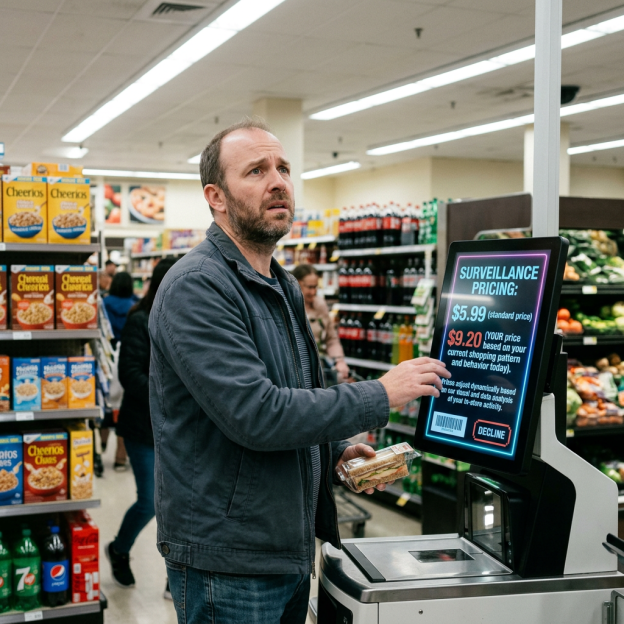
The United States Federal Trade Commission issued orders to eight companies offering surveillance pricing products and services that incorporate data about consumers’ characteristics and behavior. The orders seek information about the potential impact these practices have on privacy, competition, and consumer protection.

The orders are aimed at helping the FTC better understand the opaque market for products by third-party intermediaries that claim to use advanced algorithms, artificial intelligence and other technologies, along with personal information about consumers—such as their location, demographics, credit history, and browsing or shopping history—to categorize individuals and set a targeted price for a product or service. The study is aimed at helping the FTC better understand how surveillance pricing is affecting consumers, especially when the pricing is based on surveillance of an individual’s personal characteristics and behavior.

“Firms that harvest Americans’ personal data can put people’s privacy at risk. Now firms could be exploiting this vast trove of personal information to charge people higher prices,” said FTC Chair Lina M. Khan. “Americans deserve to know whether businesses are using detailed consumer data to deploy surveillance pricing, and the FTC’s inquiry will shed light on this shadowy ecosystem of pricing middlemen.”

The FTC is using its 6(b) authority, which authorizes the Commission to conduct wide-ranging studies that do not have a specific law enforcement purpose, to obtain information from eight firms that advertise their use of AI and other technologies along with historical and real-time customer information to target prices for individual consumers. The orders were sent to: Mastercard, Revionics, Bloomreach, JPMorgan Chase, Task Software, PROS, Accenture, and McKinsey & Co.

FTC Issues Orders to Eight Companies Seeking Information on Surveillance Pricing, Press Release, July 23, 2024

Genetic Surveillance based on Stray DNA

Everywhere they go, humans leave stray DNA. Police have used genetic sequences retrieved from cigarette butts and coffee cups to identify suspects; archaeologists have sifted DNA from cave dirt to identify ancient humans. But for scientists aiming to capture genetic information not about people, but about animals, plants, and microbes, the ubiquity of human DNA and the ability of even partial sequences to reveal information most people would want to keep private is a growing problem, researchers from two disparate fields warn this week. Both groups are calling for safeguards to prevent misuse of such human genomic “bycatch.”

Genetic sequences recovered from water, soil, and even air can reveal plant and animal diversity, identify pathogens, and trace past environments, sparking a boom in studies of this environmental DNA (eDNA). But the samples can also contain significant amounts of human genes, researchers report today in Nature Ecology & Evolution. In some cases, the DNA traces were enough to determine the sex and likely ancestry of the people who shed them, raising ethical alarms…Similarly, scientists have for decades analyzed the genetic information in fecal matter to reveal the microbes in people’s intestines—the gut microbiome, which plays dramatic roles in human health and development.

The power to extract personal data from eDNA and microbiome samples will continue to increase, both groups of authors warn. That raises concerns about misuse by police or other government agencies, collection by commercial companies, or even mass genetic surveillance, says Natalie Ram, a law and bioethics scholar at the University of Maryland Francis King Carey School of Law. In the United States, she says, researchers and funding agencies should make greater use of federal Certificates of Confidentiality. They prohibit the disclosure of “identifiable, sensitive research information” to anyone not connected with a study, such as law enforcement, without the subject’s consent….

“Which companies and governments are going to pay and license to have poop-based surveillance technology?” he asks. “Imputing people’s identity based on their poop is compelling and interesting, for a number of reasons, and most of them are all the wrong reasons.”

Excerpts from Gretchen Vogel, Privacy concerns sparked by human DNA accidentally collected in studies of other Species, Science, May 15, 2023