Tag Archives: trade wars

The New Opium War: How the World Got Addicted to China

 A fundamental axiom of economics is that when two individuals or countries trade, both are better off. In the decades after World War II, the U.S. was the world’s largest exporter and economy and as it grew, it imported more, helping its partners. As they grew, they bought more of what the U.S. made. Expanding trade helped everyone specialize, leading to more competition, innovation and choice, and lower costs.

China is now the world’s second-largest economy and its largest exporter, but its philosophy is quite different. It has never believed in balanced trade nor comparative advantage. Even as it imported critical technology from the West, its long-term goal was always self-sufficiency. In 2020, Chinese leader Xi Jinping codified this approach as “dual circulation.” This would, he said, “tighten the international industrial chain’s dependence” on China while ensuring China’s production was “independent” and “self-sustaining.”

And as China expands into high-end manufacturing such as aircraft and semiconductors, Xi has decreed it must not relinquish low-end production such as toys and clothes. Beijing has discouraged Chinese companies that invest abroad from transferring key know-how, such as in the production of iPhones and batteries. Xi has rejected fiscal reforms that would tilt its economy away from investment, exports and saving and toward household consumption and imports.

Excerpt from Greg Ip, World Pays a Price for China’s Growth, WSJ, Dec. 6, 2025

Can the United States Drown in Disease? China has the Answer

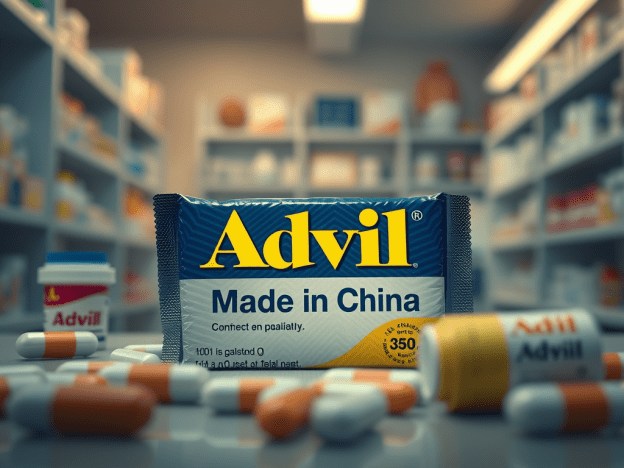
While drugs sold in U.S. pharmacies or over the counter typically don’t say “made in China,” the country often supplies active pharmaceutical ingredients in the drugs or precursor chemicals used to make those active ingredients. Most of the acetaminophen and ibuprofen imported into the U.S. comes from China. Those are the active ingredients in Tylenol and Advil, respectively. China is also a significant producer of antibiotic ingredients. The U.S. imports many branded drugs from Europe, while for generics, it relies heavily on India. Still, a significant amount of the active ingredients used in India-made generics originates in China.

Perhaps aware of the sensitivity of turning medicine into a political tool, China hasn’t often threatened to cut off drug supplies to the U.S. Still, it signaled awareness of its leverage early in the Covid-19 pandemic, when the world faced shortages of masks and personal protection equipment owing to supply disruptions from China. In March 2020, the official Xinhua News Agency said that if China were to restrict exports of medical goods, the “U.S. will be plunged into the vast ocean of coronavirus.”

Excerpt from Yoko Kubota, How China’s Chokehold on Drugs, Chips and More Threatens the U.S., WSJ, Nov.  4, 2025

Nationalizing a Crown Jewel: the case of Nexperia

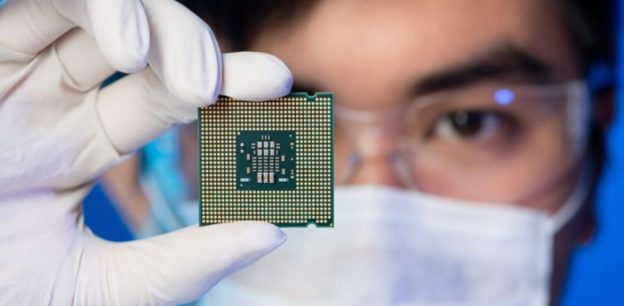
U.S. officials’ warning to their Dutch counterparts was stark: If they wanted a Netherlands-based chip maker to avoid being put on a trade blacklist, it would almost certainly have to remove its Chinese owner as CEO. “The fact that the company’s CEO is still that same Chinese owner is problematic,” American officials said in a June 2025 meeting on the topic. The Americans soon got their wish. In September 25, 2025, the Dutch economy ministry seized control of Nexperia from China’s Wingtech Technology. The next day, a Dutch court granted an emergency petition to suspend Wingtech founder Zhang Xuezheng as Nexperia’s CEO and put all but one of the semiconductor company’s shares under external management.

China quickly fired back at the seizure, ordering Wingtech in early October to suspend exports of Nexperia of chips that the company has long sent for packaging and testing in China…The Dutch economy minister said in a letter to parliament that he moved to seize control of Nexperia based on evidence that the CEO was moving quickly to shift production capacity, financial resources and intellectual property to China, not because of pressure from any other country… The Dutch government and Dutch and German executives of the company had tried for months to ringfence the company’s business from Chinese control to accommodate domestic concerns—and avoid being hit by the U.S. blacklist… Dutch officials told Nexperia that the coming expansion of U.S. trade restrictions could lead to restrictions on the business, unless measures were taken to limit the transfer of knowledge and capabilities to China.

In the past, Nexperia relied on its European factories and contract manufacturers in Taiwan to make chips for China. In 2020, Zhang set up a wafer factory in Shanghai. The business, called Wingskysemi, started production in 2023 and has become one of Nexperia’s key suppliers….

Excerpt from Sam Schechner et al, , How U.S. Pressured Netherlands to Oust CEO of Chinese-Owned Chip Maker, WSJ, Oct. 14, 2025

How China Plans to Destroy the U.S. AI Industry

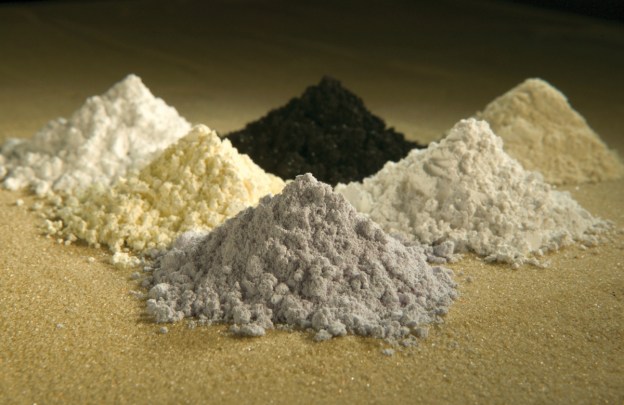
China’s restrictions on rare-earth materials announced on October 9, 2025 would mark a nearly unprecedented export control*** that stands to disrupt the global economy, giving Beijing more leverage in trade negotiations and ratcheting up pressure on the Trump administration to respond.

The rule, put out by China’s Commerce Ministry, is viewed as an escalation in the U.S.-China trade fight because it threatens the supply chain for semiconductors. Chips are the lifeblood of the economy, powering phones, computers and data centers needed to train artificial-intelligence models. The rule also would affect cars, solar panels and the equipment for making chips and other products, limiting the ability of other countries to support their own industries. China produces roughly 90% of the world’s rare-earth materials.

Global companies that sell goods with certain rare-earth materials sourced from China accounting for 0.1% or more of the product’s value would need permission from Beijing, under the new rule. Tech companies will probably find it extremely difficult to show that their chips, the equipment needed to make them and other components fall below the 0.1% threshold, industry experts said. The rules could cause a U.S. recession if implemented aggressively because of how important AI capital spending is to the economy… “It’s an economic equivalent of nuclear war—an intent to destroy the American AI industry,” said Dmitri Alperovitch, co-founder of the Silverado Policy Accelerator think tank.

Excerpt from Amrith Ramkumar,et al., China’s Rare-Earth Escalation Threatens Trade Talks—and the Global Economy, WSJ, Oct. 9, 2025

***The new export controls mark the first time China has applied the foreign direct product rule (FDPR)—a mechanism introduced in 1959 by the United States and long used United States to restrict semiconductor exports to China. The FDPR enables the United States to regulate the sale of foreign-made products if they incorporate U.S. technology, software, or equipment, even when produced by non-U.S. companies abroad. In effect, if U.S. technology appears anywhere in the supply chain, the United States can assert jurisdiction. See CSIS

The Cat-and-Mouse Game: US-China, Chip Giants

The U.S. on March 28 2025 added dozens of Chinese companies to a trade blacklist over national security concerns. American businesses seeking to sell technology to these companies will need approval from the government. Among those added were subsidiaries of Inspur Group, China’s largest server maker and a major customer for U.S. chip makers such as Nvidia, Intel and Advanced Micro Devices. Companies linked to China’s largest supercomputer maker, Sugon, were also added…

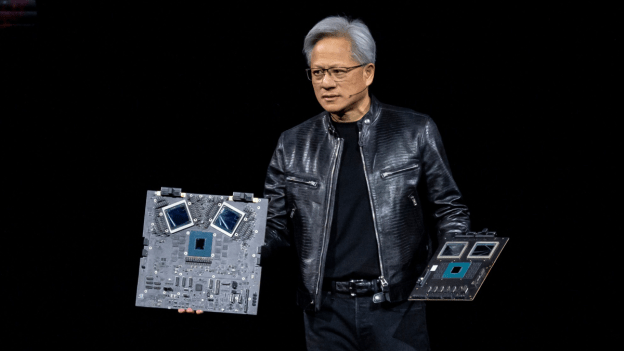
Nearly 80 companies were put on the Commerce Department’s blacklist, known as the entity list…including the U.S. server maker Aivres Systems that is wholly owned by Inspur Electronic. The latter is one-third owned by Inspur Group, according to corporate records. Aivres has been assembling high-end artificial-intelligence equipment for Nvidia. The AI-chip giant has said that Aivres will make servers using chips in the Blackwell family, Nvidia’s newest and most powerful processors.  Aivres advertises on its website that it sells servers and infrastructure powered by Blackwell chips, which are banned from sale into China…About two months after Inspur Group was added to the trade blacklist in March 2023, California-based Inspur Systems changed its name to Aivres Systems.

Excerpts from Liza Lin, Trump Takes Tough Approach to Choking Off China’s Access to U.S. Tech, WSJ, Mar. 26, 2025

Designers Not Doers: Who’s Gonna Save the Chip Industry?

Although designing chips for electronic devices is now easier than ever, making them has never been harder requiring spending vast—and growing—sums on factories (called fabs) stuffed with ultra-advanced equipment.

At the turn of the millennium, a cutting-edge factory might have cost $1bn… More recently, a TSMC factory that produces 3 nm (nanometer) chips, completed in 2020, in southern Taiwan, cost $19.5bn. The firm is already pondering another for factory for 2nm chips, which will almost certainly be more. ..Asia’s nanoscale manufacturing duopoly remains fiercely competitive, as Samsung and TSMC keep each other on their toes… At some point, one company, in all likelihood TSMC, could be the last advanced fab standing. For years, says an industry veteran, tech bosses mostly ignored the problem in the hope it would go away. It has not…

The other big industry rupture is taking place in China. As America has lost ground in making chips, it has sought to ensure that China lags behind, too. The American tech embargo began as a narrow effort against Huawei over national security, but bans and restrictions now affect at least 60 firms, including many involved in chips. SMIC, China’s chip champion, has just been put on a blacklist, as has Xiaomi, a smartphone firm.

Excerpts from Betting All Chips, Economist, Jan. 23, 2021 and Semiconductors: A New Architecture, Economist, Jan. 23, 2021

How Un-American: Attacking Private Companies because they are Chinese

America is no fan of Huawei. Its officials have spent months warning that the Chinese giant’s smartphones and networking gear could be Trojan horses for Chinese spies (something Huawei has repeatedly denied). They have threatened to withhold intelligence from any ally that allows the firm in.

On May 15th, 2019  they raised the stakes. President Donald Trump barred American firms from using telecoms equipment made by firms posing a “risk to national security”. His order named no names. But its target was plain.  More significant was the announcement by the Commerce Department, on the same day, that it was adding Huawei to a list of firms with which American companies cannot do business without official permission. That amounts to a prohibition on exports of American technology to Huawei.  It is a seismic decision, for no technology firm is an island. Supply chains are highly specialised and globally connected. Cutting them off—“weaponising interdependence”, in the jargon—can cause serious disruption. When ZTE, another Chinese technology company, received the same treatment in 2018 for violating American sanctions on Iran, it was brought to the brink of ruin. It survived only because Mr Trump intervened, claiming it was a favour to Xi Jinping, China’s president.

By May 20th, 2019  the impact of the ban was becoming clear. Google said it had stopped supplying the proprietary components of its Android mobile operating system to Huawei. A string of American chipmakers, including Intel, Qualcomm and Micron, have also ceased sales. Later that day the Commerce Department softened its line slightly, saying that firms could continue to supply Huawei for 90 days, but for existing products—for instance, with software updates for Huawei phones already in use. New sales, on which Huawei’s future revenue depends, remain banned…

 Without Google’s co-operation, new Huawei phones will lack the latest versions of Android, and popular apps such as Gmail or Maps. That may not matter in China, where Google’s apps are forbidden. But it could be crippling in Europe, Huawei’s second-biggest market. Its telecoms business needs beefy server chips from Intel. The supply of software to manage those networks could dry up too. Huawei is developing replacements for all three, but they are far from ready….Accrording to Paul Triolo of Eurasia Group, the Huawei ban as “the logical end-game of the US campaign to take down Huawei”. A long-lasting ban would force the firm to look for alternative chips and software that Chinese suppliers would struggle to provide.

The second question concerns the reach of American power. The tangled nature of chip-industry supply chains means that many non-American companies make use of American parts or intellectual property. They may therefore consider themselves covered, wholly or partially, by the ban. Take Arm, a Britain-based firm whose technology powers chips in virtually every phone in the world, including those made by HiSilicon. Arm says that it will comply with the Commerce Department’s rules. That suggests that Arm will not grant Huawei new licences. It is unclear if Arm will offer support for existing licences, however. As Arm’s technology advances, Huawei risks being left behind.

Other non-American companies are as important. One industry insider with contacts in Taiwan says that American officials are pressing Taiwan Semiconductor Manufacturing Company (tsmc), a big and cutting-edge chipmaker, to drop Huawei, which is its third-biggest customer. That would be a crushing blow, for Chinese chip factories are not up to the task of manufacturing HiSilicon’s sophisticated designs. tsmc’s only peer is Samsung—and South Korea is another of America’s allies. tsmc said on May 23rd that it would continue supplying Huawei for now.

Even if the optimists are right, and the ban is lifted in exchange for trade concessions, a return to business as usual seems unlikely. America has twice demonstrated a willingness to throttle big Chinese companies. Trust in American technology firms has been eroded, says Mr Triolo. China has already committed billions of dollars to efforts to boost its domestic capabilities in chipmaking and technology. For its rulers, America’s bans highlight the urgency of that policy. Catching up will not be easy, believes Mr Ernst, for chips and software are the most complicated products that humans make. But, he says, if you talk to people in China’s tech industry they all say the same thing: “We no longer have any other option.”

Excerpts from Huawei has been cut off from American technology, Economist, May 25,  2019.
Can’t Touch This! America FANG v. China BATX

The Economist magazine has considered four measures of Chinese corporate unfairness, using data from Morgan Stanley and Bloomberg. The first is the weight of China in the foreign sales that American firms bring in. It stands at 15%; if it was in line with China’s share of world GDP, it would be 20%. This shortfall amounts to a small 1% of American firms’ global sales (both foreign and domestic). America Inc is similarly underweight in the rest of Asia, but there is much less fighting talk about South Korea or Japan.

The second test is whether there is parity in the commercial relationship. Firms based in China make sales to America almost exclusively through goods exports, which were worth $506bn last year. American companies make their sales to China both through exports and through their subsidiaries there, which together delivered about $450bn-500bn in revenue. Again, there is not much of a gap. American firms’ aggregate market share in China, of 6%, is almost double Chinese firms’ share in America, based on the sales of all listed firms.

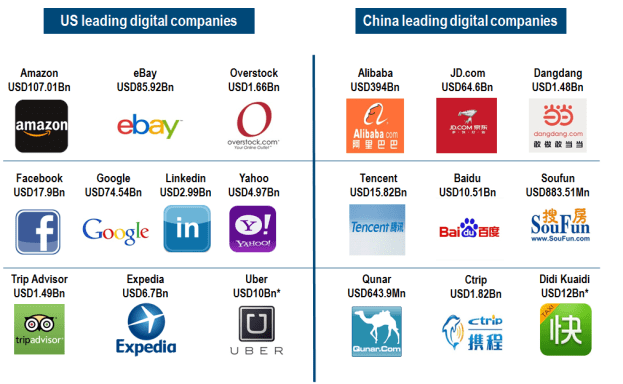
The third yardstick is whether American firms underperform other multinationals and local firms. In some cases failure is not China-specific. Walmart has had a tough time in China, but has also struggled in Brazil and Britain. Uber sold out to a competitor in China, but has done the same in South-East Asia. American consumer and industrial blue chips are typically of a similar scale in China to their nearest rivals. Thus the sales of Boeing and Airbus, Nike and Adidas, and General Electric and Siemens are all broadly in line with each other. Where America has a comparative advantage—tech—it leads (Facebook, Amazon, Netflix, Google (FANG)). Over half of USA Inc’s sales in China are from tech firms, led by Apple, Intel and Qualcomm. Overall, American firms outperform. For the top 50 that reveal data, sales in China have risen at a compound annual rate of 12% since 2012. That is higher than local firms (9%) and European ones (5%).

The final measure is whether American firms are shut out of some sectors. This is important as China shifts towards services and as the smartphone market, a goldmine, matures. The answer is clearly “yes”. Alphabet, Facebook and Netflix are nowhere, and Wall Street firms are all but excluded from the mainland. Chinese firms, however, can make a similar complaint. The market share of all foreign firms (incuding China’s Baidu, Alibaba,Tencent and Xiaomi popularly called BATX) in Silicon Valley’s software and internet activities, and on Wall Street, is probably below 20%. America’s national-security rules, thickets of regulation, lobbying culture and political climate make it inconceivable that a Chinese firm could play a big role in the internet or in finance there.

Far-sighted bosses know their stance on China must reflect a balanced assessment, not a delusional vision of globalisation in which anything less than a triumph is considered a travesty. But their voices are being drowned out. The shift of the business establishment to hawkishness on China has probably emboldened the White House and also led the Treasury and Department of Commerce to be more combative. Most big firms are blasé about tariffs; they can pass on the cost to clients. Few export lots to China. But soon China will run out of American imports to subject to retaliatory tariffs; in a tit-for-tar war, beating up American firms’ Chinese subsidiaries is a logical next step. USA Inc’s Sino-strop would then end up enabling the opposite of what it wants.

Excerpts from Raging Against Beijing, Economist,  June 30, 2018, at 58