Tag Archives: United States China rivalry

The Race for Fusion: US v. China

A high-tech race is under way between the U.S. and China as both countries chase an elusive energy source: nuclear fusion.  China is outspending the U.S., completing a massive fusion technology campus and launching a national fusion consortium that includes some of its largest industrial companies. Crews in China work in three shifts, essentially around the clock, to complete fusion projects.

The result is an increasing worry among American officials and scientists that an early U.S. lead is slipping away. JP Allain, who heads the Energy Department’s Office of Fusion Energy Sciences, said China is spending around $1.5 billion a year on fusion, nearly twice the U.S. government’s fusion budget. What’s more, China appears to be following a program similar to the road map that hundreds of U.S. fusion scientists and engineers first published in 2020 in hopes of making commercial fusion energy. “They’re building our long-range plan,” Allain said. “That’s very frustrating, as you can imagine.”

China already has a fast-growing nuclear-technology industry and is building more conventional nuclear power plants than any other country. The country’s nuclear-plant development will give it an advantage when commercial fusion is reached, according to a report released last month by the Information Technology and Innovation Foundation, a Washington, D.C.-based think tank with backers that include big tech companies…

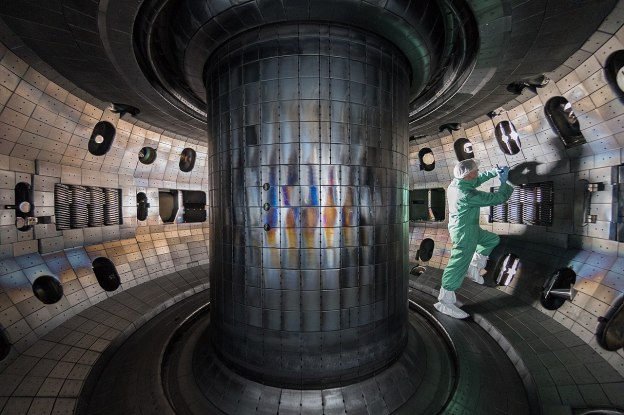
The Chinese Academy of Sciences’ Institute of Plasma Physics in the eastern Chinese city of Hefei in 2018 broke ground on a nearly 100-acre magnetic fusion research and technology campus. The facility is expected to be completed in 2025 but is already largely operational and focused on industrializing the technology. In 2023 China said it would form a new national fusion company, and said the state-owned Chinese National Nuclear Corp. would lead a consortium of state-owned industrial firms and universities pursuing fusion energy. Among the largest efforts by a private Chinese company are those of ENN, an energy conglomerate, which created a fusion division from scratch in 2018. Since then, ENN has built two tokamaks, the machines where fusion can happen, using powerful magnets to hold plasma. ENN’s fusion work isn’t well-understood outside of China and its pace of development would be difficult to replicate in the U.S. or Europe.

Excerpts from Jennifer Hiller, China Outspends the U.S. on Fusion in the Race for Energy’s Holy Grail, WSJ, July 9 2024
Great Fear and Uphill Struggle: US, Japan and China

In Japan’s glory days of the the late 1980s, the country accounted for about half of the global semiconductor industry, and the U.S. was left to beg, plead and threaten as it tried to get a small slice of the Japanese market. A bestselling book in Japan during the Cold War’s waning days called “The Japan That Can Say No” suggested that Tokyo could leverage its dominance in semiconductors to control the world’s military balance—and perhaps help the Soviet Union instead of the U.S.

Today, the great fear driving chip investments in both U.S. and Japan is China. The U.S. policy calls for helping allies such as Japan build a supply chain that is less exposed to risks posed by a hostile Beijing. While the U.S. is expanding its own chip production through the Chips and Science Act, which includes some $53 billion of spending, people involved in the Rapidus project (between U.S. and Japan) said the U.S. needed further global diversification. ..The Rapidus project aims to get Japan back into the heart of the business of chip making by building facilities on the northern island of Hokkaido, known for its ski resorts. Rapidus says it wants to begin pilot production in 2025 and full-scale production in 2027. Some 6,000 workers are being drafted to put up the factory.

Japan’s Ministry of Economy, Trade and Industry has said that it intends to help Rapidus achieve its goals, and that it wants the Japanese semiconductor industry to have revenue of some $100 billion in 2030, triple the 2020 figure. The ministry is pitching in billions of dollars for additional projects in Japan. TSMC is building an $8.6 billion factory on the southern island of Kyushu and is in talks about a second. Assuming it gets the money, Rapidus still has to master a level of manufacturing technology attained so far by only two companies, TSMC and South Korea’s Samsung Electronics. Both are projected to have the ability to mass-produce 2-nanometer chips by 2025.

Excerpts from Peter Landers and  Yang Jie, Japan’s Plan to Become a Chipmaking Champ Hinges on This Football-Loving Engineer, WSJ, July 6, 2023

The Deterrent Power of 44 000 tonnes Assault Ships: Sea Dragon Commandors v. US Marines

China launched its military build-up in the mid-1990s with a top priority: keep the United States at bay in any conflict by making the waters off the Chinese coast a death trap. Now, China’s People’s Liberation Army (PLA) is preparing to challenge American power further afield.

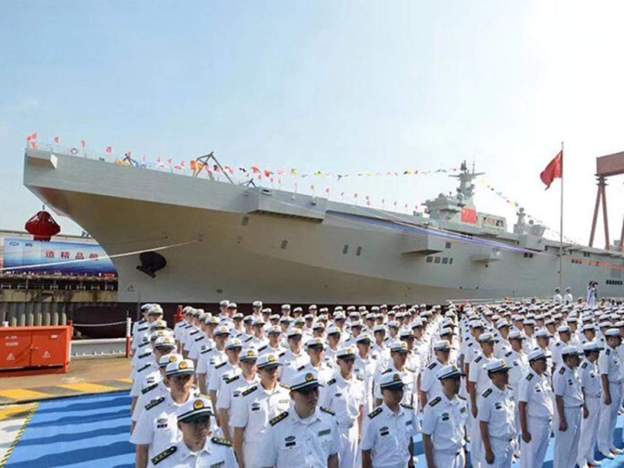
China’s shipyards have launched the PLA Navy’s first two Type 075 amphibious assault ships, which will form the spearhead of an expeditionary force to play a role similar to that of the U.S. Marine Corps. And like the Marines, the new force will be self-contained – able to deploy solo with all its supporting weapons to fight in distant conflicts or demonstrate Chinese military power.

The 40,000-tonne Type 075 ships are a kind of small aircraft carrier with accommodation for up to 900 troops and space for heavy equipment and landing craft, according to Western military experts who have studied satellite images and photographs of the new vessels. They will carry up to 30 helicopters at first; later they could carry fighter jets, if China can build short take off and vertical landing aircraft like the U.S. F-35B…Chinese military commentators say China’s shipyards are now building and launching amphibious ships so rapidly it is like “dropping dumplings” into water.

As shipyards churn out amphibious vessels, China is expanding its force of marines under the command of the PLA Navy. These troops are being trained and equipped to make landings and fight their way ashore. China now has between 25,000 and 35,000 marines, according to U.S. and Japanese military estimates. That’s a sharp increase from about 10,000 in 2017…“Without an amphibious force, any military force is greatly constrained in where and how it can conduct operations,” said Grant Newsham, a retired U.S. Marine Corps colonel… “Jets can drop bombs and ships can fire missiles at the shore – but you might need infantry to go ashore and kill the enemy and occupy the ground.” In China, the state-controlled media regularly reports on the gruelling training and military skills of the Jiaolong, or Sea Dragon commandos – a unit from the marines special forces brigade based on Hainan Island off southern China.

“We are currently only seeing the tip of the iceberg,” said Ian Easton, the senior director of the Project 2049 Institute, an Arlington, Virginia-based security research group. “Ten years from now, China is almost certainly going to have marine units deployed at locations all over the world. The Chinese Communist Party’s ambitions are global. Its interests are global. It plans to send military units wherever its global strategic interests require.”…

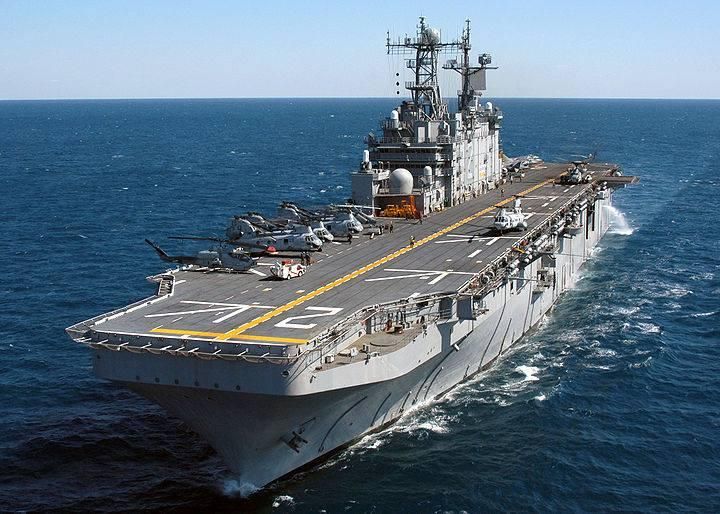
[China has learnt lessons from the U.S.]——U.S. expeditionary flotillas, packed with marines, all their heavy equipment and air support, are a potent reminder of American power. A raw demonstration came in the tense period in 1999 when an Australian-led United Nations peacekeeping force intervened to stop violence in what was then Indonesian-controlled East Timor. American forces didn’t become heavily involved on the ground. But the presence of the USS Belleau Wood, a 40,000-tonne amphibious assault ship carrying 900 marines and heavy lift and attack helicopters, served as formidable back-up as the UN troops restored order without any significant resistance from Indonesia.

Excerpts from DAVID LAGUE, China expands its amphibious forces in challenge to U.S. supremacy beyond Asia, Reuters, July 20, 202