
Tag Archives: untreated sewage

Future of Green Life Depends on a Toilet

Innovator Cranfield University, U.K.: Putting down the toilet lid activates a dry flush. The motion turns a set of gears that drop feces and urine into a pan, where they are separated and either combusted into ash that can be thrown away or filtered into clean water that could be used to water plants, for instance, though not drinking. It was one of the few completely standalone toilets at the expo, able to function without links to water, sewer or electric lines.

The Innovator: Helbling Group, Switzerland: Helbling’s self-contained toilet system
Similar to other models, this toilet is a mostly self-contained system that transforms waste into clean water and a form of charcoal. But its makers, who were contracted by the Gates Foundation to develop this model, also had modern design in mind: A sleek, black-and-white prototype includes a touchpad for the flush and a container that can be detached to dump out excess water. While it doesn’t have to connect to water or sewer lines, one limit is that the model still needs electricity from an outside source

Sedron Technologies makes the Janicki Omni Processor, a small-scale waste-treatment plant that can filter wet fecal matter so thoroughly that the resulting water is not only free of bacteria and viruses but also safe for drinking. At its highest capacity the plant can manage waste for up to 500,000 people, the same range as two other plants featured at the expo. A trial has been running in Dakar, Senegal, over the past three years to identify and fix technical problems.

Excerpts  from Flush With Ideas: Bill Gates Pursues the Toilet of the Future, WSJ, Nov. 9, 2018
 

Water Sharing Agreement – Middle East

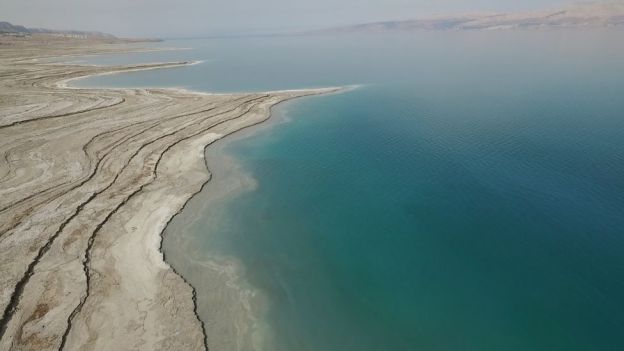
Drained by farms along its banks, the River Jordan is barely a trickle by the time it dribbles into the Dead Sea, and most of that is sewage coming out of Jerusalem and West Bank settlements. Israeli and Jordanian factories also use the water to recover potash.So fast are the Dead Sea’s briny waters shrinking that it has already shed its southern half. Much of the seabed is now as crusty as the pillar of salt that Lot’s wife turned into after fleeing Gomorrah. Hotels built on the shores in the 1980s have a cliff-top view today. Arthritic pensioners keen on the sea’s therapeutic powers are reduced to swimming in saline hotel pools. By 2050, say Friends of the Earth, a conservation group, the sea will be little more than a pond the size of two football fields.

After years of regional squabbling, Israeli, Jordanian and Palestinian ministers signed a deal ( a Memorandum of Understanding)* on December 9th, 2013 to slow desiccation. Backed by the World Bank, they plan to build a desalination plant on the Red Sea and pipe the run-off 180km (112 miles) north to the Dead Sea.  Some see advantages in diluting the Dead Sea’s nose-twitchingly sulphurous tides with ocean water. But there are drawbacks. Mucky algae might spread, turning the sea red. “It’s playing with an entire ecosystem,” says Mira Edelstein of Friends of the Earth.

The Dead Sea: Emptying out, Economist, Dec. 14, 2013, at 58

*The MoU outlines in broad language three major regional water sharing initiatives that will be pursued over the coming months by the cooperating parties. These initiatives include the development of a desalination plant in Aqaba at the head of the Red Sea, where the water produced will be shared between Israel and Jordan; increased releases of water by Israel from Lake Tiberias for use in Jordan; and the sale of about 20-30 million m3/year of desalinated water from Mekorot (the Israeli water utility) to the Palestinian Water Authority for use in the West Bank. In addition, a pipeline from the desalination plant at Aqaba would convey brine to the Dead Sea to study the effects of mixing the brine with Dead Sea water. In order to proceed with these actions, especially the desalination plant at Aqaba, technical work and studies will need to be undertaken.  See World Bank