Tag Archives: bitcoin technology

World Reeling, Trump Mining

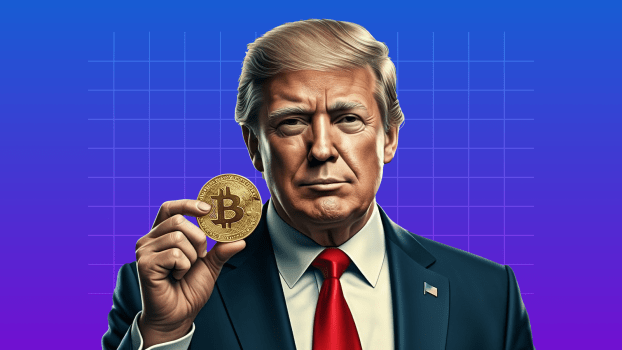
The two oldest sons of President Trump are investing in a bitcoin-mining company, adding to the Trump family’s expanding portfolio of cryptocurrency businesses.   Eric Trump and Donald Trump Jr.’s American Data Centers will merge with and take a 20% stake in American Bitcoin, a mining operation majority-owned by Hut. Together, they aim to create the world’s largest miner of the digital currency, with designs on building its own “bitcoin reserve.”

In a matter of months, the Trumps started a decentralized-finance, or DeFi, project called World Liberty Financial, said their social-media company would invest in bitcoin and other digital assets, launched meme coins to capitalize on the popularity of the president and his wife and announced plans to issue a World Liberty dollar-backed stablecoin. And in his return to the White House, President Trump has said he aims to make the U.S. the “crypto capital of the world.” …As part of the deal, Hut 8 will shift nearly 61,000 of its specialized bitcoin-mining machines to American Bitcoin in exchange for an 80% ownership in the new entity. The companies said no cash changed hands in the deal…

The business of mining new bitcoin has grown more challenging as new companies have sprung up to capitalize on rising prices and the number of unmined tokens has dwindled. Bitcoin’s pseudonymous creator, Satoshi Nakamoto, capped the digital currency’s supply at 21 million, and more than 90% of those tokens have already been released. Critics also raised concerns about the environmental impact of bitcoin mining, pointing to the massive amounts of energy required to run mining operations.

Excerpt from The Trump Family Advances Its All-Out Crypto Blitz, This Time With Bitcoin Mining, WSJ, Mar. 31, 2025
The Magic of Tether: Why the United States Tolerates Tether Land?

A giant unregulated currency is undermining America’s fight against arms dealers, sanctions busters and scammers. Almost as much money flowed through its network in 2024 as through Visa cards. And it has recently minted more profit than BlackRock, with a tiny fraction of the workforce. Its name: tether. The cryptocurrency has grown into an important cog in the global financial system, with as much as $190 billion changing hands daily. In essence, tether is a digital U.S. dollar—though one privately controlled in the British Virgin Islands by a secretive crew of owners, with its activities largely hidden from governments.  Known as a stablecoin for its 1:1 peg to the dollar, tether gained early use among crypto aficionados. But it has spread deep into the financial underworld, enabling a parallel economy that operates beyond the reach of U.S. law enforcement. Wherever the U.S. government has restricted access to the dollar financial system—Iran, Venezuela, Russia—tether thrives as a sort of incognito dollar used to move money across borders.

Russian oligarchs and weapons dealers shuttle tether abroad to buy property and pay suppliers for sanctioned goods. Venezuela’s sanctioned state oil firm takes payment in tether for cargoes. Drug cartels, fraud rings and terrorist groups such as Hamas use it to launder income. Yet in dysfunctional economies such as Argentina and Turkey, beset by hyperinflation and a shortage of hard currency, tether is also a lifeline for people who use it for quotidian payments and as a way to protect their savings.

Tether is arguably the first successful real-world product to emerge from the cryptocurrency revolution that began over a decade ago. It has made its owners immensely rich. Tether has $120 billion in assets, mostly risk-free U.S. Treasury bills, along with positions in bitcoin and gold. Last year it generated $6.2 billion in profit, out-earning BlackRock, the world’s largest asset manager, by $700 million.

The company behind tether, Tether Holdings, issues the virtual coins to a select group of direct customers, mostly trading firms, who wire real-world dollars in exchange. Tether uses those dollars to purchase assets, mostly U.S. Treasurys, that back the coin’s value. Once in the wider market, tether can be traded for other tokens or traditional currencies through exchanges and local brokerages. In Iran, for example, a crypto exchange called TetherLand allows Iranians to swap rials into tether. Tether vets the identities of its direct customers, but much of its vast secondary market goes unpoliced. The tokens can be pinged near-instantaneously along chains of digital wallets to obfuscate the source. A United Nations report in January 2024 said tether was “a preferred choice” for Southeast Asian money launderers. 

The company says it can track every transaction on public blockchain ledgers and can seize and destroy tether held in any wallet. But freezing wallets is a game of Whac-A-Mole. Between 2018 and this June, Tether blacklisted 2,713 wallets on its two most popular blockchains that had received a total of about $153 billion, according to crypto data provider ChainArgos. Of that massive sum, Tether could only freeze $1.4 billion because the rest of the funds had already been sent on.

Excerpts from Angus Berwick & Ben Foldy, The Shadow Dollar That’s Fueling the Financial Underworld, WSJ, Sept. 10, 2024

The Coin Curse: Bitcoin, Dogecoin and Carbon

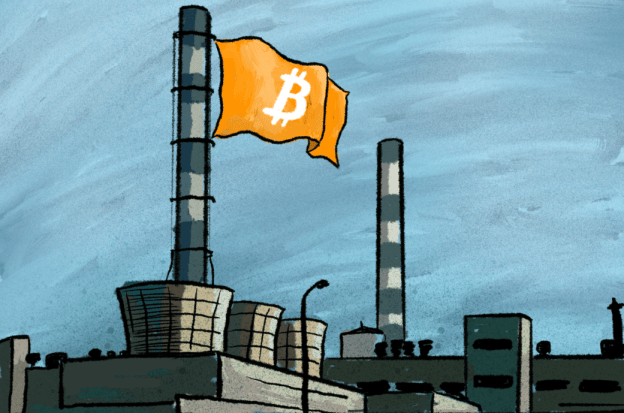
Environmentalists…fret about how much energy bitcoin uses. In a paper in Nature Communications, a group of academics…examine bitcoin’s energy use in China. They conclude that, in the absence of legal curbs, bitcoin could by 2024 become a “non-negligible” barrier to China’s efforts to decarbonize its economy.

Bitcoin’s hunger for energy stems from its design. It forgoes centralised record-keeping in favour of a “blockchain”, a transaction database that is distributed among users. The blockchain is maintained by “miners”, who validate transactions by competing to crack mathematical puzzles with solutions that are hard to find but easy to check. Each successfully mined block of transactions generates a reward, currently 6.25 bitcoins ($357,000).

The system varies the difficulty of the puzzles to ensure that one new block is created, on average, every ten minutes. High bitcoin prices make it worthwhile to spend more computing power—and therefore electricity—chasing mining rewards…

Despite the currency’s democratic ambitions, mining is concentrated among a handful of professional operators. About 70% takes place in China. Scientists have concluded that, without regulation, Chinese bitcoin mining could consume around as much energy as Italy or Saudi Arabia by 2024. Annual carbon emissions, at 130m tonnes, would approach those of Nigeria. Such numbers should be taken with a good deal of salt. Bitcoin’s energy use depends crucially on its price, which swings wildly…

But the general picture—that bitcoin is a dirty business—fits with other research. One oft-cited model, which uses publicly available blockchain data, reckons its global energy consumption is already equal to that of Kazakhstan, and that its carbon footprint matches Hong Kong’s.

Excerpts from The dirty truth: Totting up bitcoin’s environmental costs, Economist, Apr. 10, 2021

Messaging Secrecy: US Military

The United States Department of Defense and DARPA [seek to establish] a secure messaging system that can provide repudiation or deniability, perfect forward and backward secrecy, time to live/self delete for messages, one time eyes only messages, a decentralized infrastructure to be resilient to cyber-attacks, and ease of use for individuals in less than ideal situations….The messaging platform will transfer messages via a secure decentralized protocol that will be secured across multiple channels, including but not limited to: 1) Transport protocol, 2) Encryption of messages via various application protocols, 3) Customized blockchain implementation of message deconstruction and reconstruction, and decentralized ledger implementation

Excerpts from SBIR.defense business. org