Tag Archives: blood minerals

Free-For-All: Gold Mining and the Polluted Rivers of Central African Republic

Four Chinese-run gold mines should be closed in the Central African Republic because of pollution threatening public health, a parliamentary panel said in a report published on July 14, 2019.  “Ecological disaster,” “polluted river,” “public health threatened,” were some of the phrases used in the report.  “Gold mining by the Chinese firms at Bozoum is not profitable for the state and harmful to the population and the environment,” the commission found after its investigation into mining in the northern town.  “The nature of the ecological disaster discovered onsite justifies the immediate, unconditional halt to these activities,” the report found.

Members of the commission spent four days in Bozoum a month ago in response to “multiple complaints from the population.”  There, they found a badly polluted River Ouham, shorn of several aquatic species following the excavation of its riverbed.  They discovered that a rising death rate in fishing villages as well as shrinking access to clean drinking water.

The investigators also voiced fears that the country’s “resources are being squandered with the complicity of certain ministry of mines officials.”  The CAR is rich in natural resources but riven by conflict which has forced around one in four of its 4.5 million population to flee their homes. Under those circumstances, exploitation of the country’s natural resources is difficult to monitor effectively given that the state only has partial control of its own territory.

Central African Republic Report Cites Ecological Disaster in Calling for Closing of 4 Chinese Gold MInes, Agence France Presse,  July 14, 2019
Tin, Tantalum and Tungsten: Congo

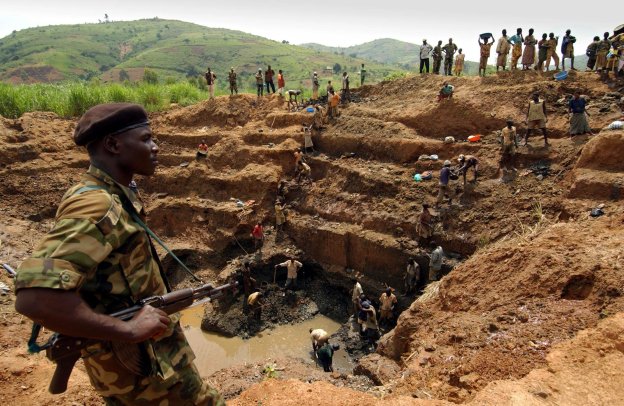
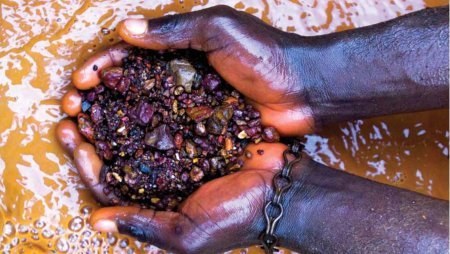
Congo’s tin, tantalum and tungsten are used in electronics around the world. Although some of these minerals come from big industrial copper mines in Katanga, Congo’s south, and a gold mine in South Kivu, there is not yet a single modern mine in North Kivu.

Until now the province’s metal has been dug out almost entirely by hand. Yet Alphamin hopes to show that it can run a modern industrial mine in a part of the world that scares other modern miners away.

Alphamin says that the investment is attractive—even at a time of low commodity prices—because the ore that it plans to extract is richer than that found anywhere else in the world. Behind the company’s camp on the hill are stacks of carefully ordered cylinders of rock drilled out to map the riches beneath the mountain. (Like almost everything else in the camp, the drill rig had to be lifted in by helicopter.) The ore they contain is 4.5% grade. That means that for every 100 tonnes of ore extracted, the firm will be able to sell 3.25 tonnes of tin (not all the tin can be extracted from the rock). Most other mines would be happy to produce 0.7 tonnes…..

If the gamble pays off Alphamin’s investors will make juicy returns. But to do so they may have to convince locals that the project is in their interest. If not, they risk protests and sabotage  .In 2007 some 18,000 people lived at Bisie, working the site with pickaxes and shovels. They produced some 14,000 tonnes of tin that year—or perhaps 5% of world production. To get it to market people carried concentrated ore on their heads through the jungle to an airstrip where small planes could land to carry it out. It was back-breaking work but lucrative for many Congolese. That era began to come to an end in 2011, thanks in part to an American law.

Under the Dodd-Frank act, a law aimed mainly at tightening bank regulation, firms operating in the United States must be able to show where the minerals used in their products came from. The idea was to stop rebels in poor countries from selling gold and diamonds to fund wars. The law all but shut down artisanal mining in much of eastern Congo.

Elsewhere in eastern Congo artisanal mines have gradually reopened thanks to a verification scheme under which the UN and the government check mines and allow certified ones to “tag and bag” minerals. The site at Bisie has, however, never been certified. And although Alphamin will provide some well-paid jobs to locals, as well as pay taxes to the central government, its mechanised operations will never employ anything like the thousands of people who once toiled there with pick and shovel. Alphamin has promised to fund local projects, such as a new school, that are intended to benefit 44 villages.

Excerpts from Mining in the Democratic Republic of Congo: The richest, riskiest tin mine on Earth, Economist, Aug. 27, 2016