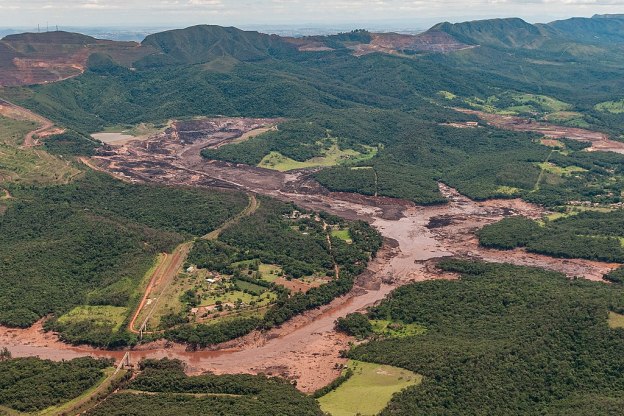
Less than half of the world’s larger miners have released safety and environmental details about their mine-waste dams, showing the mixed success of investors’ demands for greater transparency after the deadly Brumadinho dam collapse in Brazil. In January, 2019, 270 people died following the collapse of a tailings dam owned by Brazil’s Vale SA. The incident prompted a coalition of investors who manage more than $13 trillion to ask 726 companies in the mining and oil-sands business to disclose information on their dams. Nearly 55% of companies hadn’t delivered as of November 2019. While some of the largest miners—including Vale, BHP , and Anglo American have disclosed their information, others have yet to do so. Investors are increasingly examining ethical issues when looking at mining.
Tailings, the waste material from extracting valuable minerals, are often held for decades behind dams that can be risky if they are poorly constructed, ill-maintained or filled with too much waste. Major failures of tailings dams have become more frequent as mining companies ramp up production to meet the world’s growing demand for commodities. Norilsk Nickel one of world’s most valuable miners with a market capitalization of roughly $43 billion, hasn’t publicly released details on its tailings dams. In 2016, heavy rainfall caused a Norilsk Nickel tailings dam in northern Russia to overflow, coloring a local river red. Miners of potash and phosphate—minerals used mainly in fertilizers—have been slow to disclose.
Another big company that has not released details is Canada-based Nutrient. Satellite images show two of the company’s six Saskatchewan mines are located a few miles from residential communities and one neighbors a bird-breeding area. A tailings pond at the company’s North Carolina phosphate mine is located next to the Pamlico River, which feeds into the state’s largest estuary.
In 2017, Israel Chemicals reported that the partial collapse of a subsidiary’s dike in Israel released 100,000 cubic meters of acidic wastewater that flowed into a nearby nature reserve. The wastewater resulted from the production of phosphate fertilizer.Vancouver-based Imperial Metals Corp.is tied to what is considered one of Canada’s worst environmental catastrophes. In 2014, a British Columbia dam owned by the company burst, sending some 25 million cubic meters of mining waste pouring into a pair of glacial lakes
Large Chinese miners such as Jiangxi Copper, Zijin Mining Group Co. and Zhongjin Gold Corp. also haven’t shared information with the investor coalition. There are 8,869 documented tailings dams, of which 16% are within about half a mile of a residential area, school or hospital, according to research led by the School of University of Science and Technology in Beijing. Karen Hudson-Edwards, a mining specialist at Britain’s University of Exeter, said the actual number in China is estimated at around 12,000 dams and there is little transparency on tailings risk in the country. There have been at least 12 serious tailings-dam accidents in China since the 1960s, with one in 2008 killing 277 people, according to the World Information Service on Energy, a Netherlands-based nonprofit.
Alistair MacDonald et al, Many Mining Companies Fail to Provide Waste-Dam Data, WSJ, Dec. 18, 2019
 Law-In-Action