Tag Archives: Chernobyl sacrophagus

The Devil’s Scenario: Drone Striking Nuclear Power Plant

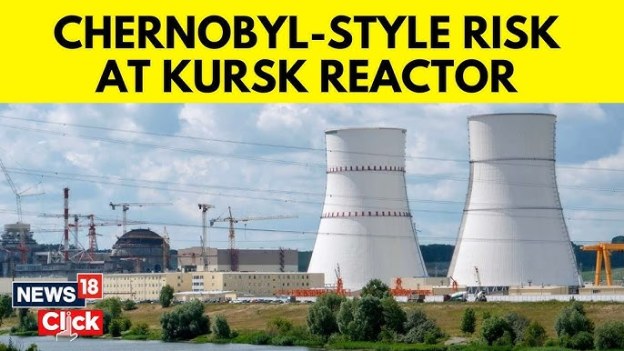
The International Atomic Energy Agency (IAEA) was informed on August 22, 2024 by Russia that the remains of a drone had been found within the Kursk nuclear power plant. Russian President Vladimir Putin on Thursday accused Ukraine of trying to strike the Kursk nuclear power plant in an overnight attack. The nuclear plant is located in western Russia, where fighting is raging between Russian and Ukrainian forces, is especially vulnerable to a serious accident because it lacks a protective dome that could shield it from missiles, drones or artillery, the head of IAEA said on August 27, 2024.

The nuclear plant– the same model as the Chernobyl plant in Ukraine that witnessed the world’s worst civilian nuclear disaster in 1986 – lacks the containment dome and protective structure that is typical of modern nuclear power stations. According to Grossi, director-general of the IAEA: “This means that the core of the reactor containing nuclear material is protected just by a normal roof. This makes it extremely exposed and fragile, for example, to an artillery impact or a drone or a missile,” So this is why we believe that a nuclear power plant of this type, so close to a point of contact or a military front, is an extremely serious fact that we take very seriously.”

Excerpt from UN watchdog says Russian nuclear plant ‘extremely exposed’ if attacked, Reuters, Aug. 27, 2024
Chernobyl Nuclear Accident: 1986 to 2016

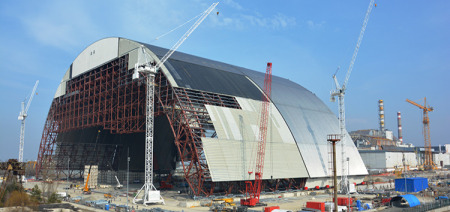
A workforce of around 2,500 people is finishing a massive steel enclosure that will cover Chernobyl’s reactor 4, where the radioactive innards of the nuclear plant are encased in a concrete sarcophagus hastily built after the disaster.  If all goes to plan, the new structure—an arch more than 350 feet high and 500 feet long—will be slid into place late next year over the damaged reactor and its nuclear fuel, creating a leak-tight barrier designed to contain radioactive substances for at least the next 100 years.

The project, known as the New Safe Confinement,  is a feat of engineering.  [see also the Chernobyl Gallery] It will take two or three days to slide the 36,000-ton structure into place. The arch, which looks something like a dirigible hangar, is large enough to cover a dozen football fields. “You could put Wembley Stadium underneath here, with all the car parks,” said David Driscoll, the chief safety officer for the French consortium running the construction site.

Three decades ago, an army of workers scrambled to build a concrete sarcophagus around Chernobyl Reactor 4, which released a radioactive plume after a reactor fire and explosion on April 26, 1986.  At least 30 people died as an immediate result of the accident, which contaminated parts of Ukraine, Belarus and Russia and sent radioactive dust and debris over Europe. Pripyat, the company town of 50,000, was completely evacuated.

Emergency workers and evacuees received doses of radiation significantly above natural background levels, according to the World Health Organization. Researchers acknowledge high levels of thyroid cancer among people who were children at the time of the accident, from exposure to radioactive iodine…

Nicolas Caille, project director for Novarka, the consortium of Vinci SA and Bouygues SA, the French contractors running the project, said about 1,000 people work on a typical shift at the construction site, keeping to a schedule of 15 days in and 15 out….

A new facility to safely and securely store spent nuclear rods is being built at the nuclear power complex. The Interim Spent Fuel Storage Facility, or ISF2, is intended to store spent fuel rods for a minium of 100 years…..The Liquid Radioactive Waste Treatment Plant in Chernobyl…retrieves highly active liquids from their current tanks, processes them into a solid state and moves them to containers for long-term storage. …

Wildlife has flourished in the forest [surrounding Chernobyl], which is largely off limits to humans. Officials say species such as lynx, wild boar, wolves, elk, bear and European bison have rebounded.

Excerpts from Nathan Hodge, 30 Years After Chernobyl Disaster, an Arch Rises to Seal Melted Reactor, Wall Street Journal, Apr. 25, 2016