Tag Archives: Comprehensive Nuclear Test  Ban Treaty Organization (CTBTO)

Can it Be An Earthquake? Covering Up Nuclear Weapon Testing

In the afternoon on 22 June 2020, a seismic station in eastern Kazakhstan registered two small earthquakes 12 seconds 
apart near China’s Lop Nur nuclear test site. Closely spaced jolts can arise from underground explosions followed by a cavity collapse, or simply from earthquakes. U.S. officials in February 2026 asserted the shaking was from a clandestine nuclear detonation—an accusation that could sound the starting gun for a new global arms race…. Low-yield tests would help China refine weapons designs and probe plutonium properties as it expands from a stockpile of about 600 nuclear weapons to what the Pentagon projects will be roughly 1000 by 2030.

Such tests contravene the Comprehensive Nuclear-Test-Ban Treaty (CTBT), which has not entered into force since the major nuclear powers, such as China and the United States, have not ratified it and Russia rescinded ratification in 2023. Renewed testing would also underscore the limitations of the CTBT and its International Monitoring System (IMS), a global network of instruments that can spot blatant treaty violations but is not equipped to distinguish low-yield tests from earthquakes or nonnuclear blasts.

Incentives for nuclear testing are strong. The U.S. is developing a new submarine-launched warhead, Russia is deploying hypersonic missiles nearly impossible to intercept, and China is ramping up its arsenal. All three powers need to ensure the reliability of new or existing warheads, and they may calculate that insights gleaned from low-yield tests outweigh the risks of adversaries following suit. Heightening concerns is the lapse this month of the New Strategic Arms Reduction Treaty (New START), which capped U.S. and Russian deployed nuclear warheads at 1550 each.

In 2025, satellite images circulated of what appears to be a new laser fusion complex in Sichuan province akin to the U.S. National Ignition Facility, which weapons scientists use to simulate the intense temperatures and pressures of a thermonuclear explosion. Other imagery has spotted the excavation of three tunnels and 30-meter-tall rigs for drilling shafts at Lop Nur. Renny Babiarz, a geospatial analyst with AllSource Analysis, believes two shafts dug in the past few years are “most likely” for yield-producing nuclear tests.

Excerpt from Richard Stone, Allegations of a Chinese nuclear blast may reignite weapons testing, Science, Feb. 24, 20
Who’s Not Giving a Damn about Nuclear Fallout

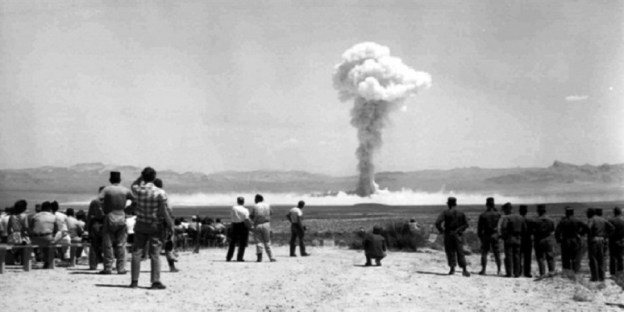
On May 1st 1962, French officials in Algeria told Algerians to leave their homes in the southern city of Tamanrasset. It was just a precaution. France was about to detonate an atom bomb, known as Beryl, in the desert some 150km away. The blast would be contained underground. Two French ministers were there to witness the test. But things did not go as planned. The underground shaft at the blast site was not properly sealed. The mountain (Taourirt Tan Afella) above the site cracked and black smoke spread everywhere. The ministers (and everyone else nearby) ran as radioactive particles leaked into the air. Nevertheless, in the months and years after, locals would go to the area to recover scrap metal from the blast for use in their homes.

France carried out 17 nuclear tests in Algeria between 1960 and 1966. Many took place after Algeria’s independence from France in 1962, under an agreement between the two countries. There are no good data on the effects of the explosions on public health and the environment, but locals note that some people living near the test sites have suffered cancers and birth defects typically caused by radiation. The sites, say activists, are still contaminated.

Taourirt is a group dedicated to identifying the location of nuclear waste left by France. All that exists in the public domain is an inventory of the contaminated materials buried somewhere in the desert. (The known test sites are poorly secured by the Algerian government.) Others are pressing France to clean up the sites and compensate victims. There has been some progress in this direction, but not enough, say activists.

In 2010 the French parliament passed the Morin law, which is meant to compensate those with health problems resulting from exposure to the nuclear tests. (France carried out nearly 200 tests in French Polynesia, too.) But the law only pertains to certain illnesses and requires claimants to show they were living near the tests when they took place. This is difficult enough for Algerians who worked for the French armed forces: few had formal contracts. It is almost impossible for anyone else. Only a small fraction of the claims filed have come from Algeria.

Excerpts from Algeria and France: Lingering Fallout, Economist, June 26, 2021

Sniffing the Earth for Nuclear Exposions

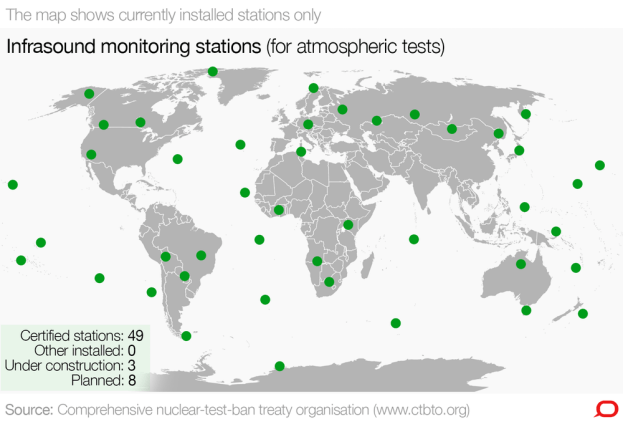
Australia’s infrasound station “IS03” in Davis Base, Antarctica, is one of nearly 300 certified stations of the Comprehensive Nuclear Test Ban Treaty (CTBT) Organization monitoring system, feeling and sniffing the Earth for any signs of a nuclear explosion. The global system will comprise 337 facilities when complete.  “The monitoring stations in Australia cover a large expanse of the Southern hemisphere. They are strategically positioned to contribute significantly to the International Monitoring System (IMS) detection and location capability. All six nuclear tests by North Korea were clearly detected by Australia’s IMS seismic stations,” Zerbo said.

“Australia ranks third among countries hosting the largest number of monitoring facilities.  It covers all four technologies used for nuclear test detection. Some of the stations are located in particularly remote and inaccessible areas of the Earth, such as Antarctica. This has been a 20 year-long joint effort by CTBTO and Australia and is truly an extraordinary achievement,” Zerbo said.

The CTBTO’s global monitoring network captures four types of data: vibrations through the ground and in water – seismic and hydroacoustic; sound beyond the range of the human ear and detection of radioactive particles – infrasound and radionuclide.

The network guards against violations of the Comprehensive Nuclear-Test-Ban Treaty (CTBT) banning nuclear explosions by everyone, everywhere: in the atmosphere, underwater and underground.  The global network detects nuclear tests with high reliability. For example, on 3 September 2017, over 100 stations in the network detected and alerted Member States to North Korea’s last announced nuclear test.

Excerpts from Comprehensive Nuclear Test  Ban Treaty Organization (CTBTO), Australia Completes Its Monitoring Stations in the Global Network to Detect Nuclear Tests, Nov 18, 2018, 15:45 ET