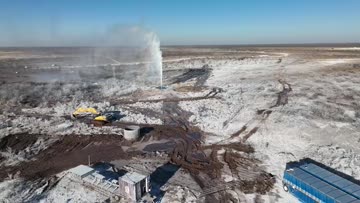
Producers in the Permian Basin of West Texas and New Mexico extract roughly half of the U.S.’s crude oil. They also produce copious amounts of toxic, salty water, which they pump back into the ground. Now, some of the reservoirs that collect the fluids are overflowing—and the producers keep injecting more. A buildup in pressure across the region is propelling wastewater up ancient wellbores, birthing geysers that can cost millions of dollars to clean up. …Swaths of the Permian appear to be on the verge of geological malfunction.
When pressure of the injected into the ground wastewater exceeds 0.5 pound per square inch per foot, the liquid…can flow to the surface and pose a risk to underground sources of drinking water.
The fracas above ground is raising questions about how the Permian can sustain red-hot production without causing widespread environmental damage that could leave taxpayers on the hook—and complicate the region’s economic plans. The basin is trying to lure data centers with cheap land and energy and has plans to become a hub for burying carbon dioxide captured at industrial plants and sucked out of the air.
“You need to have a stable, locked-down geology that’s going to behave as it’s supposed to,” said Adam Peltz, a director at the Environmental Defense Fund, a nonprofit advocacy group. “Otherwise, you’re going to cause a huge, expensive mess that Texans will pay for for generations.” The industry is working to clean up its act, but solutions to treat and ditch meaningful volumes of water far from the oil fields remain years away.
In the Delaware portion of the Permian, its most prolific region, drillers crank out between 5 and 6 barrels of water, on average, for every barrel of oil. For years, they pumped the toxic water deep into the ground—and triggered hundreds of earthquakes, some with a magnitude of over 5. They caused little damage in the sparsely populated Permian, but they were felt as far as Dallas, El Paso and San Antonio, where a historic building was damaged.
In 2021, the Railroad Commission of Texas, the agency that oversees the oil-and-gas industry in the state, began cracking down on deep disposal. Companies pivoted to shallow reservoirs, which now absorb roughly three-quarters of the billions of barrels of water that they inject in the Permian every year. The shift largely cured the tremors but has created unintended consequences.
As more and more of toxic water is injected in shallow underground reservoirs pressure is built and the toxic water migrates up some of the decaying wells that litter the Permian erupting back on the surface. In 2022, a 100-foot column of toxic water erupted from an abandoned well in Texas’ Crane County near the unincorporated community of Tubbs Corner. Chevron, which owned the well, plugged it. But nearly two years later, water started to ooze from a different well in the same area, a sign that bottling up the geyser likely repressurized the subsurface and triggered the new outburst, scientists said. It took the Railroad Commission about 53 days and roughly $2.5 million to plug that leak. Eventually, the agency quietly shut in the injection wells that it said were likely causing the increase in pressure.
Researchers at the Bureau of Economic Geology painted a critical picture of the frenzied injection in the Permian basin. Operators were injecting wastewater with little concern over how it might travel underground or its impact on reservoir pressure, they said.
Excerpt from Benoît Morenne et al., America’s Biggest Oil Field Is Turning Into a Pressure Cooker, WSJ, Dec. 25, 2025
 Law-In-Action