Tag Archives: GM foods China

Who Knew? Weed Killer Roundup Found in GM Foods

A highly influential organization of pediatricians is facing blowback over advice it published earlier this year urging parents to avoid foods with ingredients from genetically modified organisms (GMOs). Guidelines from the American Academy of Pediatrics (AAP) are a go-to source for practicing pediatricians and for some parents. But critics say the advice ignores a wide body of evidence supporting GMOs’ safety. They add that AAP is raising unfounded fears that will drive parents to assume they must buy only organic products, which by definition are not genetically engineered—an option that’s financially out of reach for many families…

The guidelines, published in Pediatrics in January in 2024, were accompanied by a parent newsletter that included “tips for limiting GMOs on your family plate” and referred to “news stories [that] may shrug off the dangers of GMOs.” The Pediatrics paper, whose senior author is Boston College pediatrician and epidemiologist Philip Landrigan, cautioned about potential health harms, especially to infants and children, of residues in food from the weed killer glyphosate, which is widely used on genetically engineered crops.

The AAP guidelines had an impact almost immediately; by March 2024, Mexico was citing them in a trade dispute with the United States, which is challenging Mexico’s ban on imports of genetically modified corn grown in the U.S. But the Pediatrics paper did not mention that regulators in the U.S. and Europe have judged glyphosate at the levels currently found in food to be safe….

The AAP report authors focus on glyphosate, sold commercially by Bayer as Roundup, because its use has exploded in recent decades: Ninety percent of the corn and 96% of the soybeans planted in the U.S. this year were genetically modified, much of it to be resistant to destruction by glyphosate, which instead kills all the weeds around the crops. The herbicide is often sprayed on genetically modified canola and sugar beets as well. As a result, glyphosate residues are in foods made with ingredients such as high fructose corn syrup, sugar, and canola oil, among them children’s favorites from hot dogs and chicken nuggets to sweetened cereal and potato chips.

The AAP report notes a 2015 finding from an arm of the World Health Organization that glyphosate is “probably carcinogenic to humans.” It also cites one meta-analysis that found an elevated risk of non-Hodgkin lymphoma in people with high exposure to glyphosate from years of applying it to crops.

But the U.S. National Academies of Sciences, Engineering, and Medicine found no evidence of adverse health effects in humans from genetically engineered foods or from glyphosate residues in them. The U.S. Food and Drug Administration tests foods for glyphosate residues and has rarely found levels exceeding those determined safe for consumption by the U.S. Environmental Protection Agency (EPA). Numerous other agencies worldwide have similar positions.

Excerpts from Meredith Wadman, Pediatrics academy accused of ‘fearmongering’ over GMO ingredients in kids’ diets, Science, Sept. 17, 2024
Stealing Patent-Protected Seeds

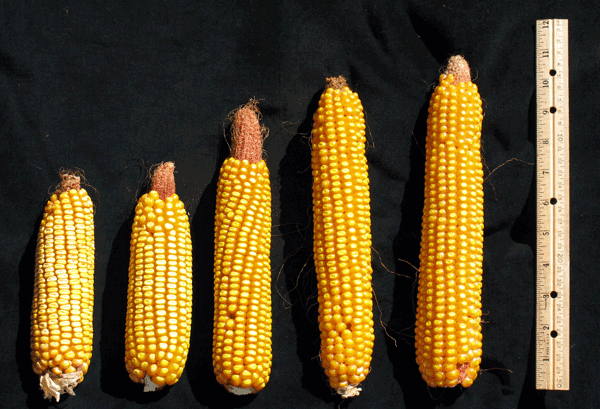
A Chinese man pleaded guilty in a US court on January 27, 2016 to stealing patent-protected corn seed from agribusiness giants Monsanto and DuPont to take back to China for commercial use.  Mo Hailong, 46, participated in a plot to steal inbred corn seeds from the two US companies so that his then employer, Beijing Dabeinong Technology Group, could use them in its own seed business, the US Department of Justice said.Mo “admitted to participating in the theft of inbred – or parent – corn seeds from fields in the southern district of Iowa for the purpose of transporting those seeds to China,” the department said in a statement.“The stolen inbred seeds constitute the valuable intellectual property of DuPont Pioneer and Monsanto.”..

Man admits stealing patented corn seeds from US fields to take to China, Guardian, Jan. 27, 2016

Genetically Modified Food – China v. US

Public unease about genetic modification is common around the world. In China, alongside rising concerns about food safety, it has taken on a strongly political hue. Chinese anti-GM activists often describe their cause as patriotic, aimed not just at avoiding what they regard as the potential harm of tinkering with nature, but at resisting control of China’s food supply by America through American-owned biotech companies and their superior technology. Conspiracy theories about supposed American plots to use dodgy GM food to weaken China

They are even believed by some in the government. In October an official video made for army officers was leaked on the internet and widely watched until censors scrubbed it. “America is mobilising its strategic resources to promote GM food vigorously,” its narrator grimly intoned. “This is a means of controlling the world by controlling the world’s food production.”  Peng Guangqian, a retired major-general and prominent think-tanker, echoed these sentiments in an article published by official media in August. He said America might be setting a “trap”. The result, he said, could be “far worse than the Opium War” between Britain and China in the 1840s that Chinese historians regard as the beginning of a “century of humiliation” at the hands of foreign powers.

China already uses plenty of GM products. More than 70% of its cotton is genetically modified. Most of the soyabeans consumed in China are imported, and most of those imports are GM (often from America). The technology is widely used for growing papayas. The government wants to develop home-grown GM varieties and has spent heavily on research, eager to maintain self-sufficiency in food. Officials see GM crops as a way of boosting yields on scarce farmland.

In 2009 China granted safety certificates for two GM varieties of rice and one of maize. This raised expectations that it might become the first country in the world to use GM technology in the production of a main staple. But further approvals needed for commercial growing have yet to be granted. To the consternation of GM supporters, the safety certificates for the rice are due to expire next August.

Public opinion is a big reason for the delay. Environmental groups in China have rarely succeeded in changing government policy. Officials have long treated such NGOs with suspicion and made it hard for them to register or set up offices in more than one place. The only NGO in China that devotes much time to the GM issue is an international one: Greenpeace. But the anti-GM lobby has thrived, thanks not least to the adoption of the cause by conservatives in the establishment as well as by informal groups of diehard Maoists who see America as a threat.

To the Maoists, opposing GM food is an urgent priority. Hardly a speech is made by one of them without mentioning it. “I support Mao Zedong thought,” shouted one of the protesters outside the agriculture ministry. The police usually treat them with kid gloves; unlike others who protest in public, they are ardent supporters of Communist Party rule. And on this issue, at least, the Maoists enjoy much sympathy; public anxiety about food safety has soared in recent years thanks to a series of scares. Of 100,000 respondents to an online poll in November, nearly 80% said they opposed GM technology.

Since a change of China’s leadership a year ago, however, supporters of GM food inside the government and among the public have begun fighting back. In October Chinese media reported that 61 senior academics, in a rare concerted effort, had petitioned the government to speed up the commercialisation of GM crops. The Ministry of Agriculture was also said to be preparing a new public-education campaign on the merits of GM food…One of the recent petitioners, Li Ning of China Agricultural University, laments that the issue remains ensnared by nationalist sentiment.

Excerpts, Genetically Modified Crops, Food Fight, Ecomomist,  Dec. 14, 2013, at 53