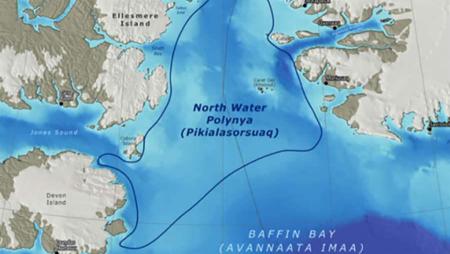
 Europe’s space agency is defending plans to launch two satellites that would drop a rocket stage likely to contain highly toxic fuel in some of the most ecologically sensitive waters of the Canadian Arctic… North Water Polynya between Baffin Island and Greenland. Inuit have said those plans treat seas…as a garbage dump.
On October 13, 2017, the European Space Agency plans to launch the Sentinel 5P satellite, an environmental probe designed to monitor trace gases in the atmosphere. A second launch of a similar satellite is planned for 2018. The second stage of both rockets are expected to splash down in water that is part of Canada’s exclusive economic zone. Both will use Soviet-era rockets fuelled by hydrazine. The fuel is a carcinogen and causes convulsions, nervous system damage, kidney and liver failure in humans.
Hvistendahl, representative of European Space Agency, said unused fuel will be destroyed before it reaches the ocean. Re-entry temperatures are much higher than hydrazine’s boiling point, he said. “The structural parts lose their integrity and, by melting, the destruction of the stage occurs. Six kilometres above ground the propellant components have completely burnt up.”
Michael Byers, a Canadian academic who has just published research on the launch in a top Arctic journal, questioned those assurances. “The ESA is making lots of assumptions about what happens to the residual (fuel) in these returning rocket stages,” he said Friday in an email. “Unless they have real science that proves their assumptions, they should not be taking chances with Inuit lives and the Arctic environment.” In his paper, published in Polar Record from Cambridge University, Byers cites extensive evidence suggesting that instead of burning, hydrazine forms fine droplets that settle on the Earth below. Byers quotes a UN report that found “the products of combustion and non-combusted remains of fuel and oxidants falling from the height of 20–100 kilometre spread and land over thousands of square kilometres.”The rocket stage could be carrying up to a tonne of unused hydrazine as it falls, the paper says. It will drop into the North Water Polynya, an 85,000-square-kilometre ocean that is free of ice year-round. It shelters most of the world’s narwhal, as well as about 14,000 beluga whales and 1,500 walrus, bowhead whales, polar bears, seals and tens of millions of seabirds…
In his paper, Byers points out there have been 10 such launches dropping rocket stages into the North Water Polynya over the last 15 years. Nearly every country in the world, including Russia, has stopped using hydrazine. He said Europe launched a very similar satellite earlier this year with a rocket using a much safer fuel.
Excerpts from European satellite splashdown in Canadian Arctic probably toxic, Canadian Press, Oct. 6, 2017.

 Law-In-Action