
Companies and governments around the world are anxiously watching the fate of a sprawling industrial facility 30 kilometers north of this city on the east coast of peninsular Malaysia.The 100-hectare Lynas Advanced Materials Plant (LAMP) produces 10% of the world’s output of rare earth oxides (REOs), minerals needed in technologies including mobile phones, hard drives, fiber optic cables, surgical lasers, and cruise missiles. Lynas, an Australian company, imports concentrated ores from mines on Mount Weld in Australia and refines them in Malaysia, where costs are lower; it sells REOs—which include cerium compounds, used in catalytic converters, and neodymium, critical to permanent magnets—to Japan, the United States, and other countries. The plant produced almost 18,000 tons of REOs in 2018.
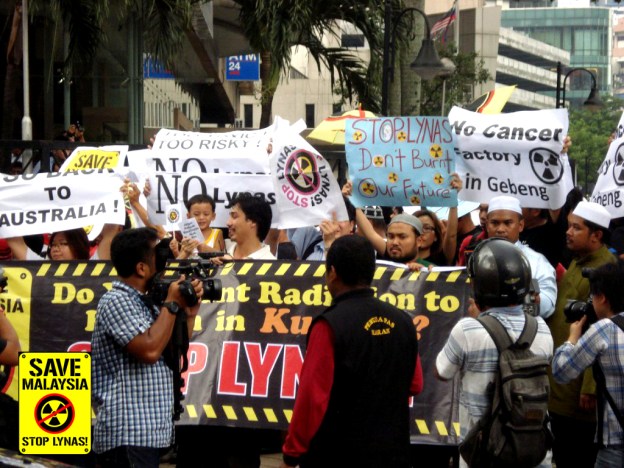
Now, the LAMP faces closure, barely 7 years after it opened. Environmental groups have long opposed the storage on the site of slightly radioactive waste from the extraction process, and they found a sympathetic ear in a new government elected in May 2018. In December 2018, the government demanded that the facility ship its radioactive waste back to Australia if it wants to renew its operating license, which expires on 2 September. On 12 March 2019overnment task force to help organize the shipments was announced. But the company says exporting the more than 451,000 tons of residue by the deadline is “unachievable.”
A shutdown would be “a significant event with a ripple effect,” says Ryan Castilloux, a metals and minerals analyst at Adamas Intelligence in Amsterdam. For one thing, the shutdown would strengthen China’s position as the dominant supplier of REOs, which many countries deem a strategic risk. Japan’s electric vehicle industry, for instance, would lose its main supplier of REOs for permanent magnets; “it would have to reestablish a relationship with China after almost a decade of friction” in the REO trade, Castilloux says…. “Although rare earth oxides production worldwide is only worth several billions of dollars, it is essential for industries worth trillions,” Castilloux says.
Rare earth deposits themselves are not scare..Refining them takes lots of corrosive chemicals and generates huge amounts of residue. China was long the sole supplier; when it reduced exports in 2010, citing environmental concerns, prices jumped as much as 26-fold and major consumers scrambled for alternate sources. Lynas has become a “flagship” of REO production outside China, Castilloux says. The United States and Myanmar mine REEs as well, but they are processed in China, which today produces about 89% of the global REO output…
But in Malaysia, the waste has raised red flags. At the LAMP, concentrated ores are roasted with sulfuric acid to dissolve the rare earths and then diluted with water in a process called water leach purification, leaving a moist, pastelike residue. By September 2018, the LAMP had already produced 1.5 million tons of residue; because the ores contain thorium and uranium, almost 30% of it is slightly radioactive. Some REO facilities elsewhere have built permanent, secure facilities to store such waste, says Julie Klinger, a geographer and expert in REO mining at Boston University; others are secretive about what they do with it. Radioactivity isn’t the only risk…heavy metals as ickel, chromium, lead, and mercury could contaminate groundwater.
Excerpts by Yao-Hua, Radioactive waste standoff could slash high tech’s supply of rare earth elements, Science Magazine, Apr. 1, 2019

 Law-In-Action