
Tag Archives: net negative greenhouse emissions

Laughingstock: The Net-Zero Banking Alliance

The Net-Zero Banking Alliance (NZBA) said in August 2025 that it was pausing operations and initiating a vote to decide on whether to continue working as a membership-based alliance or operate as a framework initiative…The move by the NZBA to suspend activities comes after numerous banks from the U.S. and Europe left the alliance. Those banks said that being part of such an organization was no longer necessary and that their business practices now incorporated the ESG principles learned over the past five years…Shortly after President Trump’s electoral win, major banks including JPMorgan, Citi and Morgan Stanley exited the alliance that they had proudly been a member of for years. The departure of the banks came as many faced strong pressure from the Trump administration and Republican attorneys generals to oppose climate groups and ESG investing more generally…

A sister organization, the Net Zero Asset Managers initiative was also set up, with a similar remit but instead focused on the activities of asset managers. It suspended activities in January 2025 after a wave of departures from the likes of BlackRock and Vanguard…. BlackRock, State Street and Vanguard were sued in November2024 by Texas Attorney General Ken Paxton, who alleged that the asset managers were violating antitrust law by being part of alliances like the NZAM initiative, which worked to move investments away from fossil fuels, especially coal. Paxton said this raised energy costs for consumers by not providing the full remit of energy sources.

In August 2025, a federal-district court judge denied the asset manager’s motion to dismiss the case, allowing litigation to continue under Texas and federal antitrust laws. “Today’s victory represents a major step in holding them accountable. I will continue fighting to protect Texas and defend America’s energy independence from this unlawful conspiracy,” Paxton said…

Excerpt from Yusuf Khan,, Net-Zero Banking Alliance Suspends Activities Amid Wave of Departures, WSJ, Aug. 27, 2025
Chasing Super-Polluters

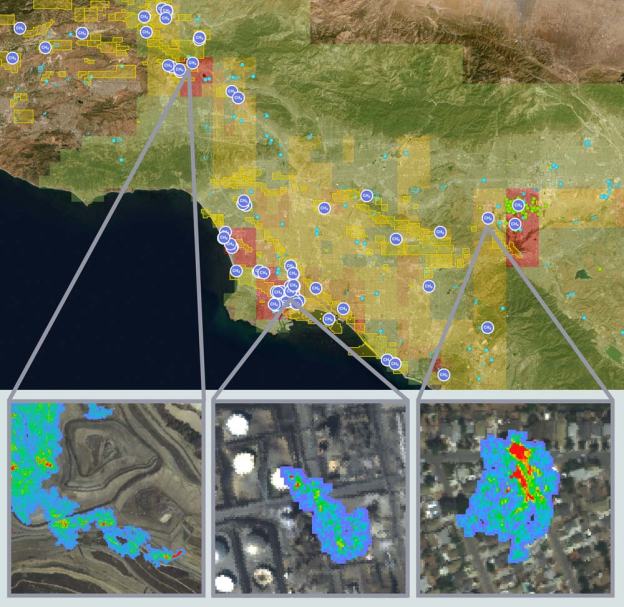
A constellation of satellites will be flown this decade to try to pinpoint significant releases of climate-changing gases, in particular carbon dioxide and methane. The initiative is being led by an American non-profit organisation called Carbon Mapper.
It will use technology developed by the US space agency over the past decade.
The satellites – 20 or so – will be built and flown by San Francisco’s Planet company.
Planet operates today the largest fleet of Earth-observing spacecraft.

There are already quite a few satellites in the sky that monitor greenhouse gases, but the capability is far from perfect. Most of these spacecraft can sense the likes of methane over very large areas but have poor resolution at the local level, at the scale, say, of a leaking pipeline. And those systems that can capture this detail will lack the wide-area coverage and the timely return to a particular location. The Carbon Mapper project wants to fix this either-or-situation by flying multiple high-resolution (30m) sensors that can deliver a daily view, or better.

They will look for super-emitters – the actors responsible for large releases of greenhouse gases. These would include oil and gas infrastructure, or perhaps poorly managed landfills and large dairy factory facilities.

Often these emitters want to know they have a problem but just don’t have the data to take action. “What we’ve learned is that decision support systems that focus just at the level of nation states, or countries, are necessary but not sufficient. We really need to get down to the scale of individual facilities, and even individual pieces of equipment, if we’re going to have an impact across civil society,” explained Riley Duren, Carbon Mapper’s CEO and a research scientist at the University of Arizona…The aim is to put the satellite data in the hands of everyone, and with the necessary tools also to be able to understand and use that information….

Excerpt from Jonathan Amos Carbon Mapper satellite network to find super-emitters, Reuters, April 16, 2021

Cut or Pay up: Net Negative Carbon Emissions

Sweden’s parliament passed a law in June which obliges the country to have “no net emissions” of greenhouse gases into the atmosphere by 2045. The clue is in the wording. This does not mean that three decades from now Swedes must emit no planet-heating substances; even if all their electricity came from renewables and they only drove Teslas, they would presumably still want to fly in aeroplanes, or use cement and fertiliser, the making of which releases plenty of carbon dioxide. Indeed, the law only requires gross emissions to drop by 85% compared with 1990 levels. But it demands that remaining carbon sources are offset with new carbon sinks. In other words greenhouse gases will need to be extracted from the air

[I]f the global temperature is to have a good chance of not rising more than 2ºC above its pre-industrial level, as stipulated in the Paris climate agreement of 2015, worldwide emissions must similarly hit “net zero” no later than 2090. After that, emissions must go “net negative”, with more carbon removed from the stock than is emitted…

To keep the temperature below a certain level means keeping within a certain “carbon budget”—allowing only so much to accumulate, and no more. Once you have spent that budget, you have to balance all new emissions with removals. If you overspend it…you have a brief opportunity to put things right by taking out more than you are putting in…

Climate scientists like Mr Henderson have been discussing negative-emissions technologies (NETs) with economists and policy wonks since the 1990s. [But] NETs were conspicuous by their absence from the agenda of the annual UN climate jamboree which ended in Bonn on November 17th 2017.

 Reforesting logged areas or “afforesting” previously treeless ones presents no great technical challenges. More controversially, they also tend to invoke “bioenergy with carbon capture and storage” (BECCS). In BECCS, power stations fuelled by crops that can be burned to make energy have their carbon-dioxide emissions injected into deep geological strata, rather than released into the atmosphere….

The Carbon Capture and Storage (CCS)  technologies that exist today, under development by companies such as Global Thermostat in America, Carbon Engineering in Canada or Climeworks of Switzerland, remain pricey. In 2011 a review by the American Physical Society to which Ms Wilcox contributed put extraction costs above $600 per tonne, compared with an average estimate of $60-250 for BECCS…

Much of the gas captured by Climeworks and other pure NETs firms (as opposed to fossil-fuel CCS) is sold to makers of fizzy drinks or greenhouses to help plants grow. It is hard to imagine that market growing far beyond today’s total of 10m tonnes. And in neither case is the gas stored indefinitely. It is either burped out by consumers of carbonated drinks or otherwise exuded by eaters of greenhouse-grown produce…..

One way to create a market for NETs would be for governments to put a price on carbon. Where they have done so, the technologies have been adopted. Take Norway, which in 1991 told oil firms drilling in the North Sea to capture carbon dioxide from their operations or pay up. This cost is now around $50 per tonne emitted; in one field, called Sleipner, the firms have found ways to pump it back underground for less than that. A broader carbon price—either a tax or tradable emissions permits—would promote negative emissions elsewhere, too…

Another concern is the impact on politicians and the dangers of moral hazard. NETs allow politicians to go easy on emission cuts now in the hope that a quick fix will appear in the future.

Excerpt from Sucking up Carbon, Combating Climate Change, Economist,  Nov. 18, 2017