Tag Archives: second generation biofuels

A Cure Worse than the Disease? Biofuels in Planes

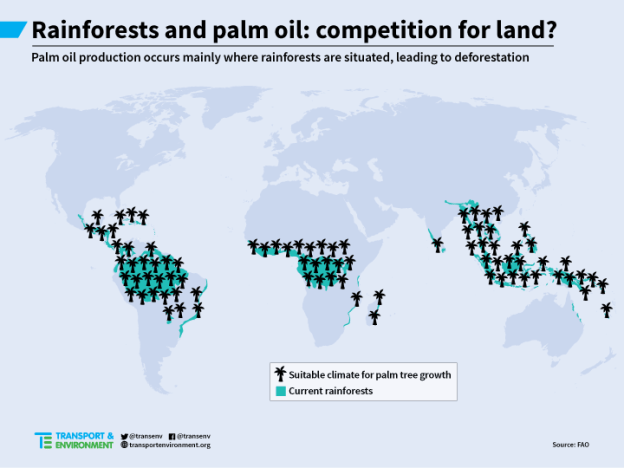
The 2019 report by the Rainforest Foundation Norway RFN is called ‘Destination Deforestation’ and reviewed the role of the aviation industry in contributing to the climate crisis, concluding that there’s a high risk that increased use of palm and soy-based biofuel in planes will lead to increased deforestation.

Finland, the world’s largest producers of renewable diesel and the only EU country that gives additional incentives for the use of palm oil products to manufacture biofuel, could spearhead the race towards deforestation, as areas of rainforest in countries like Indonesia or in South America are cleared to plant crops that will later be used to produce the fuel.  RFN says that meeting the aviation industry’s own climate-change targets to reduce emissions could result in 3.2 million hectares of tropical forest lost, an area larger than Belgium.

Researchers at Rainforest Foundation Norway believe the Finnish incentives for (Palm Fatty Acid Distillate) PFAD-based biofuels are likely to contribute to this deforestation, since Finland’s state-owned oil company Neste produces half of the world’s renewable diesel.  “Finland continues to treat the palm oil by-product PFAD as a waste, eligible for additional incentives. In addition, Finland is home to Neste, the world’s largest producer of hydrotreated biodiesel, and uses PFAD as a raw material. Therefore, Finland’s program could contribute to the massive deforestation discussed in our report” he explains.

With Finland left isolated as the only EU country to pay producers to use waste-classified PFAD in biofuel production, Rainforest Foundation Norway cautions that the country risks becoming a dumping ground for unsustainable raw material….“As long as PFAD is classified as ‘waste’, it enjoys huge incentives from the state. Biofuels made out of PFAD are completely exempt from carbon dioxide tax in Finland. Additionally, PFAD’s emissions can be discounted, and it is not subject to the same sustainability criteria as other raw materials.

With ‘flight shame’ gaining more momentum across the world, the aviation industry is desperate to find ways to make flying compatible with climate goals. While replacing fossil fuels with renewables sounds like a great idea, the sustainability of biofuels is highly dependent on the raw materials used to produce them…The most common aviation biofuels, Hydrogenated Esters and Fatty Acids (HEFA) fuels are produced from vegetable oils and animal fats. While the use of waste oils and other recycled materials is possible, the most viable raw materials for HEFA jet fuels are food crops.  “The cheapest and most readily available raw materials for HEFA jet fuel are palm oil and soy oil, which are closely linked to tropical deforestation” Ranum says.  The experts suggest that aiming to reduce emissions by increasing demand for palm and soy oil is a cure worse than the disease.

Elias Huuhtan, Report: Finland’s push to use biofuel could cause ‘massive deforestation, https://newsnowfinland.fi/ , Oct. 7, 2019

Biofuels Revolution? not really

B]iofuel schemes—ranging from fermenting starch, to recycling cooking oil, to turning algae into jet fuel—have drawn more than $126 billion in investment since 2003, according to Bloomberg New Energy Finance (BNEF), a research outfit… [But]Those biofuels that can best compete commercially are not, in fact, green. Those that are green cannot compete commercially.

The biggest cause of ungreenness is that biofuels made from food crops—or from plants grown on land that might otherwise produce such crops—hurt food supplies. A committee of the European Parliament agreed this week to cap the use of “first-generation” biofuels of this sort. The current European target is for renewables to make up 10% of the energy used in transport by 2020. The new proposal says only seven-tenths of this can come from first-generation fuels. The difference must be made up by more advanced ones based on waste products and other feedstocks that do not impinge on food production. That could mean European demand for advanced biofuels of 14 billion litres by 2020, reckons Claire Curry of BNEF.
Only two such advanced fuels, she thinks, are capable of large-scale production. One is turning waste cooking oil and other fats into diesel—a process for which Europe already has 2 billion litres of capacity. The other involves making ethanol from cellulose by enzymatic hydrolysis. Everything elseis at least four years from commercial production. That includes the much-touted idea of renewable jet fuel.  This is promising on a small scale. South African Airways (SAA), in conjunction with Boeing and other partners, is developing fuel based on the seeds of the tobacco plant—once a big crop in the country, but now fallen on hard times.

Biofuels: Thin harvest, Economist, Apr. 18, 2015, at 72

Biofuels from Agricultural Waste

Ethanol, for instance, is an alcoholic biofuel easily distilled from sugary or starchy plants. It has been used to power cars since Ford’s Model T and, blended into conventional petrol, constitutes about 10% of the fuel burned by America’s vehicles today. Biodiesel made from vegetable fats is similarly mixed (at a lower proportion of 5%) into conventional diesel in Europe. But these “first generation” biofuels have drawbacks. They are made from plants rich in sugar, starch or oil that might otherwise be eaten by people or livestock. Ethanol production already consumes 40% of America’s maize (corn) harvest and a single new ethanol plant in Hull is about to become Britain’s largest buyer of wheat, using 1.1m tonnes a year. Ethanol and biodiesel also have limitations as vehicle fuels, performing poorly in cold weather and capable of damaging unmodified engines.

In an effort to overcome these limitations, dozens of start-up companies emerged over the past decade with the aim of developing second-generation biofuels. They hoped to avoid the “food versus fuel” debate by making fuel from biomass feedstocks with no nutritional value, such as agricultural waste or fast-growing trees and grasses grown on otherwise unproductive land. Other firms planned to make “drop in” biofuels that could replace conventional fossil fuels directly, rather than having to be blended in…..

Even if second-generation processes can be economically scaled up, however, that might in turn highlight a further problem. To make a significant dent in the 2,500m litres of conventional oil that American refineries churn through each day, biofuel factories would have to be able to get hold of a staggering quantity of feedstock. Mr Ghisolfi of Beta Renewables points out that a factory with an annual output of 140m litres needs 350,000 tonnes of biomass a year to operate. “There are only certain areas, in Brazil and some parts of the US and Asia, where you can locate this much biomass within a close radius,” says Mr Ghisolfi. “I am sceptical of scaling to ten times that size, because getting 3.5m tonnes of biomass to a single collection point is going to be a very big undertaking.”

Billions of tonnes of agricultural waste are produced worldwide each year, but such material is thinly spread, making it expensive to collect and transport. Moreover, farms use such waste to condition the soil, feed animals or burn for power. Diverting existing sources of wood to make biofuels will annoy builders and paper-makers, and planting fuel crops on undeveloped land is hardly without controversy: one man’s wasteland is another’s pristine ecosystem. Dozens of environmental groups have protested against the EPA’s recent decision to permit plantations of fast-growing giant reed for biofuels, calling it a noxious and highly invasive weed. Just as the food-versus-fuel argument has proved controversial for today’s biofuels, flora-versus-fuel could be an equally tough struggle for tomorrow’s.

Biofuels: What happened to biofuels?, Economist Technology Quarterly, Sept. 7, 2013