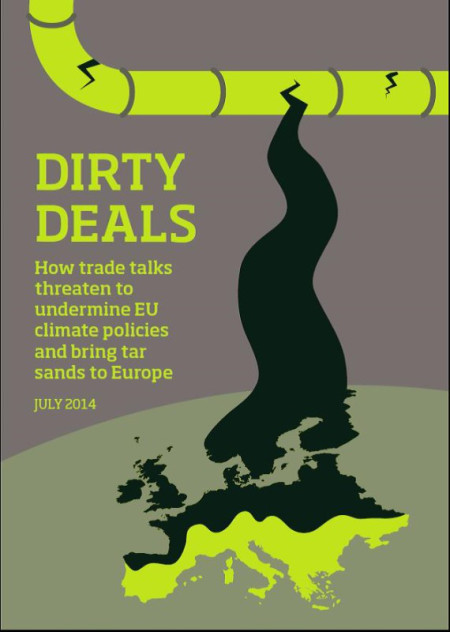
Canada and the US have threatened to pull out of TTIP [Transatlantic Trade and Investment Partnership] trade talks unless the EU ignores the massive emissions of oil from tar sands – and the EU is collapsing under the pressure…For five long years the federal government and the oil industry have lobbied against the European Union labeling oilsands (also called tar sands) bitumen as ‘dirty oil’ in its Fuel Quality Directive (FQD). A new report [authored by environmental groups] reveals the how recent involvement of the US in the lobby offensive to keep the EU market open for bitumen exports has tipped the scales in favour of oilsands proponents….
The report shows the EU Fuel Quality Directive, a piece of legislation designed to reduce global warming greenhouse gas (GHG) emissions in the EU’s transportation sector, is unlikely to acknowledge fuels from different sources of oil – conventional oil, oilsands, oil shale – have different carbon footprints. All oil is the same – no matter how great the disparity in emissions Instead all oils will more than likely be treated as having the same GHG emissions intensity ‘value’ in the Directive. This is exactly what Canada, the oil industry and now the US have been pushing for…
The EU has not fallen for the federal government’s argument that bitumen produces only marginally more GHG emissions than conventional oil in extraction, processing, and use. A European Commission study found bitumen’s carbon footprint is between 12% – 40% higher than conventional oil as so much of the bitumen produced from the tar sands is burnt to fuel the energy-intensive extraction process. The report reveals trade, not science, is the cause of the EU backing off from implementing the Fuel Quality Directive as it was originally meant to be implemented.
The US in some ways has been more open [than Canada] about its lobbying against the Fuel Quality Directive. US Trade Representative Michael Froman confirmed he “raised these issues [of the FQD implementation] with senior Commission officials on several occasions, including in the context of the Transatlantic Trade and Investment Partnerships (TTIP).” The TTIP is the highly controversial trade agreement between the US and the EU currently under negotiation. European Commission documents obtained by Friends of the Earth Europe reveal the US trade missions has “substantive concerns” with the Fuel Quality Directive singling out fuels produced from bitumen as having a higher carbon footprint than conventional oil. Like Canada and the oil industry, the US wants all oil – regardless of GHG emissions – to be treated the same as conventional oil in the Directive…Recently eleven members of US Congress sent a letter to the US trade mission expressing their concerns “that official US trade negotiations could undercut the EU’s commendable efforts to reduce carbon pollution.”
Excerpts, Derek LeahyIgnore tar sands emissions! EU buckles under US, Canada pressure in TTIP talks, Ecologist, July 23, 2014
 Law-In-Action