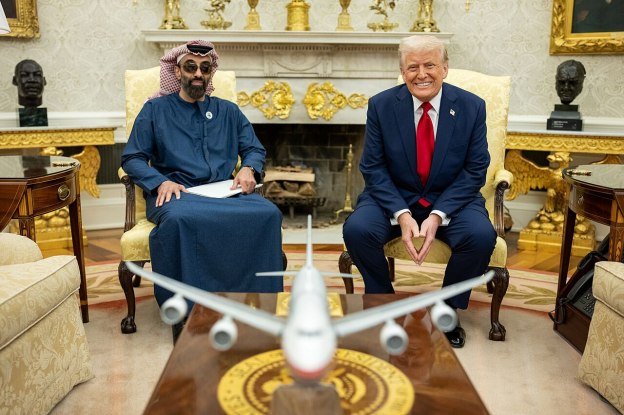
Four days before Donald Trump’s inauguration in 2025, lieutenants to an Abu Dhabi royal secretly signed a deal with the Trump family to purchase a 49% stake in their fledgling cryptocurrency venture World Liberty Financial for half a billion dollars… The buyers would pay half up front, steering $187 million to Trump family entities..
The investment was backed by Sheikh Tahnoon bin Zayed Al Nahyan, an Abu Dhabi royal who has been pushing the U.S. for access to tightly guarded artificial intelligence chips… Tahnoon—sometimes referred to as the “spy sheikh”—is brother to the United Arab Emirates’ president, the government’s national security adviser, as well as the leader of the oil-rich country’s largest wealth fund. He oversees a more than $1.3 trillion empire funded by his personal fortune and state money that spans from fish farms to AI to surveillance, making him one of the most powerful single investors in the world. The deal marked something unprecedented in American politics: a foreign government official taking a major ownership stake in an incoming U.S. president’s company.
Under the Biden administration, Tahnoon’s efforts to get AI hardware had been largely stymied over fears that the sensitive technology could be diverted to China. Of particular concern was one of Tahnoon’s own companies, the AI firm G42, which had stoked alarm among intelligence officials and lawmakers over its close ties to the sanctioned tech giant Huawei and other Chinese firms…
In 2025, the Trump administration decided to supply UAE with access to around 500,000 of the most advanced AI chips a year—enough to build one of the world’s biggest AI data center clusters. The framework agreement called for roughly one-fifth of the chips to go to G42…
The agreement was widely viewed as a coup for the emirate’s ruling family, overcoming longstanding U.S. national security concerns …Proponents hailed the deal for unlocking a flood of investment into the U.S. and for helping entrench American technology as the global standard….What wasn’t publicly known: Tahnoon’s emissaries had signed the deal to purchase 49% of World Liberty Financial cryptocurrency firm controlled by the Trump family.
Excerpt from Sam Kessler et al., Spy Sheikh’ Bought Secret Stake in Trump Company, WSJ, Jan. 31, 2026
 Law-In-Action