Senior members of Hamas’s leadership in exile met in Doha, Qatar, earlier in February 2024 amid concerns that its fighters were getting mauled by an Israeli offensive in the Gaza Strip. Enemy troops were killing dozens of militants each day as they methodically overran Hamas strongholds. Then a courier arrived with a message from Yahya Sinwar, the head of Hamas in Gaza, saying, in effect: Don’t worry, we have the Israelis right where we want them. Hamas’s fighters, the Al-Qassam Brigades, were doing fine, the upbeat message said. The militants were ready for Israel’s expected assault on Rafah, a city on Gaza’s southern edge. High civilian casualties would add to the worldwide pressure on Israel to stop the war, Sinwar’s message said, according to people informed about the meeting…
Hamas fighters are now trying to avoid large firefights and instead use small-scale ambushes—using tools ranging from rocket-propelled grenades to recorded voices of hostages to lure Israeli troops into traps. The ambushes have little chance of holding territory against Israel’s armored maneuvers. But they’re tailored to Hamas’s limited capabilities…Many in Israel’s military, from senior commanders to ordinary soldiers who spoke to The Wall Street Journal, worry that their accumulation of tactical wins on the battlefield might not add up to a lasting strategic victory. After nearly five months of intense fighting, Israel is still far from its declared war aim of eliminating Hamas as a significant military and political entity. “Fighting the enemy is like a game of whack-a-mole,” said an Israeli reservist in Khan Younis with the 98th Division….
Degrading Hamas’s capabilities is a realistic goal for Israel’s military, said Hussein Ibish, a scholar at the Arab Gulf States Institute, a think tank in Washington. But sustaining it would require fully occupying Gaza, which would give Hamas a target for a never-ending insurgency, he said. “Recent history shows that you can be an effective insurgency on a shoestring,” said Ibish. “Anyone can make an IED,” or homemade bomb, he said. “It’s easy to get a pistol. If you’re willing to die, you can kill soldiers.”
Hamas… has shifted to hit-and-run attacks by tiny groups of two or three men, sometimes just one individual….Other Hamas ambushes use so-called sticky bombs, improvised explosives that attach themselves to Israeli armored vehicles with magnets or duct tape.…Hamas also tries to kill Israeli troops by putting booby traps in buildings throughout Gaza, many Israeli soldiers say. Booby traps have been widely found in the homes of Hamas operatives, but also in many civilians’ homes, Israeli soldiers said. Early on the explosives were placed around the buildings’ entrances. The Israelis soon stopped using the front door, instead blasting or bulldozing their way through the walls of a house. Hamas has adapted, placing explosive traps in items inside buildings, from gas storage balloons to children’s’ toys, Israeli soldiers said….In other cases, Hamas used voice recordings of hostages begging for help in Hebrew to try to draw soldiers into an ambush…
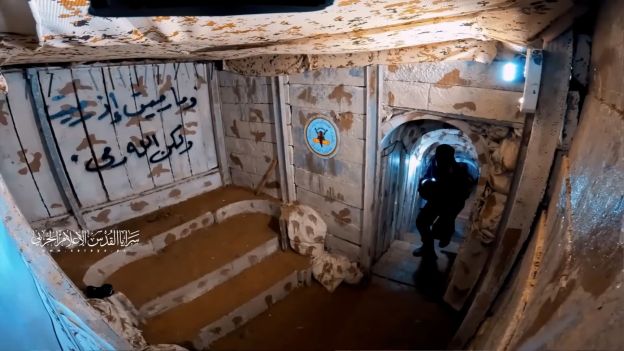
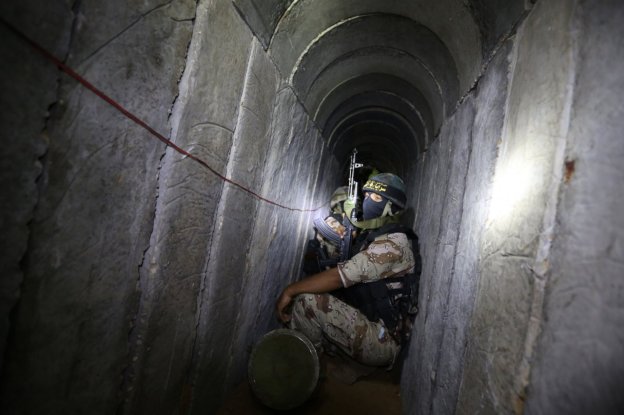
The Israelis have made only partial progress in finding and destroying Hamas’s vast tunnel network. Israeli officials now estimate that Hamas built around 350 miles of tunnels under Gaza, which is less than 30 miles long and up to 8 miles wide. There are thought to be several hundred tunnels under Khan Younis alone, which occupies an area roughly the size of the Bronx in New York…Hamas uses the tunnels as military headquarters, to maneuver across the enclave’s cities, protect its leaders, hide Israeli and other hostages, manufacture weapons and conduct hit-and-run attacks. The tunnels also contain a fixed-line phone system that Hamas used to communicate earlier in the war, along with walkie-talkies, burner SIMs and satellite phones. But with Israel hacking into those systems, the militants have increasingly shifted to using runners to convey verbal or written messages.
The Israeli army has found no systematic solution for finding and destroying Hamas’s tunnels, many soldiers said. Tunnel entrances have been found in homes, schools, mosques, courtyards, streets and farm fields. Some are covered by steel doors, others by mattresses in a home. Israeli forces have mostly relied on drones and robots to search tunnels, only sending soldiers in later to avoid firefights in the narrow passages.
Excepts from Marcus Walker, Why Hamas Thinks it Still Could Win the War, WSJ, Feb.29, 2024

 Law-In-Action