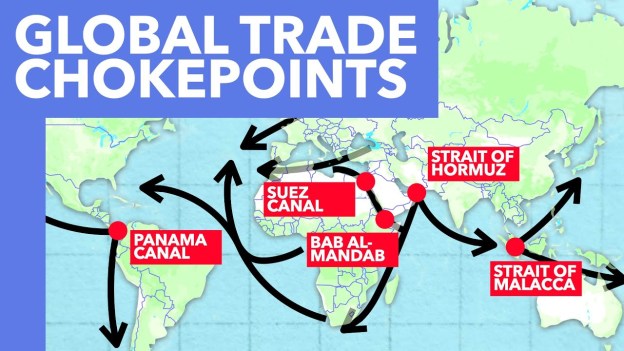
In exploiting the economic pinch-point off its coast, the strait of Hormuz, Iran is following a trail blazed by the U.S. and China, which for years have used their dominance in key areas of global commerce to pursue their foreign-policy goals…Officials and analysts say the goal is “strategic indispensability”—building deterrence by mutually assured economic destruction. “In order to have that deterrence, in order to say ‘don’t cut off what we need,’ you need to be able to say ‘I can cut off what you need,’ ” said Andrew Capistrano, a visiting research fellow at the Institute of Geoeconomics, a Tokyo-based think tank…
Larger economies can exploit pressure points that flow from their heft in the global economy. The U.S. has long used the dollar-based financial system to sanction individuals, businesses and governments. It has also used America’s grip on semiconductor technology to stymie China’s military and put the brake on Beijing’s ambitions to leapfrog the U.S. as the world’s biggest and most advanced economy.
China exercises its economic might through its near-total control of rare earths. Beijing used the supply chain of these minerals, which are critical in the manufacture of everything from jet fighters to smartphones, as leverage to pressure U.S. industries and win relief on trade and tariffs from Trump…To build deterrence, “you need to get other people hooked on your supply. You need to be part of this interconnected web of the global economy in order to have a seat at the table of power,” said Emily Benson, head of strategy at the advisory firm Minerva Technology Futures.
Excerpt from Jason Douglas, Iran Shows You Don’t Have to Be a Superpower to Wage Economic Warfare, WSJ, Apr. 9, 2026

