Tag Archives: dollar dependence

Hook Them On. Then Cut Them Off

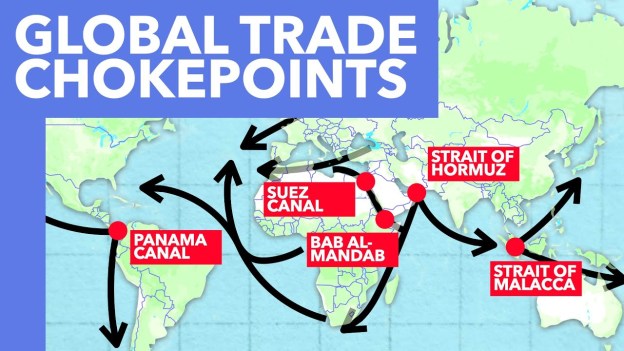
In exploiting the economic pinch-point off its coast, the strait of Hormuz, Iran is following a trail blazed by the U.S. and China, which for years have used their dominance in key areas of global commerce to pursue their foreign-policy goals…Officials and analysts say the goal is “strategic indispensability”—building deterrence by mutually assured economic destruction. “In order to have that deterrence, in order to say ‘don’t cut off what we need,’ you need to be able to say ‘I can cut off what you need,’ ” said Andrew Capistrano, a visiting research fellow at the Institute of Geoeconomics, a Tokyo-based think tank…

Larger economies can exploit pressure points that flow from their heft in the global economy. The U.S. has long used the dollar-based financial system to sanction individuals, businesses and governments. It has also used America’s grip on semiconductor technology to stymie China’s military and put the brake on Beijing’s ambitions to leapfrog the U.S. as the world’s biggest and most advanced economy.

China exercises its economic might through its near-total control of rare earths. Beijing used the supply chain of these minerals, which are critical in the manufacture of everything from jet fighters to smartphones, as leverage to pressure U.S. industries and win relief on trade and tariffs from Trump…To build deterrence, “you need to get other people hooked on your supply. You need to be part of this interconnected web of the global economy in order to have a seat at the table of power,” said Emily Benson, head of strategy at the advisory firm Minerva Technology Futures.

Excerpt from Jason Douglas, Iran Shows You Don’t Have to Be a Superpower to Wage Economic Warfare, WSJ, Apr. 9, 2026

What Eats Alive the Global Banks of China

Eight years after Chinese leader Xi Jinping and his counterparts from Brazil, Russia, India and South Africa established the New Development Bank, with headquarters in Shanghai, it has all but stopped making new loans and is having trouble raising dollar funds to repay its debts…The New Development Bank is the lesser-known of two China-based multilateral lenders. Its larger cousin, the Asian Infrastructure Investment Bank (AIIB), in June 2023 landed in the middle of a public-relations crisis after a disgruntled executive accused it of being controlled by members of China’s Communist Party

Trouble at both banks, as well as at China’s giant Belt and Road infrastructure push, which has seen China spend $1 trillion to expand its influence across Asia, Africa and Latin America, spotlights growing difficulties for Beijing’s strategy to rearrange an international order it considers biased in favor of the West.  Both the AIIB and the New Development Bank were set up in large part to reduce developing countries’ dependence on dollar-based funding—alternatives to the International Monetary Fund that would help finance development in some of the world’s fastest-growing economies. 

The AIIB operates on a much larger scale than the New Development Bank, counting many Western countries such as the U.K. and Canada among its more than 100 members. The bank found itself in a political firestorm this week after its Canadian communications chief resigned and accused the bank’s management of being “dominated by the Communist Party,” allegations that the AIIB called baseless. Nonetheless, Canada’s government said it would halt all activity with the bank while it reviews the allegations, and the bank said it would conduct an internal review.

Meanwhile, the New Development Bank is fighting for its very survival, threatened by its own reliance on the U.S. currency. Two-thirds of the bank’s borrowings are dollar-denominated—hardly in line with the bank’s stated aim to break its members’ reliance on the dollar. 

Soon after Russian troops marched into Ukraine in February 2022, the bank froze all new lending to Russia to assure investors that it was complying with Western sanctions. However, Wall Street quickly became wary of lending to a bank nearly 20% owned by Russia. Xi’s deepening alignment with Russian President Vladimir Putin was another deterrent. Since then, the bank has had to take on increasingly expensive debt to service old borrowings and stay current with its own liquidity requirements. To bolster its resources, the bank is in talks with Saudi Arabia, Argentina and Honduras about becoming members…

Excerpts from Alexander Saeedy and Lingling Wei, A Bank China Built to Challenge the Dollar Now Needs the Dollar,  WSJ, June 17, 2023