Tag Archives: anti-submarine warfare

Who is Ready for the Future Global War?

The Economist magazine estimates that the new defense commitments of all countries …will generate over $200bn-$700bn in extra defense spending globally each year…
China’s defense budget has grown by about 75% in real terms in the past ten years. It wants to “basically complete modernization” of its forces by 2035, and become a “world class” military power by 2049. America thinks China wants the capability to invade Taiwan as early as 2027… Overall America’s advantage over its rivals has eroded in the past century…During the first, second and cold wars America’s adversaries had much smaller economies than America did. No longer. Today China’s GDP alone is nearly 80% of America’s.

In the decades after the cold war, the thinking was that to spend less on armies meant to spend more on infrastructure and public services and to lower debt or taxes. Since the 1960s the world has “released” about $4trn a year of spending at current prices in this way, equivalent to the global government budget for education. Now the peace dividend is turning into a “war tax”. How heavy will it be?…

America, by far the world’s largest defense spender, is devoting growing sums to research and development of future weapons. This includes hypersonic missiles, to catch up with China and Russia; “directed energy” such as powerful lasers to shoot down drones and missiles; and artificial intelligence and robotics. It is also buying as many munitions as its factories can produce—from 155mm artillery shells to anti-ship missiles. The war in Ukraine has exposed the extraordinary quantities of munitions needed in a conflict, as well as the inability of peacetime production lines to meet such demand.

America, Russia and China are investing in their nuclear arsenals, too. America is upgrading all legs of its “triad” of ground-, air- and submarine-launched nukes. Russia is working on esoteric weapons, such as the long-distance, nuclear-powered Poseidon torpedo designed to set off an underwater nuclear explosion that, propagandists boast, can cause destructive tidal waves. China is quickly expanding its arsenal, from several hundred warheads to 1,500 by 2035, according to the Pentagon…

Cyber-security, drones and satellite technology straddle both the civilian and military worlds. SpaceX, founded by Elon Musk, has launched American military satellites. Ukrainian warriors make extensive use of his Starlink constellation of satellites. It all amounts to a change of cultural mindset from tech firms that once shunned defense as morally tainted. A defense-tech ecosystem has sprung up in America…

One way or another, a new era of rearmament beckons. As General Mark Milley, chairman of America’s joint chiefs of staff, told the Senate recently: “Preventing great-power war through readiness and deterrence is very expensive, but not as expensive as fighting a war.” And the only thing more costly than that, as he explained, is losing one.

Excerpts from Farewell peace dividend: The Cost of the Global Arms Race, Economist, May 27, 2023 
Stopping the Unstoppable: undersea nuclear torpedoes

On July 20th 1960, a missile popped out of an apparently empty Atlantic ocean. Its solid-fuel rocket fired just as it cleared the surface and it tore off into the sky. Hours later, a second missile followed. An officer on the ballistic-missile submarine USS George Washington sent a message to President Dwight Eisenhower: “POLARIS—FROM OUT OF THE DEEP TO TARGET. PERFECT.” America had just completed its first successful missile launch of an intercontinental ballistic missile (ICBM) from beneath the ocean. Less than two months later, Russia conducted a similar test in the White Sea, north of Archangel.

Those tests began a new phase in the cold war. Having ICBMs on effectively invisible launchers meant that neither side could destroy the other’s nuclear arsenal in a single attack. So by keeping safe the capacity for retaliatory second strikes, the introduction of ballistic-missile submarines helped develop the concept of “mutually assured destruction” (MAD), thereby deterring any form of nuclear first strike. America, Britain, China, France and Russia all have nuclear-powered submarines on permanent or near permanent patrol, capable of launching nuclear missiles; India has one such submarine, too, and Israel is believed to have nuclear missiles on conventionally powered submarines.

As well as menacing the world at large, submarines pose a much more specific threat to other countries’ navies; most military subs are attack boats rather than missile platforms. This makes anti-submarine warfare (ASW) a high priority for anyone who wants to keep their surface ships on the surface. Because such warfare depends on interpreting lots of data from different sources—sonar arrays on ships, sonar buoys dropped from aircraft, passive listening systems on the sea-floor—technology which allows new types of sensor and new ways of communicating could greatly increase its possibilities. “There’s an unmanned-systems explosion,” says Jim Galambos of DARPA, the Pentagon’s future-technology arm. Up until now, he says, submariners could be fairly sure of their hiding place, operating “alone and unafraid”. That is changing.

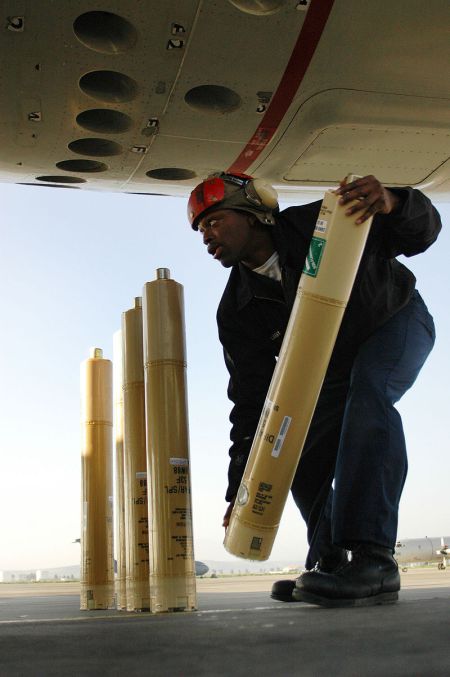
Aircraft play a big role in today’s ASW, flying from ships or shore to drop “sonobuoys” in patterns calculated to have the best chance of spotting something. This is expensive. An aeroplane with 8-10 people in it throws buoys out and waits around to listen to them and process their data on board. “In future you can envision a pair of AUVs [autonomous underwater vehicles], one deploying and one loitering and listening,” says Fred Cotaras of Ultra Electronics, a sonobuoy maker. Cheaper deployment means more buoys.

But more data is not that helpful if you do not have ways of moving it around, or of knowing where exactly it comes from. That is why DARPA is working on a Positioning System for Deep Ocean Navigation (POSYDON) which aims to provide “omnipresent, robust positioning across ocean basins” just as GPS satellites do above water, says Lisa Zurk, who heads up the programme. The system will use a natural feature of the ocean known as the “deep sound channel”. The speed of sound in water depends on temperature, pressure and, to some extent, salinity. The deep sound channel is found at the depth where these factors provide the lowest speed of sound. Below it, higher pressure makes the sound faster; above it, warmer water has the same effect…

Even in heavily surveilled seas, spotting submarines will remain tricky. They are already quiet, and getting quieter; new “air-independent propulsion” systems mean that conventionally powered submarines can now turn off their diesel engines and run as quietly as nuclear ones, perhaps even more so, for extended periods of time. Greater autonomy, and thus fewer humans—or none at all—could make submarines quieter still.

A case in point is a Russian weapon called Status-6, also known as Kanyon, about which Vladimir Putin boasted in a speech on March 1st, 2018. America’s recent nuclear-posture review describes it as “a new intercontinental, nuclear-armed, nuclear-powered, undersea autonomous torpedo”. A Russian state television broadcast in 2015 appeared to show it as a long, thin AUV that can be launched from a modified submarine and travel thousands of kilometres to explode off the shore of a major city with a great deal more energy than the largest warheads on ICBMs, thus generating a radioactive tsunami. Such a system might be seen as preserving a second-strike capability even if the target had a missile-defence system capable of shooting ICBMs out of the sky…

One part of the ocean that has become particularly interesting in this regard is the Arctic. Tracking submarines under or near ice is difficult, because ice constantly shifts, crackles and groans loudly enough to mask the subtle sounds of a submarine. With ever less ice in the Arctic this is becoming less of a problem, meaning America should be better able to track Russian submarines through its Assured Arctic Awareness programme…

Greater numbers of better sensors, better networked, will not soon make submarines useless; but even without breakthroughs, they could erode the strategic norm that has guided nuclear thinking for over half a century—that of an unstoppable second strike.

Excerpts from Mutually assured detection, Economist, Mar. 10, 2018

The Sea Hunter Drone

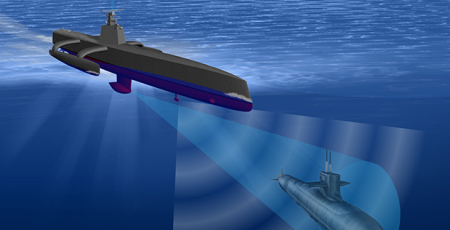
The Anti-Submarine Warfare (ASW) Continuous Trail Unmanned Vessel (ACTUV) is developing an unmanned vessel optimized to robustly track quiet diesel electric submarines. … capable of missions spanning thousands of kilometers of range and months of endurance under a sparse remote supervisory control model. This includes…autonomous interactions with an intelligent adversary.
Excerpts from Anti-Submarine Warfare (ASW) Continuous Trail Unmanned Vessel (ASW Continuous Trail Unmanned Vessel (ACTUV))