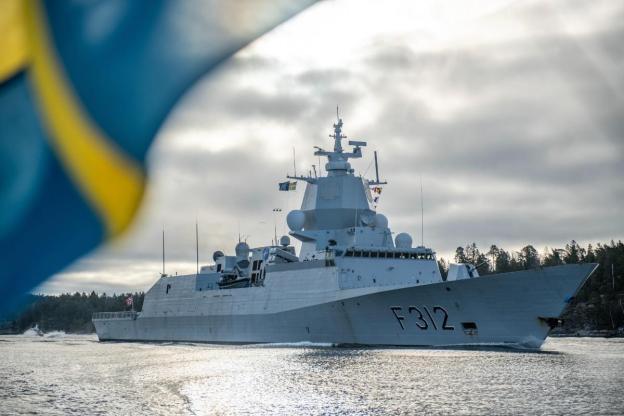
In January 2025, NATO launched the operation, dubbed Baltic Sentry, after a string of undersea cables and pipelines were damaged by ships—many with links to Russia—that had dragged their anchors. “We are functioning as security cameras at sea,” said Kockx, the Belgian commander, whose usual duty is clearing unexploded mines from the busy waterway… New undersea drones are keeping a watchful eye on pipes and cables. NATO surveillance planes from the U.S., France, Germany and occasionally the U.K. take turns scanning the seaway from high above. NATO has also strengthened its military presence on the Baltic…NATO’s goal is to prevent more damage to subsea infrastructure and respond faster if something occurs…
The Baltic, a central theater in two world wars, is littered with wrecks and explosives that still pose danger. Surrounding NATO members are world leaders in finding and disposing of sea mines, officials say….Commercial traffic on the Baltic ranks among the world’s densest, with more than 1,500 ships plying its waves on any day, so policing it all is difficult. Further complicating NATO’s sentry duty initially was a lack of comprehensive information about all the critical infrastructure snaking across the sea’s muddy bottom. Details of pipes and cables have traditionally been kept by national governments or private companies. Nobody had a picture of everything...NATO’s new undersea infrastructure center in 2024 assembled the first unified map of the Baltic’s floor.
Excerpt from Daniel Michaels, How NATO Patrols the Sea for Suspected Russian Sabotage, Mar. 31, 2025
The North Atlantic Treaty Organization (NATO) mounted its first coordinated response to the suspected sabotage campaign against critical infrastructure, after another underwater data cable was severed in the Baltic Sea in 2025. NATO vessels raced to the site of a damaged fiber-optic cable in Swedish waters on January 26, 2025 where a trio of ships carrying Russian cargo, including one recently sanctioned by the U.S., were nearby. All three vessels are now being investigated as part of a probe into suspected sabotage of the fiber optic cable.
The incident is the latest in a string of alleged underwater attacks in the region that prompted NATO to announce earlier this month the formation of a surveillance mission called Baltic Sentry. It includes regular naval patrols, as well as enhanced drone, satellite and electronic surveillance of Baltic areas that are crisscrossed by critical infrastructure such as data and power cables, along with gas pipelines and offshore wind farms…Under international maritime law, a ship in international waters is under the jurisdiction of the country of its registration and can be boarded by foreign enforcement officials only with explicit permission of its owner or flag country. The captain of the Pskov, one of the ships suspected to have cut the undersea cables, cited the international law of the sea when he argued against an official request to steer his ship into a port in Finland…
In December 2024, Finland detained a vessel called Eagle S, an oil tanker belonging to Russia’s shadow fleet that is registered in the Cook Islands, on suspicion that it had deliberately used its anchor to cut a power cable connecting Finland and Estonia. In a midnight raid, Finnish special forces dropped from a helicopter onto the deck of Eagle S and captured the ship and its crew, which have since been detained in a Finnish port.
In November 2024, an investigation was launched against a Chinese bulk carrier called Yi Peng 3, which cut two data cables in the Baltic after dragging its anchor for several hours, according to investigators. The vessel was loaded with Russian fertilizer. The probe continues.
Excerpt from Bojan Pancevski, Suspected Sabotage of Deep-Sea Cable Triggers First NATO-Led Response, WSJ, Jan. 27, 2025
U.S. officials are privately delivering an unusual warning to telecommunications companies: Undersea cables that ferry internet traffic across the Pacific Ocean could be vulnerable to tampering by Chinese repair ships. State Department officials said a state-controlled Chinese company that helps repair international cables, S.B. Submarine Systems (SSB), appeared to be hiding its vessels’ locations from radio and satellite tracking services, which the officials and others said defied easy explanation.
The warnings highlight an overlooked security risk to undersea fiber-optic cables, according to these officials: Silicon Valley giants, such as Google and Meta Platforms, partially own many cables and are investing in more. But they rely on specialized construction and repair companies, including some with foreign ownership that U.S. officials fear could endanger the security of commercial and military data.
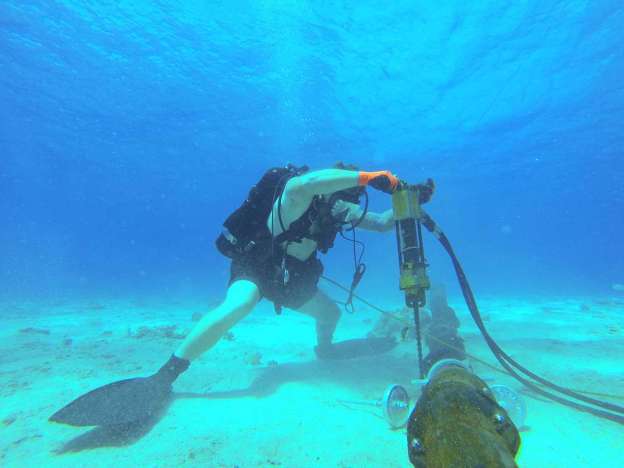
Hundreds of thousands of miles of underwater fiber-optic cables carry almost all the world’s international internet traffic. Dozens of lines lace the Pacific Ocean floor, shuttling data between the Americas, Asia and many island chains. SBSS is part of a regional consortium of companies that provides ships to fix undersea cables, including some belonging to major U.S. companies, by winching them to the surface, resplicing broken fibers that carry internet data and returning the lines to the sea floor… Underwater cables are vulnerable to tampering when they are brought to the surface for repairs, U.S. officials say. Tapping global data flows is still far easier on land, industry experts say. But at-sea repair could still offer an opportunity to install a device to remotely disable a cable or to study the technology in advanced signal repeaters installed by other companies.
SBSS was formed in 1995 as a Chinese-British joint venture. State-owned China Telecom has long held 51% of the business and is in the process of buying the remainder from U.K.-based Global Marine Systems, according to people familiar with the matter. A member of the Chinese Communist Party serves on the SBSS management team, according to the company’s website.
Safeguarding underwater cables has been a focus of U.S. national-security officials since the Cold War, when fears of Soviet espionage were paramount. In the 1970s, the U.S. secretly placed wiretaps on underwater Soviet lines in an intelligence coup known as Operation Ivy Bells….
SubCom, a U.S. cable ship company owned by private-equity giant Cerberus Capital Management, receives $10 million in annual U.S. government payments for participating in the Cable Security Fleet, a program partly overseen by the Pentagon…
Overall, cable owners have few choices with regard to repairing damaged undersea cables, as most repairing is done by an aging fleet of roughly 50 ships around the world…
Excerpts from U.S. Fears Undersea Cables Are Vulnerable to Espionage From Chinese Repair Ships, WSJ, May 19, 2024
On October 12, 2022 Vladimir Putin, Russia’s president, gave an ominous warning. Energy infrastructure around the world was now “at risk”, he said. Mr Putin’s warning came a month after explosions tore through Nord Stream 1 and 2, a pair of gas pipelines running from Russia to Europe under the Baltic Sea. The pipes were not in use at the time. But the ruptures left plumes of methane bubbling to the surface for days…
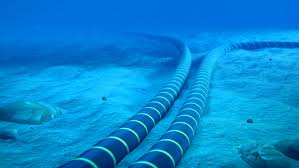
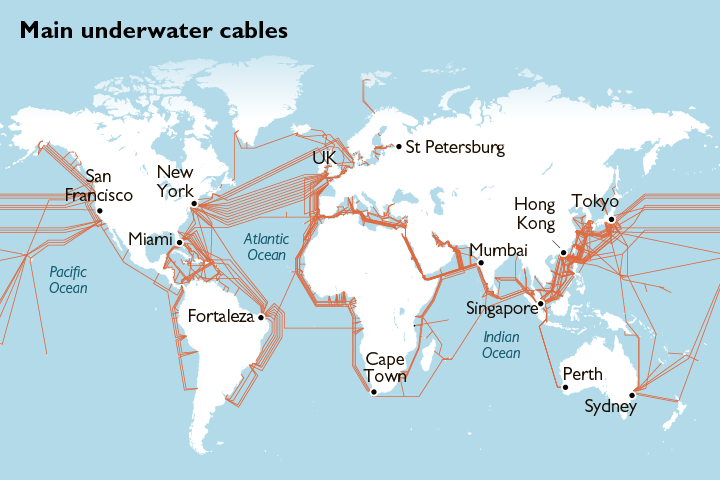
Subsea pipelines and cables have proliferated since the first one was laid, in 1850…There are more than 530 active or planned submarine telecoms cables around the world. Spanning over 1.3m kilometers they carry 95% of the world’s internet traffic. In November 2021, cables serving underwater acoustic sensors off the coast of northern Norway—an area frequented by Russian submarines—were cut.
Western officials say that a particular source of concern is Russia’s Main Directorate of Deep-Sea Research, known by its Russian acronym GUGI. It has a variety of spy ships and specialist submarines—most notably the Belgorod, the world’s biggest submarine, commissioned in July 2022—which can work in unusually deep water. They can deploy divers, mini-submarines or underwater drones, which could be used to cut cables.
Cable chicanery, though, is not a Russian invention. One of Britain’s first acts during the first world war was to tear up German telecoms cables laid across the Atlantic. Germany responded with attacks on Allied cables in the Pacific and Indian Oceans.
More recently, espionage has been the order of the day..I.n 2013 Edward Snowden, a contractor for the National Security Agency (NSA), America’s signals intelligence agency, revealed an Anglo-American project had tapped at least 200 fiber-optic cables around the world. Yet the seabed is not amenable to control. A paper published in 2021 noted that Estonia and other Baltic states had only a limited grasp of what was going on under the Baltic because of quirks of hydrology, scarce surveillance platforms and limited information-sharing between countries. It concluded, perhaps presciently: “It would be difficult to prevent Russian [drones] deployed in international waters from damaging critical undersea infrastructure.”…
The first step in a sabotage mission is finding the target. With big, heavy pipelines, which are typically made from concrete-lined metal sections, that is relatively easy. Older communication cables, being smaller and lighter, can shift with the currents. Newer ones are often buried, It is also increasingly possible for operators to detect tampering, through “distributed fiber-optic sensing”, which can detect vibrations in the cable or changes in its temperature. But that will not reveal whether the problem is a geological event or an inquisitive drone—or which country might have sent it. Underwater attribution is slow and difficult.
Determined attackers, in other words, are likely to get through. The effects of a successful attack will differ. Pipelines and subsea electricity cables are few in number. If one is blown up, gas, oil or electricity cannot easily be rerouted through another. Communication cables are different. The internet was designed to allow data to flow through alternative paths if one is blocked. And at least when it comes to connections between big countries, plenty of alternatives exist. At least 18 communication cables link America and Europe…There is significant redundancy on these routes. But “There’s no collective institution that records all the incidents that are going on, and what is behind them—we don’t have any statistics behind it.” according to Elisabeth Braw of the American Enterprise Institute.
Excerpts from Sabotage at Sea: Underwater Infrastructure, Economist, Oct. 22, 2022
In January 2022, the head of the UK’s armed forces has warned that Russia submarine activity is threatening underwater cables that are crucial to communication systems around the world. Admiral Sir Tony Radakin said undersea cables that transmit internet data are ‘the world’s real information system,’ and added that any attempt to damage then could be considered an act of war.
The internet seems like a post- physical environment where things like viral posts, virtual goods and metaverse concerts just sort of happen. But creating that illusion requires a truly gargantuan—and quickly-growing—web of physical connections. Fiber-optic cable, which carries 95% of the world’s international internet traffic, links up pretty much all of the world’s data centers…
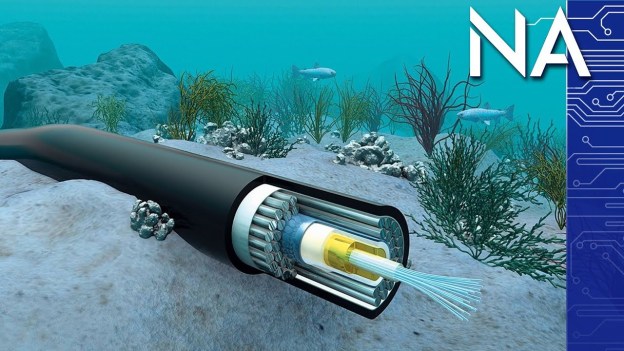
Where those fiber-optic connections link up countries across the oceans, they consist almost entirely of cables running underwater—some 1.3 million kilometers (or more than 800,000 miles) of bundled glass threads that make up the actual, physical international internet. And until recently, the overwhelming majority of the undersea fiber-optic cable being installed was controlled and used by telecommunications companies and governments. Today, that’s no longer the case.
In less than a decade, four tech giants— Microsoft, Google parent Alphabet, Meta (formerly Facebook ) and Amazon —have become by far the dominant users of undersea-cable capacity. Before 2012, the share of the world’s undersea fiber-optic capacity being used by those companies was less than 10%. Today, that figure is about 66%. In the next three years, they are on track to become primary financiers and owners of the web of undersea internet cables connecting the richest and most bandwidth-hungry countries on the shores of both the Atlantic and the Pacific.
By 2024, the four are projected to collectively have an ownership stake in more than 30 long-distance undersea cables, each up to thousands of miles long, connecting every continent on the globe save Antarctica. In 2010, these companies had an ownership stake in only one such cable—the Unity cable partly owned by Google, connecting Japan and the U.S. Traditional telecom companies have responded with suspicion and even hostility to tech companies’ increasingly rapacious demand for the world’s bandwidth. Industry analysts have raised concerns about whether we want the world’s most powerful providers of internet services and marketplaces to also own the infrastructure on which they are all delivered. This concern is understandable. Imagine if Amazon owned the roads on which it delivers packages.
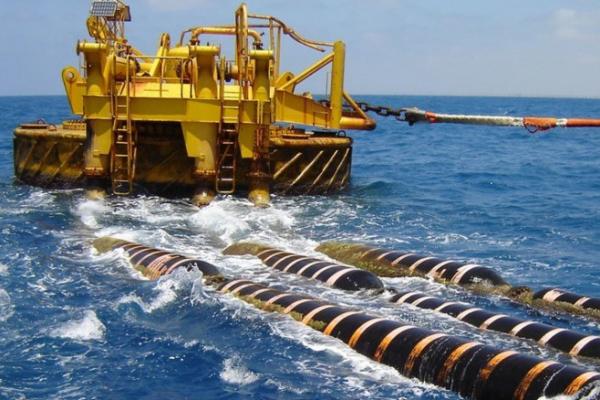
But the involvement of these companies in the cable-laying industry also has driven down the cost of transmitting data across oceans for everyone, even their competitors….Undersea cables can cost hundreds of millions of dollars each. Installing and maintaining them requires a small fleet of ships, from surveying vessels to specialized cable-laying ships that deploy all manner of rugged undersea technology to bury cables beneath the seabed. At times they must lay the relatively fragile cable—at some points as thin as a garden hose—at depths of up to 4 miles.
All of this must be done while maintaining the right amount of tension in the cables, and avoiding hazards as varied as undersea mountains, oil-and-gas pipelines, high-voltage transmission lines for offshore wind farms, and even shipwrecks and unexploded bombs…In the past, trans-oceanic cable-laying often required the resources of governments and their national telecom companies. That’s all but pocket change to today’s tech titans. Combined, Microsoft, Alphabet, Meta and Amazon poured more than $90 billion into capital expenditures in 2020 alone…
Most of these Big Tech-funded cables are collaborations among rivals. The Marea cable, for example, which stretches approximately 4,100 miles between Virginia Beach in the U.S. and Bilbao, Spain, was completed in 2017 and is partly owned by Microsoft, Meta and Telxius, a subsidiary of Telefónica, the Spanish telecom. Sharing bandwidth among competitors helps ensure that each company has capacity on more cables, redundancy that is essential for keeping the world’s internet humming when a cable is severed or damaged. That happens around 200 times a year, according to the International Cable Protection Committee, a nonprofit group.
There is an exception to big tech companies collaborating with rivals on the underwater infrastructure of the internet. Google, alone among big tech companies, is already the sole owner of three different undersea cables…
Excerpts from Christopher Mims, Google, Amazon, Meta and Microsoft Weave a Fiber-Optic Web of Power, WSJ, Jan. 15, 2022
Facebook said it would back two new underwater cable projects—one in Africa and another in Asia in collaboration with Alphabet — that aim to give the Silicon Valley giants greater control of the global internet infrastructure that their businesses rely on.
The 2Africa project, a partnership between Facebook and several international telecom operators, said that it would add four new branches: the Seychelles, Comoro Islands, Angola and Nigeria. The project’s overall plan calls for 35 landings in 26 countries, with the goal of building an underwater ring of fiber-optic cables around Africa. It aims to begin operating in 2023… Separately, Facebook that it would participate in a 7,500-mile-long underwater cable system in Asia, called Apricot, that would connect Japan, Taiwan, Guam, the Philippines, Indonesia and Singapore. Google said that it would also join the initiative, which is scheduled to go live in 2024.
Driving the investments are costs and control. More than 400 commercially operated underwater cables, also known as submarine cables, carry almost all international voice and data traffic, making them critical for the economies and national security of most countries…Telecom companies own and operate many of these cables, charging fees to businesses that use them to ferry data. Facebook and Google used so much bandwidth that they decided about a decade ago that it would make sense to cut out the middleman and own some infrastructure directly.
Excerpts from Stu Woo, Facebook Backs Underwater Cable Projects to Boost Internet Connectivity, WSJ, Aug. 17, 2021
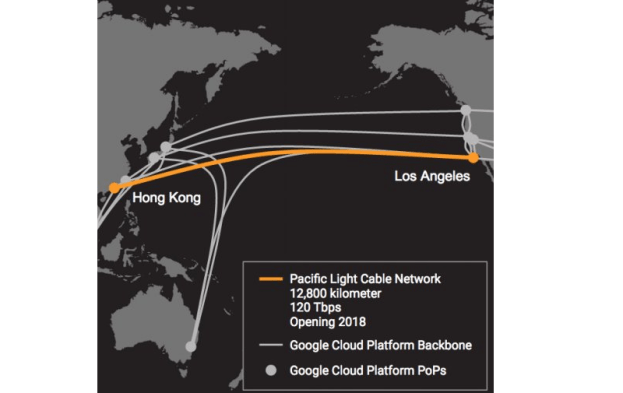
United States officials granted Google permission to turn on a high-speed internet link to Taiwan but not to the Chinese territory of Hong Kong, citing national-security concerns in a ruling that underscores fraying ties between Washington and Beijing.“There is a significant risk that the grant of a direct cable connection between the United States and Hong Kong would “pose an unacceptable risk to the national security and law enforcement interests of the United States,” the U.S. Department of Justice said in its decision, which was backed by the departments of Homeland Security and Defense. The agencies instead urged the Federal Communications Commission to grant Google owner Alphabet permission to start using the portion of its 8,000-mile underwater Pacific Light cable that connects California to Taiwan. .
The decision threatens to end Hong Kong’s dominance as a top destination for U.S. internet cables and puts at risk several ongoing projects, including a Facebook backed fiber-optic line linking Los Angeles to Hong Kong and a Google-backed project linking Hong Kong to the U.S. territory of Guam.
Washington is turning to the self-ruling island of Taiwan, which the U.S. supports with arms sales and unofficial political ties despite Beijing’s claims that it is part of China. U.S. officials are also considering alternatives such as Indonesia, Philippines, Thailand, and Vietnam.
Google and Facebook originally teamed up to build Pacific Light to Hong Kong in 2016, continuing the Silicon Valley giants’ long-term strategy to take more control of the network pipes that connect their data centers. The web companies and their Chinese investment partners kept building the cable even as U.S. authorities withheld the regulatory approvals they needed to start using it.
Major international data projects are subject to review by Team Telecom, a coalition of federal agencies with national-security oversight. The panel has taken a hard line against China in recent years. Team Telecom in 2018 recommended for the first time the denial of a Chinese application—that of China Mobile —to provide telecom services through U.S. networks, citing national-security and law-enforcement concerns.
President Trump on April 4 2020 signed an executive order that puts the attorney general in charge of overseeing Team Telecom and gives the panel direct authority to review existing licenses to provide such services, including those issued earlier to Chinese state-owned operators China Telecom and China Unicom.
Excerpts from Drew FitzGerald and Kate O’Keeffe, U.S. Allows Google Internet Project to Advance Only if Hong Kong Is Cut Out, WSJ, Apr. 9, 2020
A new front has opened in the battle between the U.S. and China over control of global networks that deliver the internet. This one is beneath the ocean. While the U.S. wages a high-profile campaign to exclude China’s Huawei Technologies Co. from next-generation mobile networks over fears of espionage, the company is embedding itself into undersea cable networks that ferry nearly all of the world’s internet data.
About 380 active submarine cables—bundles of fiber-optic lines that travel oceans on the seabed—carry about 95% of intercontinental voice and data traffic, making them critical for the economies and national security of most countries.
The Huawei Marine’s Undersea Cable Network majority owned by Huawei Technologies, has worked on some 90 projects to build or upgrade submarine cables around the world…US o fficials say the company’s knowledge of and access to undersea cables could allow China to attach devices that divert or monitor data traffic—or, in a conflict, to sever links to entire nations. Such interference could be done remotely, via Huawei network management software and other equipment at coastal landing stations, where submarine cables join land-based networks, these officials say.
Huawei Marine said in an email that no customer, industry player or government has directly raised security concerns about its products and operations.Joe Kelly, a Huawei spokesman, said the company is privately owned and has never been asked by any government to do anything that would jeopardize its customers or business. “If asked to do so,” he said, “we would refuse.”
The U.S. has sought to block Huawei from its own telecom infrastructure, including undersea cables, since at least 2012. American concerns about subsea links have since deepened—and spread to allies—as China moves to erode U.S. dominance of the world’s internet infrastructure…..Undersea cables are owned mainly by telecom operators and, in recent years, by such content providers as Facebook and Google. Smaller players rent bandwidth.Most users can’t control which cable systems carry their data between continents. A handful of switches typically route traffic along the path considered best, based on available capacity and agreements between cable operators.
In June 2017, Nick Warner, then head of Australia’s Secret Intelligence Service, traveled to the Solomon Islands, a strategically located South Pacific archipelago. His mission, according to people familiar with the visit, was to block a 2016 deal with Huawei Marine to build a 2,500-mile cable connecting Sydney to the Solomons. Mr. Warner told the Solomons’ prime minister the deal would give China a connection to Australia’s internet grid through a Sydney landing point, creating a cyber risk, these people said. Australia later announced it would finance the cable link and steered the contract to an Australian company. In another recent clash, the U.S., Australia and Japan tried unsuccessfully in September 2018 to quash an undersea-cable deal between Huawei Marine and Papua New Guinea.
U.S. and allied officials point to China’s record of cyber intrusions, growing Communist Party influence inside Chinese firms and a recent Chinese law requiring companies to assist intelligence operations. Landing stations are more exposed in poorer countries where cyber defenses tend to be weakest, U.S. and allied officials said. And network management systems are generally operated using computer servers at risk of cyber intrusion. Undersea cables are vulnerable, officials said, because large segments lie in international waters, where physical tampering can go undetected. At least one U.S. submarine can hack into seabed cables, defense experts said. In 2013, former National Security Agency contractor Edward Snowden alleged that Britain and the U.S. monitored submarine cable data. The U.S. and its allies now fear such tactics could be used against them. American and British military commanders warned recently that Russian submarines were operating near undersea cables. In 2018, the U.S. sanctioned a Russian company for supplying Russian spies with diving equipment to help tap seabed cables.
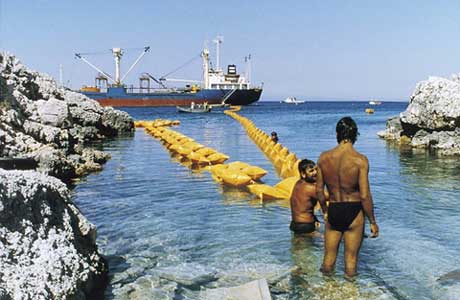
The Ionian Sea Submarine Cable Project (Greece)
China seeks to build a Digital Silk Road, including undersea cables, terrestrial and satellite links, as part of its Belt and Road plan to finance a new global infrastructure network. Chinese government strategy papers on the Digital Silk Road cite the importance of undersea cables, as well as Huawei’s role in them. A research institute attached to China’s Ministry of Industry and Information Technology, in a paper published in September, praised Huawei’s technical prowess in undersea cable transmission and said China was poised to become “one of the world’s most important international submarine cable communication centers within a decade or two.” China’s foreign and technology ministries didn’t respond to requests for comment…
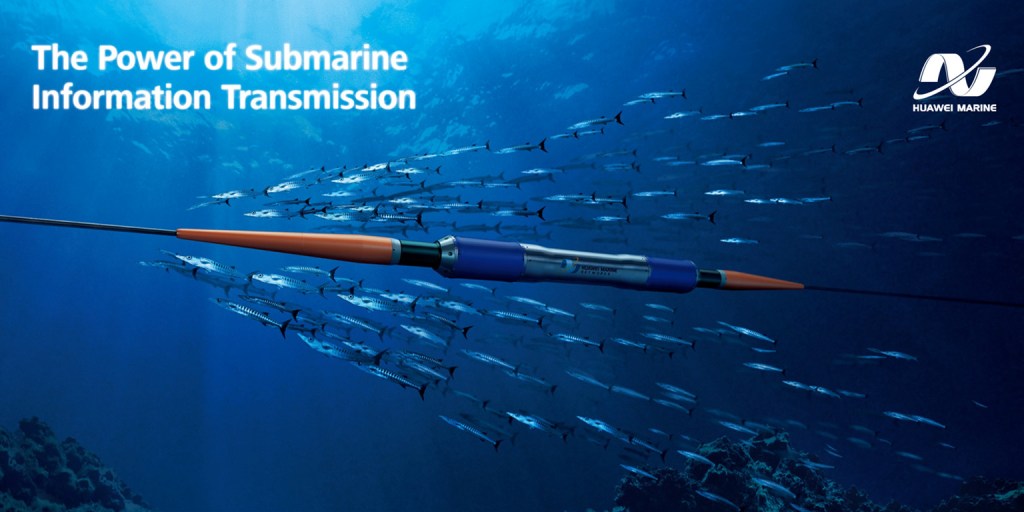
Huawei Marine Networks
Bjarni Thorvardarson, then chief executive of the cable’s Ireland-based operator, said U.S. authorities raised no objections until 2012, when a congressional report declared Huawei Technologies a national security threat. Mr. Thorvardarson wasn’t convinced. “It was camouflaged as a security risk, but it was mostly about a preference for using U.S. technology,” he said. Under pressure, Mr. Thorvardarson dropped Huawei Marine from Project Express in 2013. The older cable network continued to use Huawei equipment.
The company is now the fourth-biggest player in an industry long dominated by U.S.-based SubCom and Finnish-owned Alcatel Submarine Networks. Japan’s NEC Corp is in third place.Huawei Marine is expected to complete 28 cables between 2015 and 2020—nearly a quarter of all those built globally—and it has upgraded many more, according to TeleGeography, a research company.
Excerpts from America’s Undersea Battle With China for Control of the Global Internet Grid , WSJ, Mar. 12, 2019
 Law-In-Action