Tag Archives: Dead Sea

Red-Dead: water crisis in the Middle East

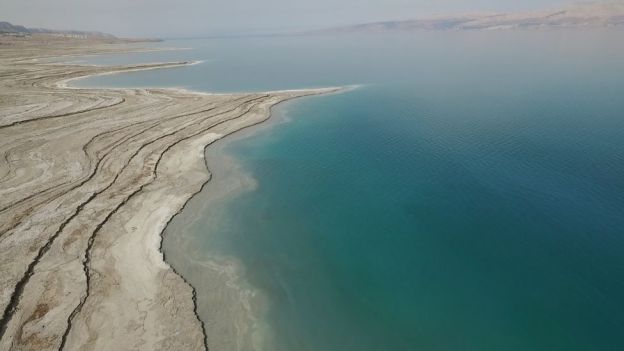
The Dead Sea is dying. Half a century ago its hyper-salty, super-pungent waters stretched 80km from north to south. That has shrunk to just 48km at its longest point. The water level is falling by more than a meter per year. All but a trickle from its source, the Jordan River, is now used up before it reaches the sea. “It will never disappear, because it has underground supplies, but it will be like a small pond in a very big hole,” says Munqeth Mehyar of EcoPeace, an NGO.

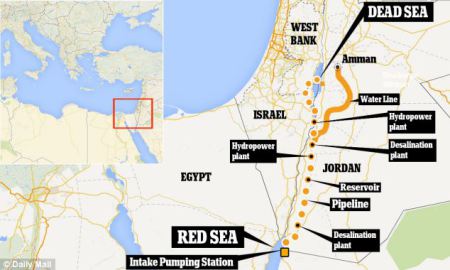
Until the summer of 2017 Israel and Jordan, which share the sea, were trying to slow the decline. The “Red-Dead project”, as it is called, would desalinate seawater at the Jordanian port of Aqaba and pump 200m cubic metres of leftover brine into the Dead Sea each year. That would not be enough to stabilise the sea, which needs at least 800m cubic metres to stay at current levels. Still, it would help—and the project has a much more important benefit.

The World Bank defines water scarcity as less than 1,000 cubic metres per person annually. Jordan can provide less than 15% of that. The Aqaba plant would send fresh water to southern towns in both Jordan and Israel. In return for its share, Israel agreed to pump an equal amount to parched northern Jordan, where most of the population lives.

But the project was now on hold due a dispute between Jordan and Israel. On July 23rd, 2017 a Jordanian teenager delivering furniture to the Israeli embassy stabbed a security guard. The guard opened fire, killing both his assailant and an innocent bystander….

Jordan is already one of the world’s most arid countries. Climate change will make matters worse. By the end of the century, say scientists from Stanford University, Jordan could be 4°C hotter, with about a third less rain. It needs to rationalise water consumption. And Israel, which wants a stable neighbour to its east, has an interest in getting water projects back on track.

Excerpts from Jordan’s Water Crisis: Diplomatic Drought: Economist, Dec. 2, 2017
Salt Lakes of the World


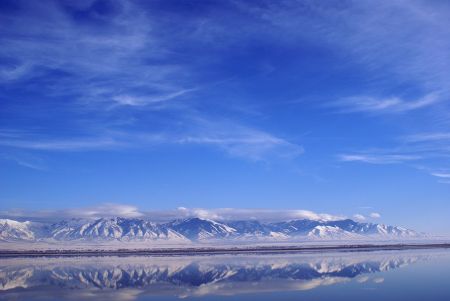
Utah Great Salt Lake has shrunk to a depth of about 14 feet—nearly half its former average since it was settled by the Mormons 170 years ago. Under a controversial engineering plan, the lake would recede even further….State engineers want to siphon off some of the river water that flows into the lake and use it for the Salt Lake City area’s booming population. Proponents say the plan, which calls for lapping up a fifth of Bear River’s current unused flow, is essential for meeting the region’s needs.

But critics note that the diversion would cause the lake to drop by almost a foot, according to state estimates, eventually exposing 30 square miles of lake bed and potentially worsening the dust storms that regularly blanket the region and ruining a fragile wetlands habitat.

The debate echoes concerns heard in many other arid parts of the world. Salt lake ecology is especially delicate and requires a certain amount of fresh water to maintain a saline balance. Brine shrimp, for instance, could die off if the water becomes too salty.

In the Middle East, diversion of the Jordan and other rivers that feed the Dead Sea has shriveled the famous body of saltwater and its once robust tourism. The Aral Sea between Kazakhstan and Uzbekistan has shrunk to about 10% of its original size after diversions.

Critics, including environmental groups and affected businesses, say that under the new diversion plan lake-dependent businesses such as brine shrimp fishing would suffer, as would farmers whose land could be inundated upstream if existing dams are raised to retain more water. In all, the lake accounts for an estimated $1.3 billion in annual economic output, according to Utah State University, much of it from the shrimping industry, as well as mineral extraction and tourism.

The plan would also destroy wetlands along the lake shoreline that provide food and habitat for an estimated eight million birds, said Zach Frankel, executive director of Utah Rivers Council, an environmental group opposed to the project.

But proponents say the diversion of up to 72 billion gallons of water—enough to meet the needs of a city of one million for a year—is needed to forestall anticipated shortages for one of the fastest-growing regions in the country….“If Utah continues to grow, it’s not a matter of if but when we are going to need more water,” said state Sen. Stuart Adams, the Republican majority whip, who sponsored a bill to begin funding the estimated $1.5 billion project.

Excerpt from Utah Searches for Water Solution, Wall Street Journal, Sept. 14, 2017

Water Sharing Agreement – Middle East

Drained by farms along its banks, the River Jordan is barely a trickle by the time it dribbles into the Dead Sea, and most of that is sewage coming out of Jerusalem and West Bank settlements. Israeli and Jordanian factories also use the water to recover potash.So fast are the Dead Sea’s briny waters shrinking that it has already shed its southern half. Much of the seabed is now as crusty as the pillar of salt that Lot’s wife turned into after fleeing Gomorrah. Hotels built on the shores in the 1980s have a cliff-top view today. Arthritic pensioners keen on the sea’s therapeutic powers are reduced to swimming in saline hotel pools. By 2050, say Friends of the Earth, a conservation group, the sea will be little more than a pond the size of two football fields.

After years of regional squabbling, Israeli, Jordanian and Palestinian ministers signed a deal ( a Memorandum of Understanding)* on December 9th, 2013 to slow desiccation. Backed by the World Bank, they plan to build a desalination plant on the Red Sea and pipe the run-off 180km (112 miles) north to the Dead Sea.  Some see advantages in diluting the Dead Sea’s nose-twitchingly sulphurous tides with ocean water. But there are drawbacks. Mucky algae might spread, turning the sea red. “It’s playing with an entire ecosystem,” says Mira Edelstein of Friends of the Earth.

The Dead Sea: Emptying out, Economist, Dec. 14, 2013, at 58

*The MoU outlines in broad language three major regional water sharing initiatives that will be pursued over the coming months by the cooperating parties. These initiatives include the development of a desalination plant in Aqaba at the head of the Red Sea, where the water produced will be shared between Israel and Jordan; increased releases of water by Israel from Lake Tiberias for use in Jordan; and the sale of about 20-30 million m3/year of desalinated water from Mekorot (the Israeli water utility) to the Palestinian Water Authority for use in the West Bank. In addition, a pipeline from the desalination plant at Aqaba would convey brine to the Dead Sea to study the effects of mixing the brine with Dead Sea water. In order to proceed with these actions, especially the desalination plant at Aqaba, technical work and studies will need to be undertaken.  See World Bank