Tag Archives: Ideal Innovations biometrics company

How Much Are Your Eyes Worth? Altman has an answer

Worldcoin is appealing a decision from Spain that temporarily banned it from scanning people’s eyes in exchange for cryptocurrency tokens…The Spanish Data Protection Agency, or AEPD, ordered a precautionary measure prohibiting Worldcoin’s activities in the country for up to three months after it received several complaints on the collection of data from minors, and what it said were other infringements.

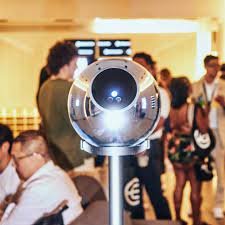
Worldcoin operates as an open-source protocol, according to its website. Users download a wallet app that supports a digital identity known as World ID. To get their identity verified, users stand in front of a physical imaging device known as the orb that relies on sensors to scan their eyes “to verify humanness and uniqueness.” More than 4 million users across 120 countries signed up for World ID, with orb verifications taking place in 36 countries, according to Worldcoin’s website.

The AEPD said its precautionary measure effectively called on Tools for Humanity—the company of which OpenAI Chief Executive Sam Altman is a co-founder—to cease the collection and processing of personal data through its Worldcoin project and to stop using the data it had gathered so far in Spain.

Excerpts from  Mauro Orru, Sam Altman’s Eye-Scanning Worldcoin Venture Appeals, WSJ, Mar. 7, 2024
Biometrics Run Amok: Your Heartbeat ID, please

Before pulling the trigger, a sniper planning to assassinate an enemy operative must be sure the right person is in the cross-hairs. Western forces commonly use software that compares a suspect’s facial features or gait with those recorded in libraries of biometric data compiled by police and intelligence agencies. Such technology can, however, be foiled by a disguise, head-covering or even an affected limp. For this reason America’s Special Operations Command (SOC), which oversees the units responsible for such operations in the various arms of America’s forces, has long wanted extra ways to confirm a potential target’s identity. Responding to a request from soc, the Combating Terrorism Technical Support Office (CTTSO), an agency of the defence department, has now developed a new tool for the job.

This system, dubbed Jetson, is able to measure, from up to 200 metres away, the minute vibrations induced in clothing by someone’s heartbeat. Since hearts differ in both shape and contraction pattern, the details of heartbeats differ, too. The effect of this on the fabric of garments produces what Ideal Innovations, a firm involved in the Jetson project, calls a “heartprint”—a pattern reckoned sufficiently distinctive to confirm someone’s identity.

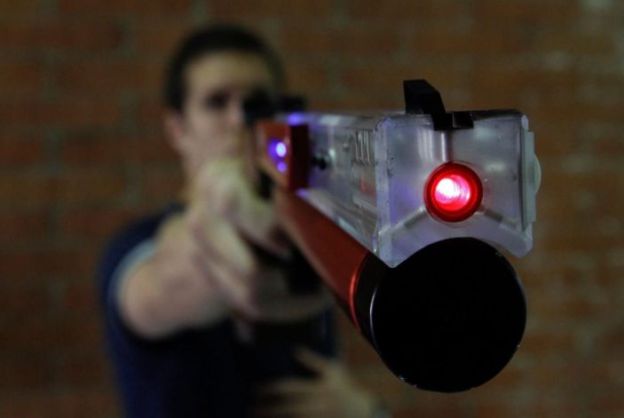
To measure heartprints remotely Jetson employs gadgets called laser vibrometers. These work by detecting minute variations in a laser beam that has been reflected off an object of interest. They have been used for decades to study things like bridges, aircraft bodies, warship cannons and wind turbines—searching for otherwise-invisible cracks, air pockets and other dangerous defects in materials. However, only in the past five years or so has laser vibrometry become good enough to distinguish the vibrations induced in fabric by heartprints….

Candice Tresch, a spokeswoman for the cttso…. cannot discuss the process by which heartprint libraries might be built up in the first place. One starting point, presumably, would be to catalogue the heartbeats of detainees in the way that fingerprints and dna samples are now taken routinely.

Excerpts from Personal identificationPeople can now be identified at a distance by their heartbeat, Economist, Jan 23, 2020