Tag Archives: Montreal Protocol

Hunting Down Polluters: Repairing the Ozone Layer

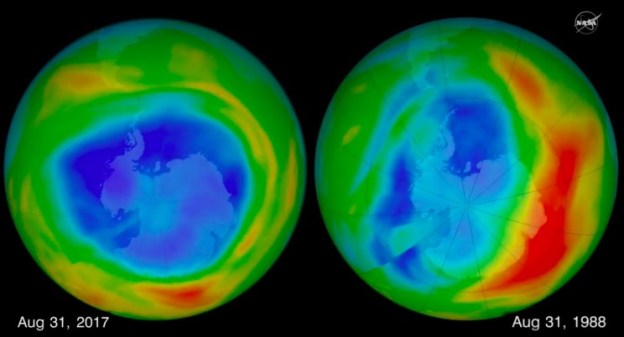
CFC-11 is also known as trichlorofluoromethane, and is one of a number of chloroflurocarbon (CFC) chemicals that were initially developed as refrigerants during the 1930s. However, it took many decades for scientists to discover that when CFCs break down in the atmosphere, they release chlorine atoms that are able to rapidly destroy the ozone layer which protects us from ultraviolet light. A gaping hole in the ozone layer over Antarctica was discovered in the mid 1980s.  The international community agreed the Montreal Protocol in 1987, which banned most of the offending chemicals. Recent research suggests that the hole in the Northern Hemisphere could be fully fixed by the 2030s and Antarctica by the 2060s.

CFC-11 was the second most abundant CFCs and was initially seen to be declining as expected.However in 2018 a team of researchers monitoring the atmosphere found that the rate of decline had slowed by about 50% after 2012.  Further detective work in China by the Environmental Investigation Agency in 2018 seemed to indicate that the country was indeed the source. They found that the illegal chemical was used in the majority of the polyurethane insulation produced by firms they contacted.One seller of CFC-11 estimated that 70% of China’s domestic sales used the illegal gas. The reason was quite simple – CFC-11 is better quality and much cheaper than the alternatives.

This new paper seems to confirm beyond any reasonable doubt that some 40-60% of the increase in emissions is coming from provinces in eastern China.  Using what are termed “top-down” measurements from air monitoring stations in South Korea and Japan, the researchers were able to show that since 2012 CFC-11 has increased from production sites in eastern China.They calculated that there was a 110% rise in emissions from these parts of China for the years 2014-2017 compared to the period between 2008-2012.

“If we look at these extra emissions that we’ve identified from eastern China, it equates to about 35 million tonnes of CO2 being emitted into the atmosphere every year, that’s equivalent to about 10% of UK emissions, or similar to the whole of London.”  The Chinese say they have already started to clamp down on production by what they term “rogue manufacturers”. In  November 2018, several suspects were arrested in Henan province, in possession of 30 tonnes of CFC-11.

Excerpts from Matt McGrath,  Ozone layer: Banned CFCs traced to China say scientists, BBC, May 22, 2019
Ozone Layer Recovery Success

The study, “Scientific Assessment of Ozone Depletion: 2018”, is the latest in a series of reports, released every four years, which monitor the recovery of ozone in the stratosphere, a layer that protects life on Earth from harmful layers of ultraviolet rays from the sun.  It shows that the concentration of ozone-depleting substances continues to decrease, leading to an improvement in the layer since the previous assessment carried out in 2014.

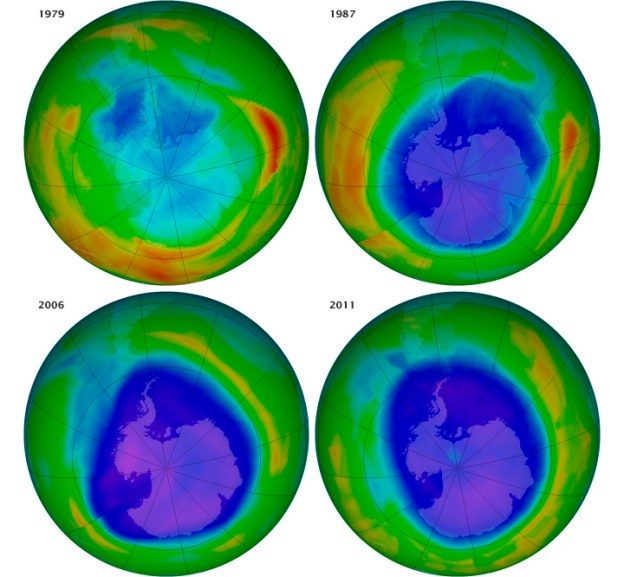
Ozone in parts of the stratosphere has recovered at a rate of 1-3 percent since 2000 and, at projected rates, Northern Hemisphere and mid-latitude ozone is scheduled to heal completely by the 2030s, followed by the Southern Hemisphere in the 2050s and polar regions by 2060.

This is due to internationally agreed actions carried out under the historic Montreal Protocol, which came into being over 30 years ago in response to the revelation that chlorofluorocarbons (CFCs) and other ozone-depleting substances – used in aerosols, cooling and refrigeration systems, and many other items – were tearing a hole in the ozone layer and allowing dangerous ultraviolet radiation to flood through.

Next year, the Protocol is set to be strengthened with the ratification of the Kigali Amendment, which calls for the future use of powerful climate-warming gases in refrigerators, air conditioners and related products to be slashed…The writers of the report found that, if the Kigali Amendment is fully implemented, the world can avoid up to 0.4 percent of global warming this century, meaning that it will play a major role in keeping the global temperature rise below 2°C.

Excerpts from Healing of ozone layer gives hope for climate action: UN report, UN News, Nov. 5, 2018

Ozone Layer at 2016

In 1974 scientists discovered that chlorofluorocarbons (CFCs), chemicals used in refrigeration and as propellants in products such as hairsprays, release chlorine into the stratosphere as they decompose. This depletes the ozone that protects Earth from ultraviolet radiation. CFCs are also powerful greenhouse gases, which absorb solar radiation reflected back from the planet’s surface and so trap heat in the atmosphere.

Initially, the consequences for the ozone layer caused most concern. In 1985 a gaping hole in it was found above Antarctica. Two years later, leaders from around the world acted decisively. They signed a deal, the Montreal protocol, to phase out CFCs. Now ratified by 197 countries, it has prevented the equivalent of more than 135 billion tonnes of carbon-dioxide emissions, and averted complete collapse of the ozone layer by the middle of the century. Instead, by that point the ozone hole may even have closed up….

In order to manage without CFCs, firms replaced them in applications such as refrigeration, air-conditioning and insulation with man-made hydrofluorocarbons (HFCs). These substances do not deplete ozone and last in the atmosphere for just a short time. However, they still contribute hugely to global warming.  The average atmospheric lifetime for most commercially used HFCs is 15 years or less; carbon dioxide can stay in the atmosphere for more than 500 years. But, like CFCs, HFCs cause a greenhouse effect between hundreds and thousands of times as powerful as carbon dioxide while they linger. Total emissions are still relatively low, but are rising by 7-15% a year. Controlling HFC emissions has been under discussion for the past decade; America and China, the world’s two biggest polluters, made a deal on the issue in 2013, which paved the way for co-operation on limiting carbon emissions ahead of UN-sponsored climate talks in Paris last year. There leaders agreed to keep warming “well below” levels expected to be catastrophic.

Average global temperatures are already 1°C higher than in pre-industrial times….America wants action on HFCs speedy enough that emissions will peak in 2021 and then start to fall; after recent talks in Hangzhou between Mr Obama and Mr Xi China may be ready to commit to reaching that point by 2023. Brazil, Indonesia and Malaysia lean towards 2025, and India has lobbied for a later date, closer to 2030.

Some sectors firms are already preparing to move away from HFCs: in 2015 the Consumer Goods Forum, an international industry group whose members include Walmart and Tesco, began enacting a plan to phase out the substances.

A big question is what to use instead….Some HFCs commonly used in refrigeration could be replaced by others that would have an impact more than 1,000 times smaller. Honeywell, an electronics giant, already makes these less-damaging alternatives. But patents covering such substances have been a sticking point in past discussions, says Achim Steiner, until recently the head of the UN Environment Programme….Other possible replacements include isobutane, propane and propylene, all of which occur naturally. These hydrocarbons are cheap and non-toxic, and can be used as coolants without the same harm to the ozone layer….

Excerpts from The Montreal protocol, Economist, Sept. 24, 2016,at 58