
Tag Archives: nuclear test French Polynesia

Back to 2030: Nuclear Race is Hot Again

The new nuclear race has begun. But unlike during the Cold War, the U.S. must prepare for two peer rivals rather than one—at a time when it has lost its clear industrial and economic edge. China, which long possessed just a small nuclear force, is catching up fast, while Russia is developing a variety of new-generation systems aimed at American cities…Russian President Vladimir Putin has already used nuclear saber-rattling to throttle American support for Ukraine. He has deployed nuclear weapons to Belarus and, in 2025, tested a nuclear-powered missile and a nuclear-powered submarine drone that he claims are impervious to American defenses.

While Russia and the U.S. are still abiding by some arms-controls limit…China, unconstrained by any commitments, is quietly but rapidly leaping ahead. According to American estimates, Beijing will reach rough parity with the U.S. in deployed nuclear warheads by the mid-2030s.

Chinese leader Xi Jinping for the first time showcased China’s nuclear triad—its land, sea and air-launched ballistic nuclear missiles—at a Beijing parade honoring the 80th anniversary of victory over Japan in September 2025. Putin, sitting to his right atop the Gate of Heavenly Peace, took note. So did North Korea’s Kim Jong Un, sitting to his left.

Excerpt from Yaroslav Trofimov, The Nuclear-Arms Race Is Now a Three-Way Contest, WSJ, Nov. 16, 2025
Who’s Not Giving a Damn about Nuclear Fallout

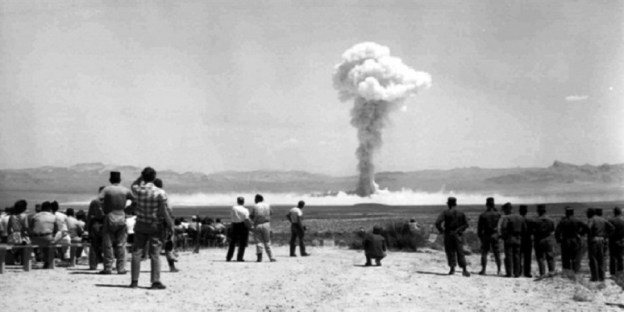
On May 1st 1962, French officials in Algeria told Algerians to leave their homes in the southern city of Tamanrasset. It was just a precaution. France was about to detonate an atom bomb, known as Beryl, in the desert some 150km away. The blast would be contained underground. Two French ministers were there to witness the test. But things did not go as planned. The underground shaft at the blast site was not properly sealed. The mountain (Taourirt Tan Afella) above the site cracked and black smoke spread everywhere. The ministers (and everyone else nearby) ran as radioactive particles leaked into the air. Nevertheless, in the months and years after, locals would go to the area to recover scrap metal from the blast for use in their homes.

France carried out 17 nuclear tests in Algeria between 1960 and 1966. Many took place after Algeria’s independence from France in 1962, under an agreement between the two countries. There are no good data on the effects of the explosions on public health and the environment, but locals note that some people living near the test sites have suffered cancers and birth defects typically caused by radiation. The sites, say activists, are still contaminated.

Taourirt is a group dedicated to identifying the location of nuclear waste left by France. All that exists in the public domain is an inventory of the contaminated materials buried somewhere in the desert. (The known test sites are poorly secured by the Algerian government.) Others are pressing France to clean up the sites and compensate victims. There has been some progress in this direction, but not enough, say activists.

In 2010 the French parliament passed the Morin law, which is meant to compensate those with health problems resulting from exposure to the nuclear tests. (France carried out nearly 200 tests in French Polynesia, too.) But the law only pertains to certain illnesses and requires claimants to show they were living near the tests when they took place. This is difficult enough for Algerians who worked for the French armed forces: few had formal contracts. It is almost impossible for anyone else. Only a small fraction of the claims filed have come from Algeria.

Excerpts from Algeria and France: Lingering Fallout, Economist, June 26, 2021