Tag Archives: OPEC and the United States

Who Terrifies an American President?

Though tensions between Iran and the U.S. have ratcheted up since the Oct. 7, 2024 attacks on Israel by Tehran-backed Hamas, exports from Iran surpassed 1.5 million barrels a day in 2024 starting in February, substantially more than at the start of the Biden presidency. Most of that oil is bought by small Chinese refineries at discounted prices. The U.S. and its allies have been “very, very careful not to go too far and damage the ability of Western economies to function,” when it comes to sanctions, said John Smith, partner at Morrison Foerster and former head of the U.S. Treasury Department’s Office of Foreign Assets Control.

U.S. diplomats and energy officials have for decades worked around the globe to keep oil flowing, often involving uncomfortable alliances and accommodations. When the Treasury department hit Moscow with a wave of sanctions on June 12, 2024 over the Ukraine war, it targeted banks but left the country’s oil industry largely untouched. There is frustration among some staffers in the U.S. Treasury Department over the lack of action against oil-trading networks that ferry Russian and Iranian oil, including one that officials are currently investigating, according to U.S. diplomats and some of the energy-industry players briefed by current officials. The network is operated by a little-known trader from Azerbaijan who emerged as the premier middleman for Russia’s Rosneft Oil, The Wall Street Journal reported.

When the Treasury imposed sanctions on Russia’s state tanker owner, Sovcomflot, it also issued licenses exempting all but 14 of the company’s fleet, which data provider Kpler estimates totals 91 ships. Industry players said the exemption licenses were a green light to oil traders to do business with those ships, minimizing the risk that they would be targeted by future sanctions. The National Economic Council, led by Lael Brainard, and others within the administration worried that broader measures would lead to logistical problems in the oil market and boost inflation, said people familiar with the matter. Rising oil output from sanctioned countries is one reason crude prices have fallen from their highs earlier this year, analysts said…

In another example of the collision of foreign and energy policies, earlier this year, Washington asked Ukraine to stop attacking some Russian refineries with drones after the damage rattled global diesel and gasoline markets….

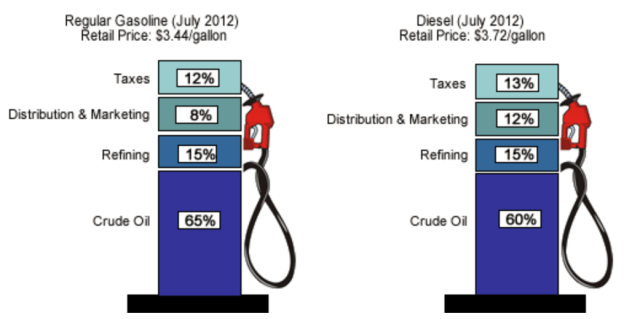
“Nothing terrifies an American president more than a gasoline-pump price spike,” said Bob McNally, president of consulting firm Rapidan Energy Group and former White House policy official under George W. Bush. “They will go to great lengths to prevent this, especially in an election year.”

Excerpts from Anna Hirtenstein et al., Biden Wants to Be Tough With Russia and Iran—but Wants Low Gas Prices Too, WSJ, June 26, 2024
 

The End of the Mindless Self-Indulgence: the Gulf States

Algeria needs the price of Brent crude, an international benchmark for oil, to rise to $157 dollars a barrel. Oman needs it to hit $87. No Arab oil producer, save tiny Qatar, can balance its books at the current price, around $40 (summer 2020)….The world’s economies are moving away from fossil fuels. Oversupply and the increasing competitiveness of cleaner energy sources mean that oil may stay cheap for the foreseeable future. 

Arab leaders knew that sky-high oil prices would not last for ever. Four years ago Muhammad bin Salman, the de facto ruler of Saudi Arabia, produced a plan called “Vision 2030” that aimed to wean his economy off oil. Many of his neighbours have their own versions. But “2030 has become 2020…” 

Still, some see an upside to the upheaval in oil-producing states. The countries of the Gulf produce the world’s cheapest oil, so they stand to gain market share if prices remain low. As expats flee, locals could take their jobs…

Remittances from energy-rich states are a lifeline for the entire region. More than 2.5m Egyptians, equal to almost 3% of that country’s population, work in Arab countries that export a lot of oil. Numbers are larger still for other countries: 5% from Lebanon and Jordan, 9% from the Palestinian territories. The money they send back makes up a sizeable chunk of the economies of their homelands. As oil revenue falls, so too will remittances. There will be fewer jobs for foreigners and smaller pay packets for those who do find work. This will upend the social contract in states that have relied on emigration to soak up jobless citizens….With fewer opportunities in the oil-producing states, many graduates may no longer emigrate. But their home countries cannot provide a good life. Doctors in Egypt earn as little as 3,000 pounds ($185) a month, a fraction of what they make in Saudi Arabia or Kuwait. A glut of unemployed graduates is a recipe for social unrest…

For four decades America has followed the “Carter Doctrine”, which held that it would use military force to maintain the free flow of oil through the Persian Gulf. Under President Donald Trump, though, the doctrine has started to fray. When Iranian-made cruise missiles and drones slammed into Saudi oil facilities in September 2019, America barely blinked. The Patriot missile-defence batteries it deployed to the kingdom weeks later have already been withdrawn. Outside the Gulf Mr Trump has been even less engaged, all but ignoring the chaos in Libya, where Russia, Turkey and the UAE (to name but a few) are vying for control.

A Middle East less central to the world’s energy supplies will be a Middle East less important to America. ..As Arab states become poorer, the nature of their relationship with China may change. This is already happening in Iran, where American sanctions have choked off oil revenue. Officials are discussing a long-term investment deal that could see Chinese firms develop everything from ports to telecoms… Falling oil revenue could force this model on Arab states—and perhaps complicate what remains of their relations with America.

Excerpts from The Arab World: Twilight of the Petrostates, Economist, July  18, 2020

Leave No Oil Under-Ground: OPEC against US Frackers

In 2014-16, the OPEC waged a failed price war to wipe out American frackers. Since then the cartel and its partners, led by Russia, have propped up oil prices enough to sustain shale, but not enough to support many members’ domestic budgets. In March 2020 Saudi Arabia urged Russia to slash output; Russia refused, loth to let Americans free-ride on OPEC-supported prices. The ensuing price war was spectacularly ill-timed, as it coincided with the biggest drop in oil demand on record.  The desire to chasten American frackers remains, though. OPEC controls about 70% of the world’s oil reserves, more than its 40% market share would suggest… If the world’s appetite for oil shrinks due to changing habits, cleaner technology or greener regulations, countries with vast reserves risk having to leave oil below ground. 

Excerpts from Crude Oil: After the Fall, Economist, June, 13, 2020

The OPEC Cartel and the US

The OPEC often described as a cartel, it is better seen as an anti-glut group. When demand is weak, its members can curb production to prevent the price plummeting. But when demand is healthy, its ability to curb new producers is limited. And new producers abound.

America’s domestic production of crude (and gas, which displaces some oil) is rocketing. The IEA says the country will produce 14m barrels a day (b/d) next year, on a par with Saudi Arabia . That has reduced America’s imports, as well as boosting exports of fuels (exports of crude oil are mostly banned). That frees crude from other places, such as West Africa, to go to Europe instead. Similarly, Latin American and Middle Eastern oil that once would have gone to America now goes to Asian customers.

For the oil-rich, even worse is in store. Other factors that have propped up the price over the past decade are likely to wane in importance. Even the slightest easing of sanctions helps Iran, potentially a huge producer….The Economist Intelligence Unit…forecasts a “significant boost” in 2014 from 2.4m b/d last year. This assumes new investment pays off, and a deal with the semi-autonomous Kurdish region. Libya could be another source of production: its exports have collapsed to only a few hundred thousand barrels a day, against 1.6m in June last year…

An alternative for Saudi Arabia would be to increase production sharply. That would send the price down: painful for the kingdom, but even more painful for higher-cost producers (not least America, where the “tight oil” now coming on stream requires prices of $50 and above to be profitable).  OPEC’s best hope is continued American protectionism. Any easing of the restrictions on the export of liquefied natural gas (LNG) or crude will exert more downward pressure on the oil price. That might be good for the world economy, but it is not a priority for American consumers, who would like cheaper petrol for cars and propane for heating…

OPEC and oil prices: Leaky barrels, Economist, Feb. 22, 2014, at 63