Tag Archives: risk disclosure

Transparency against Free Speech? Exxon v. California, the Climate Risks

Exxon Mobil says rules requiring it to disclose climate risks infringe on the company’s right to free speech. The oil-and-gas giant made the argument in a suit filed October 24, 2025 (pdf) against the state of California, which is rolling out requirements for businesses to report ton their greenhouse gas emissions and climate-related financial risks. Exxon Mobil asked the court to halt the rules, arguing that they would violate free speech protections by forcing the business to use frameworks that put “disproportionate blame on large companies” such as the energy producer itself. The rules would require Exxon Mobil “to serve as a mouthpiece for ideas with which it disagrees,” the company said in the complaint, which was submitted to the U.S. District Court for the Eastern District of California.

The California regulations were set up by state laws SB 253 and SB 261: the Climate Corporate Data Accountability Act and the Climate-Related Financial Act. The first requires companies to disclose their greenhouse gas emissions, while the second mandates disclosures of climate-related financial risks.

The rules are specific to California but their oversight reaches businesses across the globe. Under SB 253, companies doing business in the state with an annual total revenue exceeding $1 billion, be they public or private, will have to disclose their greenhouse gas emissions—the ones from their immediate operations, such as electricity intake, and those from their… supply chain. Even if they are based elsewhere in the U.S. or overseas, the rules will apply.

The climate risk reporting rule, SB 261, will affect more companies. It requires public and private firms doing business in California with annual revenue of more than $500 million to disclose climate-related financial risks, along with the measures they are taking to mitigate and adapt to such risks, starting Jan. 1, 2026

Companies are also preparing for coming climate reporting rules in Europe known as the Corporate Sustainability Due Diligence Directive.

Excerpt from Clara Hudson, Exxon Mobil Sues California Over Looming Climate Disclosure Rules, WSJ, Oct. 27, 2025
Do Not Forget Fukushima

The nuclear disaster was a sensitive subject at the 3rd UN World Conference on Disaster Risk Reduction for Civil Society that took place in Sendai, Japan, March 2015 .  Masaaki Ohashi, the co-chair of   Japan Civil Society Organization Coalition  (JCC) a coalition of humanitarian NGOs formed ahead of the summit, praised the new Sendai disaster reduction framework for stating clearly that it applies to man-made and technological hazards – which covers nuclear power – as well as natural hazards.

He and others also noted the importance of an official presentation made at the conference about the lessons learned from the Fukushima crisis.  “The Japanese government, represented by the Cabinet Office, has clearly indicated that they are breaking away from the ‘safety’ myth around nuclear power plants, so we’re seeing a step forward,” said Takeshi Komino, general secretary of aid agency CWS Japan.

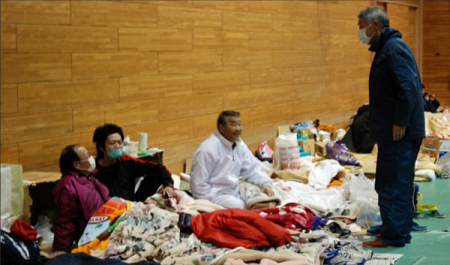
“Our preparedness (for Fukushima) was totally inefficient – we assumed the incident would affect a 10 km radius from the plant, but it was more than 30 km,” he said.The operation to evacuate people living in the danger zone was confused and not enough support was provided, he said. Failings meant that some hospital patients died at evacuation centres, he noted.A disaster prevention and evacuation plan has since been drawn up for 550,000 people, Yamamoto said. The government is continuing with its decontamination work, and is monitoring health in Fukushima, offering tests for thyroid cancer to those aged 18 and under, he added.

Civil society groups supporting Fukushima residents still struggling with the aftermath of the crisis launched a booklet at the Sendai conference containing 10 key lessons from the disaster, available in several languages including English.,,Komino of CWS Japan said it should be up to countries and communities to decide whether they want nuclear power, but “we are against the creation of the safety myth”.  “Pro-active risk identification and risk disclosure to the communities prior to the installation of such facilities is critical,” he emphasised.

JCC2015’s Ohashi said that, as the Japanese government aims to export nuclear energy technology to developing countries, it bears a “producer’s responsibility” to share its knowledge about the risks and how to deal with them….

For example, in some countries that have shown interest in nuclear power, such as Bangladesh and Thailand, it may be difficult for people to shut themselves inside concrete buildings in the event of an accident. And in others, low literacy levels make written public education materials less useful than comic strip versions.  Takeuchi questioned the legitimacy of suggesting that nuclear emergencies could really be prevented.  “Even if you can put risk reduction measures in place, it would cost a ridiculous amount,” he told the Thomson Reuters Foundation in Fukushima…

Of the 160,000 people who left their homes after the nuclear accident, around 120,000 are still classified as evacuees. Some remain in cramped temporary accommodation, in prefabricated buildings erected on parks and other public land.   In places like Iwaki City, south of the evacuation zone, the influx of displaced people seeking new homes and jobs has stirred resentment among residents  Even though local officials have made preparations to revitalize empty towns and villages once they are decreed safe, there is concern that only older generations will want to return, raising questions about their future viability.

Excerpts from MEGAN ROWLING , Japan wants to share the lessons it learned from the Fukushima nuclear disaster, Business Insider Australia, Mar. 27, 2015