Tag Archives: shipping Arctic

China’s Polar Silk Road — A U.S. Nightmare

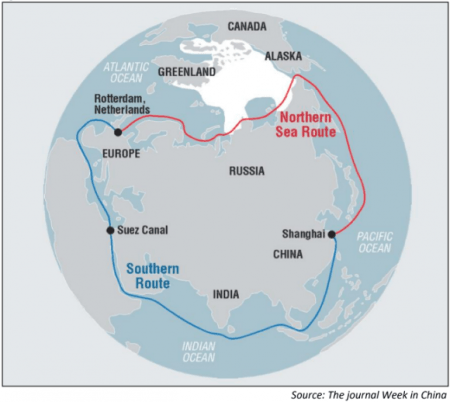
Chinese research submarines for the first time traveled thousands of feet beneath the Arctic ice the summer of 2025, a technical feat with chilling military and commercial implications for America and its allies. Beijing views future sea routes through the High North as a shortcut for global commerce, a so-called Polar Silk Road. China sent a cargo ship, in the summer of 2025, to the Polish port of Gdansk by skirting the North Pole, a route twice as fast as travel times using the Suez Canal..

Chinese and Russian military planes in 2025 flew patrols near Alaska for the first time, with Chinese long-range bombers operating from a Russian air base. Such cooperation not only gives China new abilities to strike North America but raises the prospect of a joint attack by America’s most powerful adversaries….In the Arctic, the U.S. and NATO worry most about subsea warfare. Submarine navigation relies on detailed knowledge of ocean-floor topography and undersea conditions. China is cataloging the world’s oceans to build computer models to guide submarines and help them evade detection, military experts say…U.S. analysts say data China gathered from its Arctic dives north of Alaska and Greenland isn’t just about studying climate change, but also to educate the Chinese navy, which operates relatively noisy submarines that are easily tracked by U.S. forces. ..

China’s ultimate aim, said Adm. Samuel Paparo, head of U.S. Indo-Pacific Command, is to end “American undersea dominance,” he told a conference in Canada in 2024.

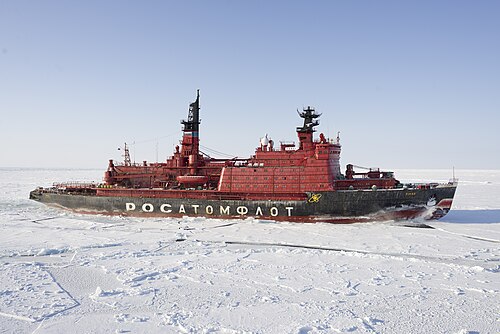
Both Beijing and the U.S. are short of vessels capable of navigating thick Arctic ice compared with Russia, which has more than 40. China in 2025 commissioned its fifth icebreaker. The U.S. has only two such vessels in operation, and Trump is buying more. After years of development, China launched its first domestically built icebreaker in 2019 with Finnish help. In 2025, it built and deployed its first domestically designed icebreaker in 10 months, a swift accomplishment noted with worry in Arctic countries.

Excerpt from Daniel Michaels, China’s Push to Master the Arctic Opens an Alarming Shortcut to U.S., WSJ
Fish, Gas and Minerals: the Arctic

Mr Xi has been showing a growing interest in Arctic countries. In 2014 he revealed in a speech that China itself wanted to become a “polar great power”..,,In January 2018 the Chinese government published its first policy document outlining its Arctic strategy.

China is also keen to tap into the Arctic resources that will become easier to exploit as the ice cap retreats. They include fish, minerals, oil and gas. The region could hold a quarter of the world’s as-yet-undiscovered hydrocarbons, according to the United States Geological Survey. Chinese firms are interested in mining zinc, uranium and rare earths in Greenland.

As the ice melts, it may become more feasible for cargo ships to sail through Arctic waters. China is excited by this possibility (its media speak of an “ice silk road”). In the coming decades such routes could cut several thousand kilometres off journeys between Shanghai and Europe. Sending ships through the Arctic could also help to revive port cities in China’s north-eastern rustbelt… China is thinking of building ports and other infrastructure in the Arctic to facilitate shipping. State-linked firms in China talk of building an Arctic railway across Finland.

Chinese analysts believe that using Arctic routes would help China strategically, too. It could reduce the need to ship goods through the Malacca Strait, a choke-point connecting the Pacific and Indian oceans. Much of China’s global shipping passes through the strait. It worries endlessly about the strait’s vulnerability to blockade—for example, should war break out with America.

There are no heated territorial disputes in the Arctic, but there are sensitivities, including Canada’s claim to the North-West Passage, a trans-Arctic waterway that America regards as international—ie, belonging to no single state.

Plenty of non-Arctic countries, including European ones, have similar dreams. But China is “by far the outlier” in terms of the amount of money it has pledged or already poured into the region, says Marc Lanteigne of Massey University in New Zealand. Its biggest investments have been in Russia, including a gas plant that began operating in Siberia in December 2017. Russia was once deeply cynical about China’s intentions. But since the crisis in Ukraine it has had to look east for investment in its Arctic regions.

The interest shown by Chinese firms could be good news for many Arctic communities. Few other investors have shown themselves willing to stomach the high costs and slow pay-offs involved in developing the far north…. The main concern of Arctic countries is that China’s ambitions will result in a gradual rewiring of the region’s politics in ways that give China more influence in determining how the Arctic is managed. Greenland is a place to watch. Political elites there favour independence from Denmark but resist taking the plunge because the island’s economy is so dependent on Danish support. The prospect of Chinese investment could change that. Should Greenland become independent, China could use its clout there to help further its own interests at meetings of Arctic states, in the same way that it uses its influence over Cambodia and Laos to prevent the Association of South-East Asian Nations from criticising Chinese behaviour in their neighbourhood.

Excerpts from The Arctic: A Silk Road through Ice, Economist, Apr. 14, 2018, at 37