Tag Archives: water transfers

Not Sharing, even a Glass of Water: the Water Crisis in India

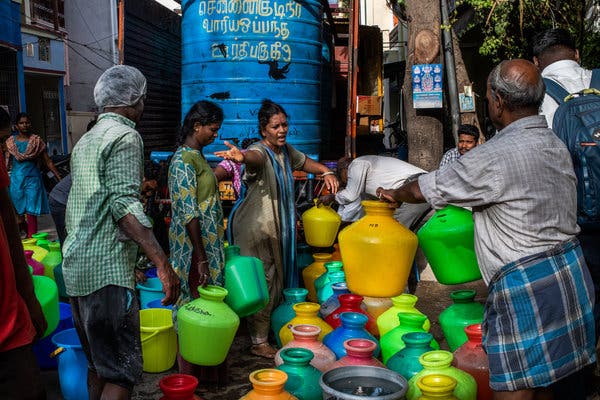
The southern city of Chennai—India’s fifth largest with a population of around 10 million—has been meeting only two-thirds of its water needs for weeks, the product of years of drought and decades of failure to manage the region’s water resources.   Residents have been scrambling around the clock to get water—spending hours chasing government tankers or paying private companies to deliver water.  Recent light rains broke a 200-day streak without rain. But the first month of India’s annual monsoon brought one-third less rain than the 50-year average, the driest June in five years, according to the India Meteorological Department.

The acute water shortage in one of India’s largest cities has been building for decades through a mix of population growth, poor planning and increasingly erratic monsoon rains….

The situation in Chennai reflects a larger water crisis spreading across India. Half the country’s population—600 million people—live in areas where water resources are highly or extremely stressed. About 100 million people living in 21 of India’s biggest cities may see their groundwater exhausted by the end of next year, according to a 2018 study by NITI Aayog, an Indian government policy think tank.  By 2030, demand for water will be double the country’s supply, the report said. And the impact will go far beyond the areas actually affected by water shortages: Almost one-third of the country’s agricultural output comes from areas most affected by water shortages…

The scarcity has led to clashes between neighbors. “No one is ready to share even a glass of water,” she said.

Excerpts from Vibhuti Agarwal and Krishna Pokhare Indians Hunt Through the Night for Water as a Megacity Runs Dry, WSJ, July 6, 2018
The Unquenchable Thirst: water mismanagement

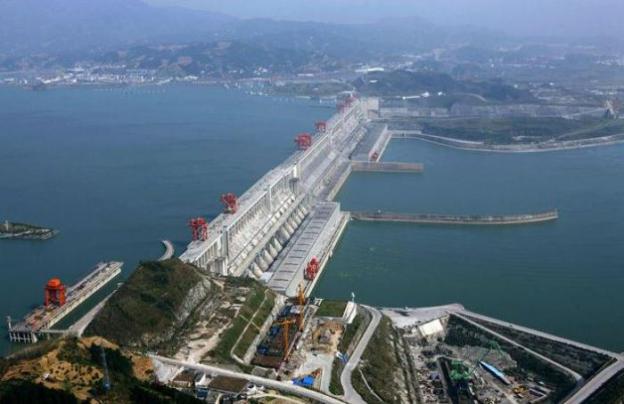
Most of the drinking water consumed in Beijing has travelled 1,432km (895 miles), roughly the distance from New York to Orlando, Florida. Its journey begins in a remote and hilly part of central China at the Danjiangkou reservoir, on the bottom of which lies the drowned city of Junzhou. The water gushes north by canal and pipeline, crosses the Yellow river by burrowing under it, and arrives, 15 days later, in the water-treatment plants of Beijing. Two-thirds of the city’s tap water and a third of its total supply now comes from Danjiangkou.

This winter and spring, the reservoir was the capital’s lifeline. No rain or snow fell in Beijing between October 23rd 2017 and March 17th 2018—by far the longest drought on record. Yet the city suffered no supply disruptions, unlike Shanxi province to the west, where local governments rationed water. The central government is exultant, since the project which irrigates Beijing was built at vast cost and against some opposition.

The South-to-North Water Diversion Project—to give the structure its proper name—is the most expensive infrastructure enterprise in the world. It is the largest transfer of water between river basins in history, and China’s main response to its worst environmental threat, which is (despite all the pollution) lack of water.

The route between Beijing and Danjiangkou, which lies on a tributary of the Yangzi, opened in 2014. An eastern route opened in 2013 using the ancient Grand Canal between Hangzhou and the capital. (Jaw-dropping hydrological achievements are a feature of Chinese history.) A third link is planned on the Tibetan plateau, but since that area is prone to earthquakes and landslides, it has been postponed indefinitely…

Downstream from Danjiangkou, pollution has proved intractable. By diverting water from the Yangzi, the project has made the river more sluggish. It has become less able to wash away contaminants and unable to sustain wetlands, which act as sponges and reduce flooding. To compensate for water taken from their rivers, local governments are also building dams wherever they can to divert it back again. Shaanxi province, for example, is damming the Han river to transfer water to its depleted river Wei….Worst of all, the project diverts not only water but money and attention from China’s real water problem: waste and pollution.

Excerpts from Water: Massive Diversion, Economist, Apr. 7, 2018