[M]ost of Israel’s water is artificially produced. About a third comes from desalination plants that are among the world’s most advanced. Farmers rely on reclaimed water for irrigation. Israel recycles 86% of its wastewater, the highest level anywhere; Spain, the next best, reuses around 20%.
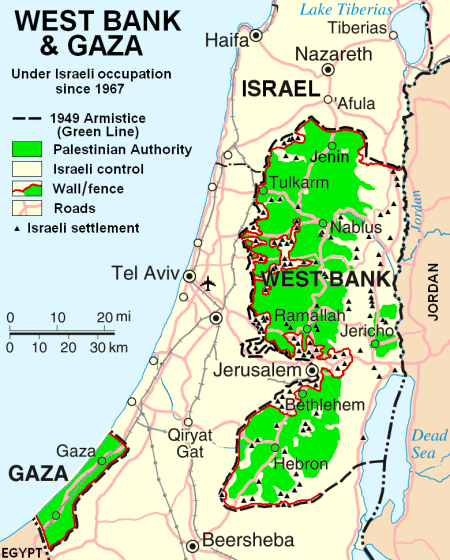
West Bank: None of these high-tech solutions helps the Palestinians [in the West Bank,] though, because they are not connected to Israel’s water grid. They rely on the so-called “mountain aquifer”, which lies beneath land Israel occupied in 1967. The 1995 Oslo Accords stipulated that 80% of the water from the aquifer would go to Israel, with the rest allocated to the Palestinians. The agreement, meant to be a five-year interim measure, will soon celebrate its 21st birthday. During that time the Palestinian population in the West Bank has nearly doubled, to almost 3m. The allocation has not kept pace.
The settler population has doubled too, and they face their own shortages. In Ariel, a city of 19,000 adjacent to Salfit, residents experienced several brief outages this month. Smaller settlements in the area, which are not hooked up to the national grid, have dealt with longer droughts. Palestinians have suffered far more, however. On average they get 73 litres per day, less than the 100-litre minimum recommended by the World Health Organisation.
The situation is even worse in Gaza, which relies almost entirely on a fast-shrinking coastal aquifer; what remains is polluted from years of untreated sewage and agricultural run-off. The stuff that comes out of Gazan taps is already brackish and salty. UN experts think that aquifer will be irreversibly damaged by 2020.
Israel’s water authority sells the Palestinians 64m cubic metres of water each year. It says they cause their own shortages, because up to a third of the West Bank’s water supply leaks out of rusting Palestinian pipes. A joint water committee is supposed to resolve these issues, but it has not met for five years…
Water in the West Bank: Nor yet a drop to drink, Economist, July 30, 2016, at 38

 Law-In-Action