Tag Archives: 2025 Operation Rough Rider against Houthis

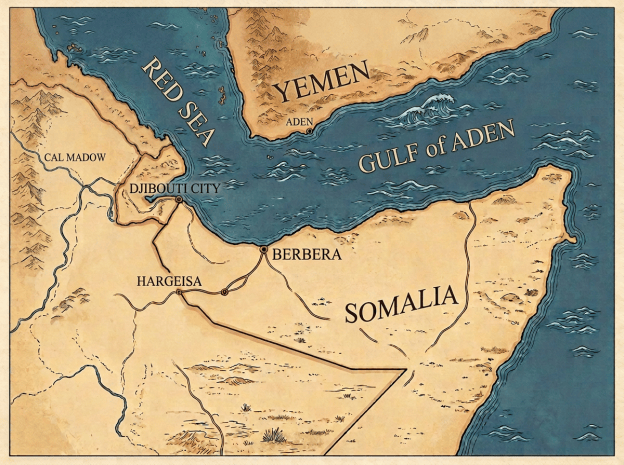
Illustrated map of the Horn of Africa coast, Red Sea, Gulf of Aden, and Somalia

My Friend? The Enemy of My Enemy: The Link between Shia and Sunni Islam

The Houthis, predominantly Shia Muslims, and al-Shabaab operating from Somalia, which adheres to Sunni Islam, are among the hundreds of millions divided by a seventh-century schism over who was the rightful successor to the Prophet Muhammad. The sectarian split still flares into violence in spots from Afghanistan to Iraq to Syria. Common enemies, however, now unite the Houthis and al-Shabaab. “They hate the West, they hate Israel,” said Abdulaahi Mohamed Ali, a former Somali intelligence chief.   The cooperation the Houthis and al-Shabaab has been strengthened through the exchange of expertise and coordination, particularly in facilitating the transfer of weapons and military equipment…

Complicating security concerns was Israel’s decision in December 2025 to recognize the independence of Somaliland, a region within the northwest of Somalia’s acknowledged borders that declared itself a separate country in 1991. Somaliland could provide Israel access to Berbera, a Red Sea port city with a runway so long that NASA once rented it as an emergency landing strip for the space shuttle. Berbera could give the Israelis another position where they could monitor and attack their Houthi enemies…

Al-Shabaab fighters regularly travel to Yemen for Houthi training to build more lethal roadside bombs as well as operate advanced weaponry. At least 100 al-Shabaab fighters have made the trip…. The U.N. reported in 2025 that al-Shabaab sends classes of about 30 militants to learn marksmanship, antiaircraft operations and techniques for making more lethal booby-trap bombs.

The Al-Shabaab brings in at least $100 million a year extorting money from Somali businesses and passersby at roadside checkpoints and the port of Mogadishu. Al-Shabaab also exploits artisanal gold mines along the northern Cal Madow Mountains, according to Abdullahi, the former Somali commander.

Excerpt from Michael M. Phillips, Al Qaeda-Houthi Alliance Stirs New Trouble for U.S., WSJ, Sept. 2, 2026
Why the Iran War Feels Like Opening a Can of Worms

Iran has attacked dozens of vessels in the strait, often with small, unmanned boats carrying explosive charges or airborne drones. Other ships have been hit by projectiles, in the strait and in the Gulf of Oman and the Persian Gulf. Iran has began laying plans to allow select ships through, with Tehran’s Parliament considering a law to charge tolls. It raised the prospect that Iran could leverage its position and make deals with nations that need oil, gas and other commodities produced in the Persian Gulf region. “In practice, this creates a form of coerced interdependence: states that seek access to gulf energy may find themselves needing to accommodate Iran, whether directly or indirectly,” said Danny Citrinowicz, a national-security fellow at the Atlantic Council…

The extent to which Iran has seeded naval mines in the strait couldn’t be determined. It has a large array of different mines, including versions that can be anchored to the sea floor and detonated by remote control when a ship passes… Only 24 miles wide at its narrowest point, the Strait of Hormuz is such a confined space that cruise missiles can be fired from hundreds of miles away and still hit ships moving through it…

Houthi militants in Yemen, who are aligned with Iran, waged a two-month campaign in 2025 with missiles, drones and unmanned boats against international shipping that parallels Iran’s closure of the strait. The U.S. struck more than 1,000 targets in Yemen, but never succeeded in halting Houthi attacks fully until the two sides declared a truce in May 2025.

Excerpt from  David S. Cloud et al.,, U.S. War Planes and Helicopters Kick Off Battle to Reopen Hormuz, WSJ, Mar. 19, 2026


,

How the Houthis Blindsided the U.S. Forces

Even less-sophisticated adversaries can pose a serious threat to U.S. forces. And fatigue among overworked soldiers, sailors, aircrews and Marines can lead to costly mistakes. Trump launched Operation Rough Rider in March 2025 threatening the Houthis would be “annihilated” if they didn’t halt attacks on shipping in the vital Red Sea trade route. He poured forces into the region including two aircraft carriers, half a dozen B-2 bombers, a squadron of advanced F-35 fighters, and destroyers armed with guided missiles.

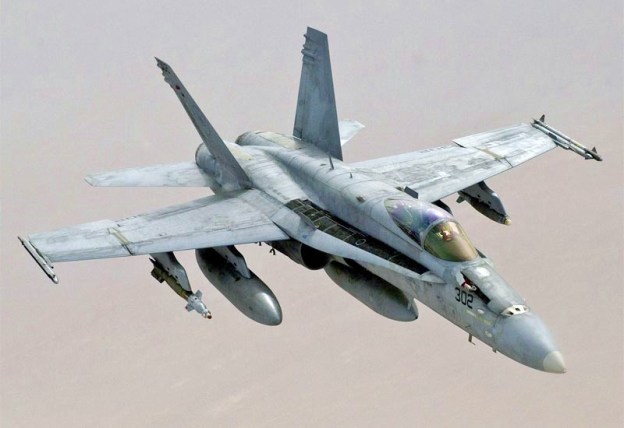
The Houthis proved resilient. In addition to nearly shooting down the two F-16s, they knocked more than a half-dozen Reaper drones out of the sky. A missile attack on the USS Harry S. Truman in April 2025 forced the carrier to make a hard turn that sent an F/A-18 rolling into the Red Sea. Another plane slid off the deck in May 2025 when its landing cable snapped, because sailors exhausted by weeks of combat likely left off a washer that held it in place.

The U.S. force had a huge edge over the Houthis. Part of that was the “Wild Weasels,” the name for F-16 units…charged with suppressing enemy air defenses. They were equipped with HARM missiles that lock on to the signal from enemy radars to knock them out…But the Houthis had developed a network to track American warplanes with observers, optics and infrared sensors whose intricacy U.S. officials didn’t entirely understand. That enabled them to flick on their air-defense radars at the last moment, so U.S. pilots would have little time to react—a tactic pilots came to call a “SAMbush.”…

The Pentagon touted the accomplishments of its 53-day fight against the Houthis. The U.S. had hit more than 1,000 targets…but never decapitated the top Houthi leadership. The US operation didn’t defeat the Houthis or degrade them to the point where they are unable to carry out future attacks in the Red Sea.

Excerpt from Michael Gordon et al., F-16 Pilot’s Narrow Escape in Missile Attack Shows Risks of a New Mideast War, WSJ, Feb. 26, 2026