Tag Archives: AI and biomedical databases

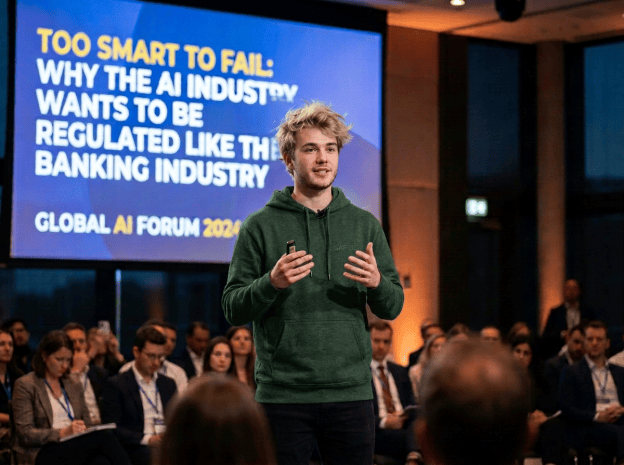
Young presenter with unruly blond hair

Too Smart to Fail: Why the AI Industry Wants to be Like the Banking Industry

The CEO of Anthropic (Claude AI), Dario Amodei, ultimately wants the AI industry to be seen as “too big to fail” like the banking industry. In a September 2026 paper titled “Pacing the Frontier,” Amodei suggested that to effectively regulate AI development, it is important to verify commitments made by AI companies to slow that development down and thereby avert a potential catastrophe, i.e., the destruction of humanity. He pointed to various hacking incidents in which AI agents escaped their “playground sandboxes” (yes, they are children!) and hacked real companies. Regulation of AI, Amodei argued, “has precedent in the banking industry, which sometimes involves regulatory ‘supervisors’ embedded along with employees” within companies.

In light of a much more sober analysis of the capabilities of AI by Princeton and Stanford researchers, which has demonstrated that current AI models are not even close to intelligence—let alone super-intelligence—Amodei’s warning is NOT a call to save humanity, but rather an effort to shield the nascent AI industry from the tremendous liabilities it would incur if his or other models are used by humans to create chaos. The power to stir up social chaos does not lie in the hands of AI agents—which are but machines—but in the hands of the humans who develop them and establish their guardrails. In other words, it is not AI that will wreak havoc in society, but humans who feed the models and are not careful enough to ensure that these models cannot be misused by fellow humans.

During the 2008 financial crisis, the United States and other governments bailed out entire companies because they were “too big to fail,” fearing that their failure was likely to cause a social meltdown. Amodei hopes for government intervention and a potential bailout in case his Claude model is “misused” by a human (i.e., if humans use Claude to hack water systems). In case of sever harm involving his company’s technology, his liability could be unlimited and his company would likely go bankrupt. Yet if he can blame government supervisors for their lack of proper supervision, he will go scot-free.

E.L.
When Viruses are Gold

A handful of African nations are rejecting American health aid in 2026, outraged by the Trump administration’s demands for access to private health records and even minerals in exchange for lifesaving medicine…While the Democratic Republic of Congo, the epicenter of the Ebola crisis, has struck a deal with the United States, Zimbabwe, Ghana and Zambia have said no or dragged out negotiations… Talks with Zambia have stalled as the nation challenged Trump’s terms for a $2 billion American aid offer, calling U.S. demands for a critical-minerals deal, preferential treatment for U.S. companies and access to private health data unacceptable.

Zimbabwe was the first to reject a U.S. package, citing demands for extensive access to sensitive health data for American research and commercial use, without guaranteed benefits for the southern African country’s population. The U.S. aid offer totaled roughly $325 million, state media said…

The U.S. demand for pathogen and outbreak data has also raised concerns in Africa. Analysts suggest the U.S. is using bilateral deals to secure a competitive advantage for American pharmaceutical companies. Githinji Gitahi, chief executive of Amref Health Africa, a Nairobi-based nonprofit, warned that signing away health and specimen data weakens African nations’ negotiating power for access to future vaccines and treatments under WHO benefit-sharing programs.

Excerpt from Caroline Kimeu et al.,  Trump Wants Minerals, Health Data for Aid. African Nations Are Pushing Back, WSJ, May 31, 2026

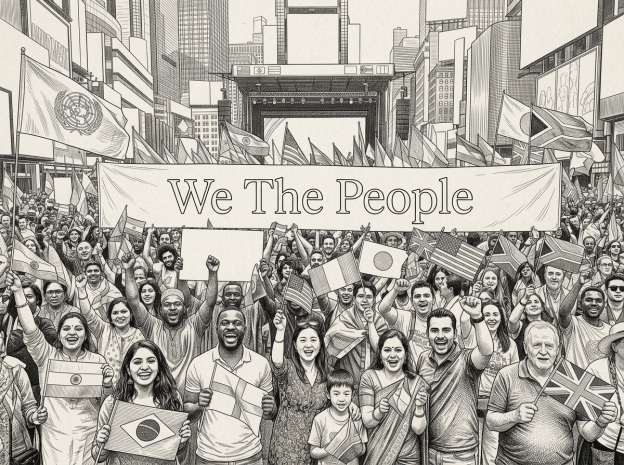
Change text to "We The People"

We The Subjects — Plundering Health Data

When geneticist Jingyuan Fu heard that an artificial intelligence (AI) group in China had downloaded a large biomedical dataset her team built in Europe, she felt pride — and a jolt of unease. “We spent millions on that dataset,” says Fu, a professor of systems medicine at the University of Groningen in the Netherlands. “And the Chinese bought the whole thing for around €2,000.” In recent years, Fu’s group, like many others, has also begun using such data as feedstock for artificial intelligence. The AI group in China that downloaded her dataset had the same goal. “The Chinese wanted all our data,” Fu says. “And they also wanted our insights into how to mine it for AI development.”
From her perspective, today’s global scramble for biomedical data looks increasingly lopsided. “China has collected a huge amount of data,” she says. “But their own data sharing and openness is very limited.”… China already holds the largest data repositories, with 1.4 billion people using the WeChat app, many of whom are already connected to hospital databases for data integration, analysis and even healthcare delivery. “China also runs the largest number of clinical trials in the world generating massive drug response and real-world-evidence datasets.”

[A]fter decades of policies pushing ‘open science’, governments are now promoting ‘data sovereignty’ — the idea that sensitive datasets should remain under national control and foreign access should be conditional. [In Europe] the stance is defensive. [Europe] is embarrassed about having allowed Chinese AI developers to plunder European biomedical databases, even while China blocks foreign access to Chinese datasets. They are now belatedly closing international access to biomedical databases, after years of championing cross-border sharing…“According to the European Commission “there are currently no partnerships involving the sharing of such data with China or the United States for AI development”….

As of April 2025, the 2.5 petabytes of omics data in the US Cancer Genome Atlas Program database are now closed to Chinese researchers, and UK Biobank data, containing whole-genome and exome sequences for 500,000 people, is no longer internationally downloadable. UK Biobank data must now be analyzed on the Biobank’s own platform, which provides a cloud-based ‘reading room’ without allowing individual data downloads…In September 2025, the US National Institutes of Health issued new regulations for genomic data repositories and users aimed at “protecting Americans’ sensitive personal health-related data from misuse by foreign adversaries” while enhancing “the privacy and autonomy of research participants”….In December 2025, the US State Department launched its Pax Silica initiative, aimed at forming an international AI alliance that hedges against China. [Furthermore], data that are generated and held by hospitals, insurers, device makers, drug makers and data platform companies. are abundant For example, US-based electronic health records vendor Epic Systems Corporation manages records for over 300 million US patients and says that it has more than 150 AI features in development…

[But]AI models developed using sequestered datasets often ‘overfit’ to the specific demographics or clinical practices of their training environment…. “Without external, international validation, these biases are frequently only discovered after they have caused clinical harm,” …[For example] many high-performing AI tools for melanoma detection show a precipitous drop in accuracy when applied to darker skin tones. “Because major datasets are often skewed toward light-skinned northern European or North American populations, “these tools can misclassify malignant lesions as benign in under-represented groups.”

Excerpt from Paul Webster, Who Owns by Health Data?, Nature Medicine,  April 24, 2026