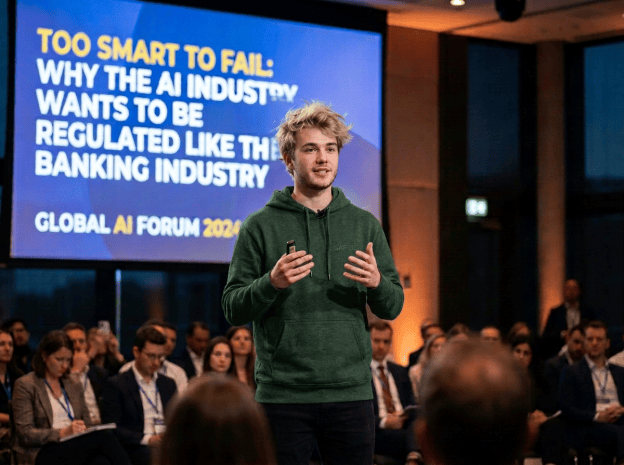
The CEO of Anthropic (Claude AI), Dario Amodei, ultimately wants the AI industry to be seen as “too big to fail” like the banking industry. In a September 2026 paper titled “Pacing the Frontier,” Amodei suggested that to effectively regulate AI development, it is important to verify commitments made by AI companies to slow that development down and thereby avert a potential catastrophe, i.e., the destruction of humanity. He pointed to various hacking incidents in which AI agents escaped their “playground sandboxes” (yes, they are children!) and hacked real companies. Regulation of AI, Amodei argued, “has precedent in the banking industry, which sometimes involves regulatory ‘supervisors’ embedded along with employees” within companies.
In light of a much more sober analysis of the capabilities of AI by Princeton and Stanford researchers, which has demonstrated that current AI models are not even close to intelligence—let alone super-intelligence—Amodei’s warning is NOT a call to save humanity, but rather an effort to shield the nascent AI industry from the tremendous liabilities it would incur if his or other models are used by humans to create chaos. The power to stir up social chaos does not lie in the hands of AI agents—which are but machines—but in the hands of the humans who develop them and establish their guardrails. In other words, it is not AI that will wreak havoc in society, but humans who feed the models and are not careful enough to ensure that these models cannot be misused by fellow humans.
During the 2008 financial crisis, the United States and other governments bailed out entire companies because they were “too big to fail,” fearing that their failure was likely to cause a social meltdown. Amodei hopes for government intervention and a potential bailout in case his Claude model is “misused” by a human (i.e., if humans use Claude to hack water systems). In case of sever harm involving his company’s technology, his liability could be unlimited and his company would likely go bankrupt. Yet if he can blame government supervisors for their lack of proper supervision, he will go scot-free.
E.L.