Tag Archives: artificial intelligence and drones

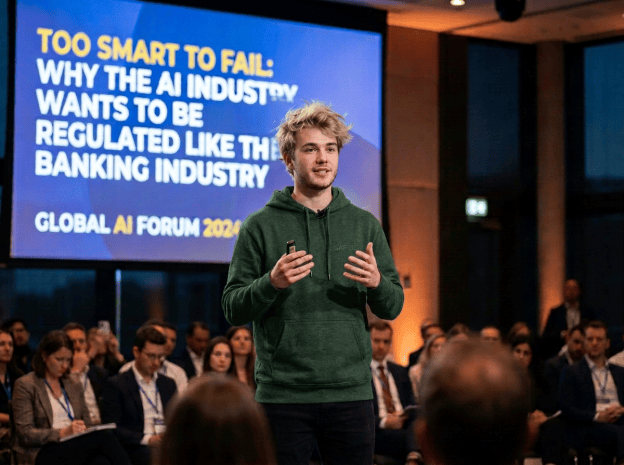
Young presenter with unruly blond hair

Too Smart to Fail: Why the AI Industry Wants to be Like the Banking Industry

The CEO of Anthropic (Claude AI), Dario Amodei, ultimately wants the AI industry to be seen as “too big to fail” like the banking industry. In a September 2026 paper titled “Pacing the Frontier,” Amodei suggested that to effectively regulate AI development, it is important to verify commitments made by AI companies to slow that development down and thereby avert a potential catastrophe, i.e., the destruction of humanity. He pointed to various hacking incidents in which AI agents escaped their “playground sandboxes” (yes, they are children!) and hacked real companies. Regulation of AI, Amodei argued, “has precedent in the banking industry, which sometimes involves regulatory ‘supervisors’ embedded along with employees” within companies.

In light of a much more sober analysis of the capabilities of AI by Princeton and Stanford researchers, which has demonstrated that current AI models are not even close to intelligence—let alone super-intelligence—Amodei’s warning is NOT a call to save humanity, but rather an effort to shield the nascent AI industry from the tremendous liabilities it would incur if his or other models are used by humans to create chaos. The power to stir up social chaos does not lie in the hands of AI agents—which are but machines—but in the hands of the humans who develop them and establish their guardrails. In other words, it is not AI that will wreak havoc in society, but humans who feed the models and are not careful enough to ensure that these models cannot be misused by fellow humans.

During the 2008 financial crisis, the United States and other governments bailed out entire companies because they were “too big to fail,” fearing that their failure was likely to cause a social meltdown. Amodei hopes for government intervention and a potential bailout in case his Claude model is “misused” by a human (i.e., if humans use Claude to hack water systems). In case of sever harm involving his company’s technology, his liability could be unlimited and his company would likely go bankrupt. Yet if he can blame government supervisors for their lack of proper supervision, he will go scot-free.

E.L.

AI or Just Bots: the Truth about Artificial Intelligence

Americans are becoming increasingly convinced that artificial intelligence is actually thinking like humans do…This fuels narratives about a future in which AI takes over the economy, leading to heightened insecurity for all of us while providing cover for companies that might be laying off workers for other reasons. It leads us to accept as true answers that are frequently made up or incorrect, even when we are repeatedly told that chatbots can’t stop delivering this kind of misinformation…Our cognitive biases developed to help us survive in complex social environments… We have evolved to view linguistic fluency as a proxy for intelligence, and engagement and helpfulness as indicators of trustworthiness. Builders of AI tools lean in to this deliberately. The humanlike qualities of chatbots are a calculated effort by designers and engineers to make AI more useful, but also more compelling and stickier [i.e. addictive]—just like social media.

Microsoft AI chief Mustafa Suleyman… warned that today’s seemingly conscious AIs [consists of a bunch of] highly accelerated information processors. “These systems are not waking up,” he wrote. “They are retracing and mirroring the contours of human drama and debate, as documented in their vast training data.” He recommends a solution: “Developers must actively engineer the illusion of consciousness out of the products.”…

Humans have a tendency to anthropomorphize animals and even inanimate objects, says Ayanna Howard, dean of Ohio State University’s College of Engineering and a robotics….Humans’ trusting nature makes sense for social creatures who must cooperate with members of their own tribe to survive. With AI and robots, however, this same tendency leads us to trust any system that appears to listen, understand and want to help, a phenomenon Howard calls “over-trust.” Today’s AIs are engineered to actively induce us to over-trust them, she adds. They do this by behaving in ways that are friendly and helpful, mimicking us through memory and personalization.

Excerpt from Christopher Mims, Why Even Smart People Believe AI Is Really Thinking, WSJ, Mar. 20, 2026

When Artificial Intelligence Goes to War

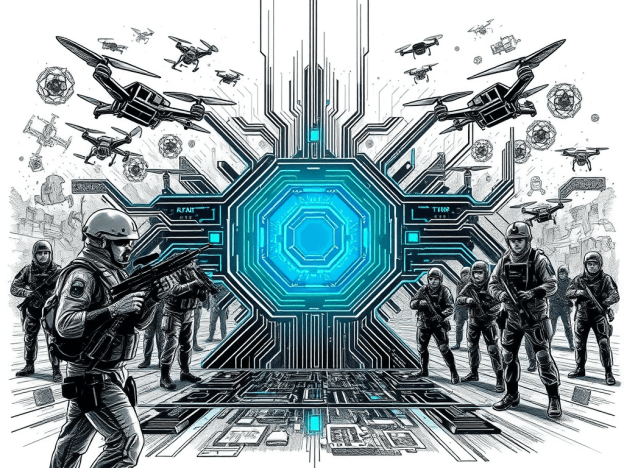
Anthropic scored a major endorsement in the summer of 2025 when it won a contract worth up to $200 million from the United States Defense Department. Now, the AI startup’s relationship with the Pentagon is on the rocks…According to Anthropic’s terms and condition Claude can’t be used for any actions related to domestic surveillance. That limits how many law-enforcement agencies such as Immigration and Customs Enforcement (ICE) and the Federal Bureau of Investigation (FBI) could deploy it. Anthropic’s focus on safe applications of AI—and its objection to having its technology used in autonomous lethal operations (e.g., drones)—have continued to cause problems…

Other AI companies including OpenAI and Google are also working with the military.

Excerpt from Keach Hagey, Anthropic-Pentagon Clash Over Limits on AI Puts $200 Million Contract at Risk, WSJ, Jan. 29, 2026