Tag Archives: artificial intelligence and the stratification of society

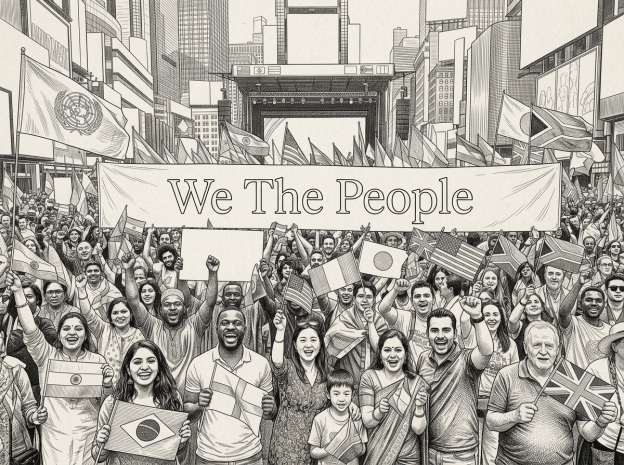
Change text to "We The People"

We The Subjects — Plundering Health Data

When geneticist Jingyuan Fu heard that an artificial intelligence (AI) group in China had downloaded a large biomedical dataset her team built in Europe, she felt pride — and a jolt of unease. “We spent millions on that dataset,” says Fu, a professor of systems medicine at the University of Groningen in the Netherlands. “And the Chinese bought the whole thing for around €2,000.” In recent years, Fu’s group, like many others, has also begun using such data as feedstock for artificial intelligence. The AI group in China that downloaded her dataset had the same goal. “The Chinese wanted all our data,” Fu says. “And they also wanted our insights into how to mine it for AI development.”
From her perspective, today’s global scramble for biomedical data looks increasingly lopsided. “China has collected a huge amount of data,” she says. “But their own data sharing and openness is very limited.”… China already holds the largest data repositories, with 1.4 billion people using the WeChat app, many of whom are already connected to hospital databases for data integration, analysis and even healthcare delivery. “China also runs the largest number of clinical trials in the world generating massive drug response and real-world-evidence datasets.”

[A]fter decades of policies pushing ‘open science’, governments are now promoting ‘data sovereignty’ — the idea that sensitive datasets should remain under national control and foreign access should be conditional. [In Europe] the stance is defensive. [Europe] is embarrassed about having allowed Chinese AI developers to plunder European biomedical databases, even while China blocks foreign access to Chinese datasets. They are now belatedly closing international access to biomedical databases, after years of championing cross-border sharing…“According to the European Commission “there are currently no partnerships involving the sharing of such data with China or the United States for AI development”….

As of April 2025, the 2.5 petabytes of omics data in the US Cancer Genome Atlas Program database are now closed to Chinese researchers, and UK Biobank data, containing whole-genome and exome sequences for 500,000 people, is no longer internationally downloadable. UK Biobank data must now be analyzed on the Biobank’s own platform, which provides a cloud-based ‘reading room’ without allowing individual data downloads…In September 2025, the US National Institutes of Health issued new regulations for genomic data repositories and users aimed at “protecting Americans’ sensitive personal health-related data from misuse by foreign adversaries” while enhancing “the privacy and autonomy of research participants”….In December 2025, the US State Department launched its Pax Silica initiative, aimed at forming an international AI alliance that hedges against China. [Furthermore], data that are generated and held by hospitals, insurers, device makers, drug makers and data platform companies. are abundant For example, US-based electronic health records vendor Epic Systems Corporation manages records for over 300 million US patients and says that it has more than 150 AI features in development…

[But]AI models developed using sequestered datasets often ‘overfit’ to the specific demographics or clinical practices of their training environment…. “Without external, international validation, these biases are frequently only discovered after they have caused clinical harm,” …[For example] many high-performing AI tools for melanoma detection show a precipitous drop in accuracy when applied to darker skin tones. “Because major datasets are often skewed toward light-skinned northern European or North American populations, “these tools can misclassify malignant lesions as benign in under-represented groups.”

Excerpt from Paul Webster, Who Owns by Health Data?, Nature Medicine,  April 24, 2026
Porn and Ads: How ChatGPT Plans for the Future

Sam Altman of OpenAI has expressed conflicted feelings about AI erotica (i.e., porn). When asked on a podcast in August 2025 if there were decisions he had made that were “best for the world, but not best for winning,” Altman replied: “We haven’t put a sex bot avatar in ChatGPT yet.” Altman indicated erotica would boost growth and revenue, but said it wouldn’t align with his company’s long-term incentive of serving users. “I’m proud of the company and how little we get distracted by that,” Altman said. “But sometimes we do get tempted.” But later in 2025, Altman posted that “We [OpenAI] “aren’t the elected moral police of the world,” “In the same way that society differentiates other appropriate boundaries (R-rated movies, for example) we want to do a similar thing here.”

Excerpt from Sam Schechner et al., OpenAI’s Bid to Allow X-Rated Talk Is Freaking Out Its Own Advisers, WSJ,  Mar. 15, 2026

On March 23, 205, it was announced that OpenAI has hired Meta Platform’s  advertising executive Dave Dugan to lead its global ad sales efforts, marking a further step in the company’s push to build out new revenue streams around its artificial intelligence products. Dugan brings experience working with large global brands at Meta, which generated nearly $200 billion in advertising revenue in 2025. (Yahoo Finance).


AI or Just Bots: the Truth about Artificial Intelligence

Americans are becoming increasingly convinced that artificial intelligence is actually thinking like humans do…This fuels narratives about a future in which AI takes over the economy, leading to heightened insecurity for all of us while providing cover for companies that might be laying off workers for other reasons. It leads us to accept as true answers that are frequently made up or incorrect, even when we are repeatedly told that chatbots can’t stop delivering this kind of misinformation…Our cognitive biases developed to help us survive in complex social environments… We have evolved to view linguistic fluency as a proxy for intelligence, and engagement and helpfulness as indicators of trustworthiness. Builders of AI tools lean in to this deliberately. The humanlike qualities of chatbots are a calculated effort by designers and engineers to make AI more useful, but also more compelling and stickier [i.e. addictive]—just like social media.

Microsoft AI chief Mustafa Suleyman… warned that today’s seemingly conscious AIs [consists of a bunch of] highly accelerated information processors. “These systems are not waking up,” he wrote. “They are retracing and mirroring the contours of human drama and debate, as documented in their vast training data.” He recommends a solution: “Developers must actively engineer the illusion of consciousness out of the products.”…

Humans have a tendency to anthropomorphize animals and even inanimate objects, says Ayanna Howard, dean of Ohio State University’s College of Engineering and a robotics….Humans’ trusting nature makes sense for social creatures who must cooperate with members of their own tribe to survive. With AI and robots, however, this same tendency leads us to trust any system that appears to listen, understand and want to help, a phenomenon Howard calls “over-trust.” Today’s AIs are engineered to actively induce us to over-trust them, she adds. They do this by behaving in ways that are friendly and helpful, mimicking us through memory and personalization.

Excerpt from Christopher Mims, Why Even Smart People Believe AI Is Really Thinking, WSJ, Mar. 20, 2026

The Essentials and the Expendables: the New Division of Humanity

For Lynn Lee, at 65, it was her fourth layoff in April 2025. Yet tears still rushed down her cheeks.“I remember thinking, ‘What are the odds this would happen again?’ ” Lee said. Lee has survived a rolling tide of economic forces that have transformed manufacturing in rural America. The textile plants that moved to Brazil in the mid-2000s. The glass-fiber plant that shut down several years later. The sign-making company that shed workers during the Covid-19 pandemic. After each layoff, Lee found something new. Now, she was at retirement age. But like many older Americans with little savings and heavy financial burdens, retirement was out of the question.

She had $7,000 in mostly out-of-pocket medical debt left over from breast-cancer treatment in 2020 and a heart procedure in 2024. Plus, there was the $42,000 she still owed from a second mortgage on her home.Lee was back to searching for work. This time, she would be competing against a legion of other job seekers in an unforgiving market. Nearly a quarter of unemployed people have been without a job for at least 27 weeks. …Excerpt from The Bruising Reality of Searching for a Job at 65, WSJ, Dec. 26, 2025

According to Jack Clark, co-founder of Anthropic: “By the summer of 2026, I expect that many people who work with frontier AI systems will feel as though they live in a parallel world to people who don’t. And I expect this will be more than just a feeling – similar to how the crypto economy moved oddly fast relative to the rest of the digital economy, I think we can expect the emerging “AI economy” to move very fast relative to everything else… But a crucial difference is that the AI economy already touches a lot more of our ‘regular’ economic reality than the crypto economy.” Excerpt from Import AI 438: Siren sirens, flashing for us all, by Jack Clark, Dec. 22, 2025