Tag Archives: artificial intelligence and jobs

AI or Just Bots: the Truth about Artificial Intelligence

Americans are becoming increasingly convinced that artificial intelligence is actually thinking like humans do…This fuels narratives about a future in which AI takes over the economy, leading to heightened insecurity for all of us while providing cover for companies that might be laying off workers for other reasons. It leads us to accept as true answers that are frequently made up or incorrect, even when we are repeatedly told that chatbots can’t stop delivering this kind of misinformation…Our cognitive biases developed to help us survive in complex social environments… We have evolved to view linguistic fluency as a proxy for intelligence, and engagement and helpfulness as indicators of trustworthiness. Builders of AI tools lean in to this deliberately. The humanlike qualities of chatbots are a calculated effort by designers and engineers to make AI more useful, but also more compelling and stickier [i.e. addictive]—just like social media.

Microsoft AI chief Mustafa Suleyman… warned that today’s seemingly conscious AIs [consists of a bunch of] highly accelerated information processors. “These systems are not waking up,” he wrote. “They are retracing and mirroring the contours of human drama and debate, as documented in their vast training data.” He recommends a solution: “Developers must actively engineer the illusion of consciousness out of the products.”…

Humans have a tendency to anthropomorphize animals and even inanimate objects, says Ayanna Howard, dean of Ohio State University’s College of Engineering and a robotics….Humans’ trusting nature makes sense for social creatures who must cooperate with members of their own tribe to survive. With AI and robots, however, this same tendency leads us to trust any system that appears to listen, understand and want to help, a phenomenon Howard calls “over-trust.” Today’s AIs are engineered to actively induce us to over-trust them, she adds. They do this by behaving in ways that are friendly and helpful, mimicking us through memory and personalization.

Excerpt from Christopher Mims, Why Even Smart People Believe AI Is Really Thinking, WSJ, Mar. 20, 2026

The Essentials and the Expendables: the New Division of Humanity

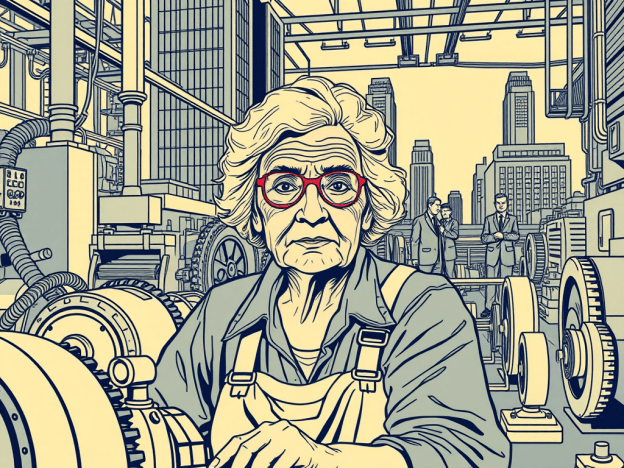
For Lynn Lee, at 65, it was her fourth layoff in April 2025. Yet tears still rushed down her cheeks.“I remember thinking, ‘What are the odds this would happen again?’ ” Lee said. Lee has survived a rolling tide of economic forces that have transformed manufacturing in rural America. The textile plants that moved to Brazil in the mid-2000s. The glass-fiber plant that shut down several years later. The sign-making company that shed workers during the Covid-19 pandemic. After each layoff, Lee found something new. Now, she was at retirement age. But like many older Americans with little savings and heavy financial burdens, retirement was out of the question.

She had $7,000 in mostly out-of-pocket medical debt left over from breast-cancer treatment in 2020 and a heart procedure in 2024. Plus, there was the $42,000 she still owed from a second mortgage on her home.Lee was back to searching for work. This time, she would be competing against a legion of other job seekers in an unforgiving market. Nearly a quarter of unemployed people have been without a job for at least 27 weeks. …Excerpt from The Bruising Reality of Searching for a Job at 65, WSJ, Dec. 26, 2025

According to Jack Clark, co-founder of Anthropic: “By the summer of 2026, I expect that many people who work with frontier AI systems will feel as though they live in a parallel world to people who don’t. And I expect this will be more than just a feeling – similar to how the crypto economy moved oddly fast relative to the rest of the digital economy, I think we can expect the emerging “AI economy” to move very fast relative to everything else… But a crucial difference is that the AI economy already touches a lot more of our ‘regular’ economic reality than the crypto economy.” Excerpt from Import AI 438: Siren sirens, flashing for us all, by Jack Clark, Dec. 22, 2025

Alas! Computers that Really Get You

 Artificial intelligence (AI) software can already identify people by their voices or handwriting. Now, an AI has shown it can tag people based on their chess-playing behavior, an advance in the field of “stylometrics” that could help computers be better chess teachers or more humanlike in their game play. Alarmingly, the system could also be used to help identify and track people who think their online behavior is anonymous

The researchers are aware of the privacy risks posed by the system, which could be used to unmask anonymous chess players online…In theory, given the right data sets, such systems could identify people based on the quirks of their driving or the timing and location of their cellphone use.

Excerpt from  Matthew Hutson, AI unmasks anonymous chess players, posing privacy risks, Science, Jan. 14, 2022

So You Want a Job? De-Humanizing the Hiring Process

Dr. Lee, chairman and chief executive of venture-capital firm Sinovation Ventures and author of “AI Superpowers: China, Silicon Valley and the New World Order,” maintains that AI “will wipe out a huge portion of work as we’ve known it.” He hit on that theme when he spoke at The Wall Street Journal’s virtual CIO Network summit.

Artificial intelligence (AI) (i.e., robots), according to Dr. Lee, can be used for recruiting…We can have a lot of résumés coming in, and we want to match those résumés with job descriptions and route them to the right managers. If you’re thinking about AI computer and video interaction, there are products you can deploy to screen candidates. For example, AI can have a conversation with the person, via videoconference. And then AI would grade the people based on their answers to your questions that are preprogrammed, as well as your micro-expressions and facial expressions, to reflect whether you possess the right IQ and EQ (emotional intelligence) for a particular job.

Excerpts from Jared Council , AI’s Impact on Businesses—and Jobs, WSJ,  Mar. 8, 2021