Tag Archives: Bhp Billiton

Mining Giants and Little People: Mariana Dam Disaster

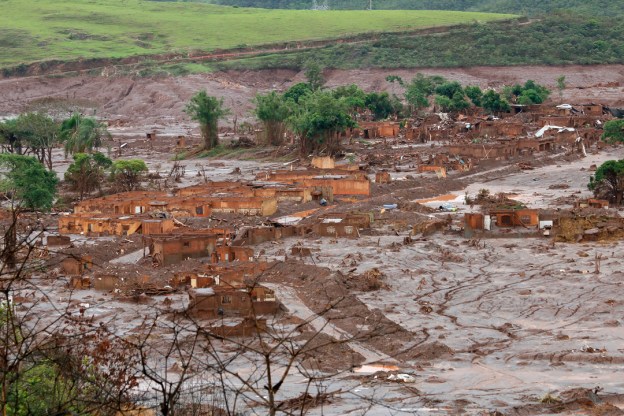
Mining company BHP has been found liable on November 13, 2025 for a 2015 dam collapse in Brazil,….[Note that this disaster was followed by yet another disaster in 2019 the Brumadinho dam disaster] The dam collapse killed 19 people, polluted the river and destroyed hundreds of homes. The civil lawsuit, representing more than 600,000 people including civilians, local governments and businesses, had been valued at up to £36bn ($48bn).

The dam in Mariana, southeastern Brazil, was owned by Samarco, a joint venture between the mining giants Vale and BHP. The claimants’ lawyers argued successfully that the trial should be held in London because BHP headquarters “were in the UK at the time of the dam collapse”. A separate claim against Samarco’s second parent company, Brazilian mining company Vale, was filed in the Netherlands, with more than 70,000 plaintiffs.

The dam was used to store waste from iron ore mining. When it burst, it unleashed tens of millions of cubic metres of toxic waste and mud. The sludge swept through communities, destroying hundreds of people’s homes and poisoning the river. Judge Finola O’Farrell said in her High Court ruling that continuing to raise the height of the dam when it was not safe to do so was the “direct and immediate cause” of the dam’s collapse, meaning BHP was liable under Brazilian law.

Excerpt from Ione Wells, UK court finds mining firm liable for Brazil’s worst environmental disaster, BBC, Nov. 14, 2025

———-

According to the UN Special Rapporteur who visited Brazil in 2019 and met BHP and Vale on numerous occasions, ” BHP and Vale rushed to create the Renova Foundation to provide the communities [affected by the collapse of the dam] an effective remedy. Unfortunately, the true purpose of the Renova Foundation appeared to be limit liability of BHP and Vale, rather than provide any semblance of an effective remedy

Furthermore, inadequate information was available about the toxicity of the waste after the Mariana disaster, the companies insisted that it was non-toxic, and rejected calls for precaution. Only three weeks after concerns were raised was information availed. When health impacts in Barra Longa emerged years later, Renova sought to exert ownership of epidemiological and toxicological studies by Ambios to suppress disclosure. Read the full report of the Special Rapporteur here.

Keep Forests Standing: the forests bond

Launched on November 1, 2016, the Forests Bond will provide investors the opportunity to invest in a traditional financial product that offers the unique option of receiving interest payments in the form of environmental impact — in this case, verified carbon credits generated through REDD, an initiative that rewards landholders for protecting forests, thereby reducing carbon emissions that worsen climate change. The development of the bond is a collaboration of the International Finance Corporation (IFC), a member of the World Bank Group, and BHP Billiton with technical support from Baker & McKenzie and Conservation International (CI).

REDD (short for Reducing Emissions from Deforestation and forest Degradation), which offers financial incentives to landholders in tropical countries to keep their forests standing, has met with mixed success since its launch in 2005, in part because the lack of a carbon market left it dependent on voluntary action and bereft of the certainty needed to attract private funding.

“If you look at the scale of the problem, roughly US$ 100 billion to 300 billion needed to cut deforestation by half over the next decade, it’s clear that we need to mobilize private institutional investors, who control vastly greater amounts than public or philanthropic aid can deliver,” said Agustin Silvani, Conservation International’s vice president of conservation finance. “The REDD mechanism has mostly excluded them because it required specific carbon expertise or a specific interest in forests to engage with it.”

The Forests Bond supports a REDD project in Kenya, and investors can choose between a cash or carbon credit coupon (the interest received from the bond), or a combination of both. This unique element of the bond is made possible by the price support that BHP Billiton**is providing, which means that investors can either 1) elect to take the carbon credits to offset corporate greenhouse gas emissions or 2) sell them on the carbon market, or 3) take a traditional financial return instead. This provides the certainty needed to attract institutional investors while still generating verified reductions in deforestation, in the form of REDD credits…

The REDD project that the Forests Bond will support takes place in the Kasigau Corridor in eastern Kenya….Forest protection activities include forest and biodiversity monitoring, funding for community wildlife scouts, forest patrols, social monitoring and carbon inventory monitoring. Community development activities include reforestation of Mount Kasigau; establishment of an eco-charcoal production facility; support to community-based organizations; and expanding an organic clothing facility.

The bond is listed on the London Stock Exchange and has raised US$152 million from institutional investors.

**BHP Billiton is providing a price support mechanism of US$12 million that ensures that the project can sell a pre-defined minimum quantity of carbon credits every year until the Bond matures, whether or not investors in the Bond elect to receive carbon credit coupons.

Excerpt from Bruno Vander Velde  New bond aims to unlock private investment to protect forest, Reuters, Nov. 1, 2016 and BHP Billiton and IFC collaborate on new Forests Bond, Press Release of BHP Billiton, Nov. 1, 2016