Tag Archives: DARPA and Space X

Mourning the Loss of Dark and Quiet Sky

The number of working satellites has soared in the past five years to around 11,000, mostly because of constellations of orbiters that provide Internet connectivity around the globe. Just one company, SpaceX in Hawthorne, California, has more than 7,000 operational Starlink satellites, all launched since 2019; OneWeb, a space communications company in London, has more than 630 satellites in its constellation. On paper, tens to hundreds of thousands more are planned from a variety of companies and nations, although probably not all of these will be launched.

Satellites interfere with ground-based astronomical observations, by creating bright streaks on images and electromagnetic interference with radio telescopes. The satellite boom also poses other threats, including adding pollution to the atmosphere…

Before the launch of Starlinks, astronomers had no centralized reference for tracking satellites. Now, the International Astronomical Union (IAU) has a virtual Centre for the Protection of the Dark and Quiet Sky from Satellite Constellation Interference (CPS), which serves as an information hub…One of the centre’s tools, called SatChecker, draws on a public database of satellite orbits, fed by information from observers and companies that track objects in space. Astronomers can use SatChecker to confirm what satellite is passing overhead during their observations…Tools such as SatChecker help telescope operators avoid problems by allowing them to target a different part of the sky when a satellite passes overhead or by simply pausing observations as it flies by. It would aid astronomers if SatChecker had even more accurate information about satellite positions, but there are constraints on improving the system. SatChecker data come from the US Space Force, which draws on a global network of sensors that tracks objects in orbit and issues updates on satellite locations as often as several times a day. The frequency of these updates is limited by factors such as how often a sensor can observe an object and whether the sensor can distinguish what it’s looking at.

Excerpts from   Alexandra Witze, Swarms of satellites are harming astronomy. Here’s how researchers are fighting back, Nature, Mar. 18, 2025

 

How Europe Gave In to Musk Space X

A new European rocket is poised to blast into space with a mission that officials here say is vitally important: reducing the region’s reliance on Elon Musk and SpaceX. Europe’s satellites and military intelligence have come to depend on the U.S. company after delays and malfunctions left the continent unable to get to orbit with its own rockets. Officials fear that dependence could extend to the battlefield: SpaceX’s Starlink internet service has been crucial for Ukraine to fight off Russia, fanning worries in Europe that its armies might also need Musk for satellite communications in a war.  Governments say the Ariane 6 rocket, operated by the European consortium Arianespace, will begin to change that equation. It is set to lift off from French Guiana on in July 2024, Europe’s first rocket to launch in a year.

“Clearly, we must deliver. We must restore autonomous access to space” for Europe, Stéphane Israël, chief executive of Arianespace, said in an interview.  With European rockets stuck on the ground, SpaceX stepped in to fill the void. Its Falcon 9 rocket has launched all of Europe’s most important satellites over the past year, including two that were supposed to be handled by Arianespace. The most recent blow came last month when Europe’s weather-satellite agency canceled a contract to launch in 2025 with Ariane 6 and hired SpaceX instead. The decision left European space officials crestfallen, with the head of the French space agency saying: “How far will we, Europeans, go in our naivety?”…

The rise of SpaceX has upended Europe’s rocket industry and its champion, Arianespace, which used to lead the world in commercial launch services. SpaceX’s mastery of reusable rocket technology has left Arianespace struggling to compete on price and more than a decade behind with its own reusable rocket.  The French government is the biggest backer of Arianespace and is aiming to keep the consortium in business amid doubts in Germany that it is still worth subsidizing. French officials say they fear the continent would be happy to let SpaceX keep launching for Europe. ArianeGroup, Arianespace’s parent company, is vital to what France calls its strategic autonomy because it has a military arm that provides the rocket technology for France’s nuclear arsenal.

Excerpts from Matthew Dalton, The Mission for Europe’s New Rocket: Challenge SpaceX, WSJ, July 8, 2024

Whoever Controls Space Controls Everything

The U.S. military wants allies to train and plan together for space operations, in the same way that they already do in ground, air and naval combat, Gen. Chance Saltzman, chief of space operations, said in an interview in July 2023. The move comes amid concerns about China and Russia’s ability to disrupt the West’s satellites and new technology the two countries have developed, including satellites that can grab others

Russia, for instance, has conducted operations to disrupt Ukraine’s space-enabled communications. Saltzman said that Russia has been sending satellites “irresponsibly close” to those of other nations to shadow them. Moscow has “nesting doll” satellites, which can release an object that can be used to attack other objects in space, while China has tested robotic arms that can be used to grab other satellites. Both countries have demonstrated missiles that can destroy orbiting satellites…

“Quantity is a quality in itself,” he said, using an expression often employed in the military. For example, the satellites of a large coalition would be harder to target than those of one nation, he added.

Excerpt from Alistair MacDonald, U.S. Pushes Military Cooperation in Space, WSJ, July 18, 2023

The Military Internet: DARPA, Amazon and Space X

Satellites are crucial military infrastructure for spying and communications. They are also vulnerable to attack and disruption. In November 2021, three months before it invaded Ukraine, Russia fired a missile into a defunct satellite. Then, in October, a Russian diplomat declared even commercial satellites could be legitimate targets. Satellite systems used by Ukraine have been hacked and jammed. Ground antennae have been attacked.

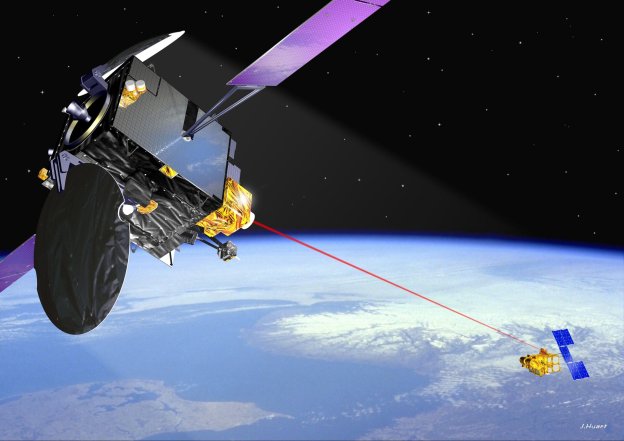
In light of this sort of thing, America’s military establishment is worried that its satellite network is not up to snuff. But it has a plan. The Space-Based Adaptive Communications Node (Space-BACN, or “Space Bacon”) will, if successful, create a laser-enabled military internet in orbit around Earth by piggybacking on a number of satellites that would have been launched anyway.

Space Bacon is a brainchild of DARPA, the special-projects research arm of the Department of Defense, and is an intriguing orbiting echo of the original, terrestrial ARPNET, which evolved into the internet…The plan is to fit as many newly launched satellites as possibly with laser transceivers that will be able to communicate with counterparts as far away as 5,000km. Satellite owners will pay for these transceivers, but will then receive payments from the American government for their use.

Space Bacon promises many benefits. Unlike radio, the normal mode of communication with and between satellites, transmissions by laser beam are hard to intercept and almost impossible to jam. Indeed, adversaries might not even know when a transmission is taking place, a bonus for operational secrecy.

DARPA wants Space Bacon to cost a maximum of $100,000 a satellite, the better to encourage participation. It bodes well that Amazon, SpaceX and Viasat are all designing command-and-control architectures for Space Bacon.

Excerpts from DARPA, lasers and an internet in orbit, Economist, Feb. 11, 2023