Tag Archives: herbicides

Satellites Reveal Depth of Destruction Vietnam War

During the Vietnam War, the United States dropped more than 8 million tons of bombs and sprayed 74 million liters of Agent Orange and other herbicides in Vietnam, Cambodia, and Laos. Nearly 50 years after the war’s end, the deadly impacts of these campaigns persist: Unexploded ordnance continues to maim and kill, while hot spots of dioxin, a potent toxin in the herbicides, might still be contributing to cancers and birth defects today. Now, using declassified military satellite photos, scientists have identified the likely locations of these hidden dangers, which could help direct remediation and cleanup efforts based on research, presented on December 11, 2024 at the annual conference of the American Geophysical Union (AGU)

Identifying these risky areas in the modern landscape is challenging. Tenacious vegetation growth has long since hidden the scars of war, and historical records of bombing and herbicide spraying are both incomplete and imprecise. That’s why Philipp Barthelme, a graduate student in geoscience at the University of Edinburgh, and his colleagues turned to declassified satellite photos from the KH-9 HEXAGON and KH-4a/b CORONA missions, which were sharp enough to reveal details as small as 0.6 meters.

Although the satellite data alone cannot identify unexploded bombs, the researchers surmised they are most likely to be found in regions that were heavily bombarded. The craters from the exploded bombs stand out in the satellite images as bright white splotches. The researchers used machine learning, a kind of artificial intelligence, to pinpoint more than 500,000 such craters in Vietnam’s Quang Tri province, which was the most heavily bombed during the war, as well as a region near the borders of Vietnam, Laos, and Cambodia.

In collaboration with the nonprofit Conflict and Environment Observatory, Barthelme also used satellite data to study herbicide spraying in southern Laos. The U.S. sprayed these compounds in secretive wartime campaigns to destroy crops and improve visibility by defoliating the lush jungles. However, the dioxin in the herbicides killed and debilitated hundreds of thousands of people…The zones of defoliation from the herbicides appear in satellite data as bright, sinuous lines….

Excerpts from Maya Wei-Haas, Declassified satellite photos reveal impacts of Vietnam War, Science, Dec. 14, 2024
Herbicides: safer than table salt

It’s been a tough year for glyphosate, the world’s most popular weedkiller. In 2015, the International Agency for Research on Cancer (IARC), an arm of the World Health Organization, declared that glyphosate—the key ingredient in Monsanto’s Roundup products—was probably carcinogenic to humans. In the months since, multiple lawsuits have been filed blaming the chemical for causing cancer and birth defects. In February, testing found traces of glyphosate in German beer and organic panty liners sold in France. Other tests have found chemical residue in British bread, as well as in the urine of people across Europe. In early March, the European Union put off a vote to renew a 15-year license for glyphosate after several member states balked.

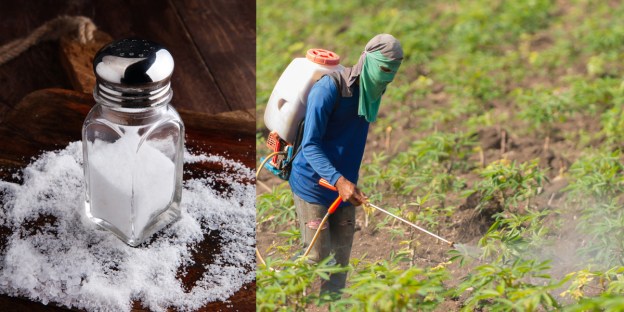
Monsanto famously advertised Roundup, which was introduced in 1974, as safer than table salt. In 1996 the company stopped making the table salt claim after complaints from New York state….. In September 2016 state officials in California proposed adding the herbicide to a list of known carcinogens. The FDA said in February 2016 that it would begin testing for glyphosate residue in food in the U.S. The results aren’t yet available. The Environmental Protection Agency has been reviewing its use since 2009. The agency, which in 1985 temporarily classified glyphosate as “possibly carcinogenic,” was supposed to wrap up sometime last year; it now says a draft of its decision should be available for public comment sometime this year.

The herbicide industry has mounted an aggressive campaign to discredit the cancer finding and to convince regulators—and the public—that the herbicide should remain in use. …

Glyphosate works by blocking the production of certain amino acids that a plant needs to grow, and it’s nonselective, meaning it kills most plants. It began to dominate the herbicide market only after Monsanto genetically engineered crops to survive it, marketing them under its Roundup Ready brand. Global sales of glyphosate were about $7.8 billion in 2014, 30 percent of the herbicide market, according to Cropnosis, a market-research firm. Monsanto’s dominance of the glyphosate market has declined since the chemical went off patent in 2000. Some weeds have become resistant to glyphosate, triggering the need for other weedkillers. Nonetheless, Roundup remains the primary money-maker for Monsanto’s agricultural productivity segment, which brought in 32 percent of its revenue in fiscal 2015.

A rejection of glyphosate by either the U.S. or Europe would have “massive” ramifications on farming and food production, says Jason Miner, an analyst for Bloomberg Intelligence. “You could quickly take us two decades back in terms of farm yields,” he says. “The world doesn’t have capacity to produce all the alternatives.”

Monsanto’s Roundup Could Get Whacked by European Regulators, Bloomberg BusinessWeek, Mar. 10, 2016

The Toxic Herbicides Case: Ecuador v. Colombia

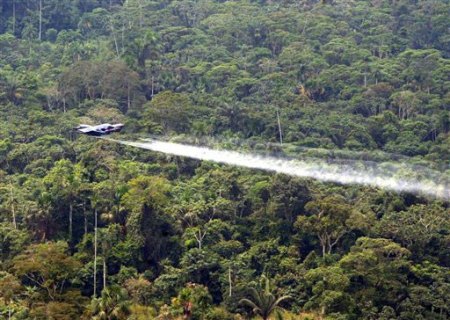
The case brought by the Republic of Ecuador against the Republic of Colombia on 31 March 2008 before the International Court of Justice (ICJ) in respect of a dispute concerning “Colombia’s aerial spraying of toxic herbicides at locations near, at and across its border with Ecuador” was removed from the Court’s List on 13 September 2013 at the request of Ecuador…

According to the letters received from the Parties, the Agreement of 9 September 2013 [between Colombia and Ecuador] establishes, inter alia, an exclusion zone, in which Colombia will not conduct aerial spraying operations, creates a Joint Commission to ensure that spraying operations outside that zone have not caused herbicides to drift into Ecuador and, so long as they have not, provides a mechanism for the gradual reduction in the width of the said zone; according to the letters, the Agreement sets out operational parameters for Colombia’s spraying programme, records the agreement of the two Governments to ongoing exchanges of information in that regard, and establishes a dispute settlement mechanism.  In consequence, the President of the Court, on 13 September 2013, made an Order recording the discontinuance by Ecuador of the proceedings and directing the removal of the case from the Court’s List.

Aerial Herbicide Spraying (Ecuador v. Colombia), Case removed from the Court’s List at the request of the Republic of Ecuador, Press Release International Court of Justice,  Sept. 17, 2013