Tag Archives: illegal mining and slavery

How to Kill People 8 000 Feet Below Ground

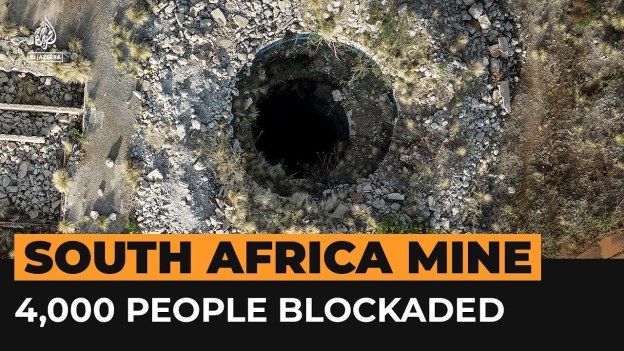
The South Africa’ government has been trying to starve out 1,000 informal prospectors so as to force them out of the Buffelsfontein mine, which extends some 8,000 feet below ground. For months in 2024, police have been sealing most entrances to the tunnels, blocking food and water deliveries and stationing guards at remaining exits to arrest any miners who make their way to the surface. In recent days, nearly 1,200 have surrendered. Police estimate that hundreds of men remain below, but it isn’t clear if they are unwilling or unable to reach the surface.

The operation is part of what police call their “Close the Hole” plan to combat illegal mining, an acute problem in what was once the gold-mining capital of the world. The South African government estimates that illegal gold mining costs the country the equivalent of over $3.8 billion a year in lost revenue, and is often associated with a jump in violent crime in nearby communities and an influx of migrants from neighboring countries… Facing a 42% unemployment rate, impoverished South Africans and migrants from nearby countries pry open sealed entrances and venture thousands of feet underground to try their luck. Locals call the men zama zamas, a Zulu phrase meaning “take a chance.”

Whole ecosystems exist below ground, with entrepreneurs selling miners everything from soda to toothpaste to sex.  The miners in Stilfontein, 100 miles southwest of Johannesburg, are suffering from hunger and dehydration, according to police. Industry experts say the zama zamas are often the lowest-level workers for larger criminal gangs that ultimately sell the gold abroad. Those who have migrated from elsewhere are sometimes victims of abuse, forced to work underground to pay off debts. Police said most miners who emerge will be charged with crimes and imprisoned or deported. 

Excerpt from Alexandra Wexler, The Standoff Deep Inside an Abandoned South African Gold Mine, WSJ, Nov. 15, 2024
Wild West: Mercury Pollution in the Amazon Rainforest

Munduruku Indigenous people in the Tapajós basin – an epicenter of illegal gold mining in the Amazon rainforest – in southwestern Pará state have reported increasing encroachments upon their lands by armed “wildcat” miners known as “garimpeiros” since March 14, 2021. The Federal Prosecutor’s Office has warned of a potential for violence between local residents and the miners and urged the deployment of the federal police and other authorities to remove the trespassers. But the government has yet to act. The tension has escalated in recent weeks after a group of miners brought equipment to the area.

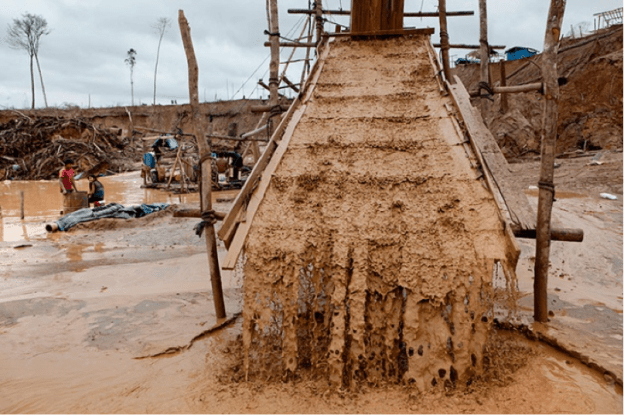
Illegal mining causes significant deforestation in the Brazilian Amazon and has been linked to dangerous levels of mercury poisoning, from mercury widely used to process the gold, in several Munduruku communities along the Tapajós basin. Indigenous people also fear that miners could spread the Covid-19 virus in their communities.

In a public statement on March 16, 2021 the Federal Prosecutor’s Office reported that a helicopter appeared to have escorted the miners and their equipment, suggesting the invasion is “an orchestrated action” by an organized crime group. The office also reported that the miners may be coordinating the invasion with a “small group” of Indigenous people who support the mining. Members of Munduruku communities who oppose the mining and have reported the invasions to the authorities say they have faced threats and intimidation. On March 19, 2021 armed men reportedly prevented a group of Munduruku Indigenous people from disembarking from their boats in an area within their territory. On March 25, 2021 in the Jacareacanga municipality, miners and their supporters forced their way into a building that houses the Wakoborun Women’s Association and other community organizations that have opposed the mining. The attackers destroyed furniture and equipment and set fire to documents, Indigenous leaders reported…

President Bolsonaro has signaled his aversion to protecting Indigenous lands. As a candidate, he vowed not to designate “one more centimeter” of land as Indigenous territory. His administration has halted the demarcation of Indigenous territories – there are 237 pending requests – leaving Indigenous communities even more vulnerable to encroachments, deforestation, and violence. The Munduruku territory is already demarcated. In 2020, Bolsonaro introduced a draft bill in Congress to allow mining and other commercial activities in Indigenous territories. The bill is pending in Congress and is listed as one of Bolsonaro’s priorities.

Excerpt from Brazil: Remove Miners from Indigenous Amazon Territory, Human Rights Watch, Apr. 12, 2021

Satellites and Algorithms against Slaveholders

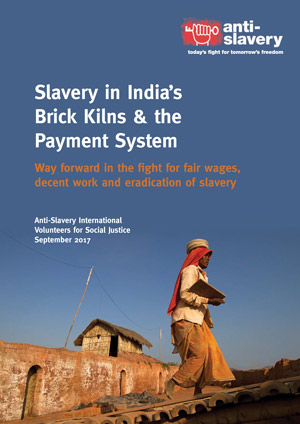
Brick kilns, tens of thousands across South Asia are often run on forced labor.  Satellite imagery of such kilns can help tally the kilns, enabling organizations on the ground to target slaveholders at the sites…

Some 40.3 million people are held in bondage today, according to the latest estimates from the International Labor Organization, headquartered in Geneva, Switzerland. But finding them is hard… Boyd who works for the Rights Lab estimates, however, that one-third of all slavery is visible from space, whether in the scars of kilns or illegal mines or the outlines of transient fish-processing camps.

Boyd is now using artificial intelligence to speed up the search. As a pilot project, she and her colleagues at the Rights Lab used crowdsourced visual searchers to identify brick kilns. The oval shape of the large ovens, sometimes 150 meters long, and their chimneys are distinctive, even from space. “You cannot mix them up with something else,” Boyd says.

Since then, Boyd has turned to machine-learning algorithms that recognize the kilns after being trained on the human-tagged examples. Last month, in the journal Remote Sensing, she and her colleagues reported that the algorithms could correctly identify 169 of 178 kilns in Google Earth data on one area of Rajasthan, although it also output nine false positives…

Another company, called Planet, has about 150 small satellites that snap images of the globe’s entire landmass daily. The images are lower-resolution than DigitalGlobe’s, but their frequency opens up opportunities to identify changes over time.With Planet data, Boyd and the Rights Lab plan to investigate fast moving signatures of slavery. From space, you can watch a  harvest in Turkmenistan and, based on how quickly the cotton disappears, you can tell whether machines or hands picked it. In the Sundarbans, an area spanning India and Bangladesh, shrimp farms and fish-processing camps employ slave labor to clear mangrove trees—a process satellites can capture.

Excerpts from Sarah Scoles, Researchers Spy Signs of Slavery from Space, Science, Feb. 21, 2018