Tag Archives: Iran economic sanctions

Paranoia: What Happens When the Enemy Can See You Naked

During the 2025 Israel/U.S. war against Iran, Israeli authorities, and a pro-Israeli hacking group called Predatory Sparrow, targeted financial organizations that Iranians use to move money and sidestep the U.S.-led economic blockade…Predatory Sparrow…crippled Iran’s state-owned Bank Sepah, which services Iran’s armed forces and helps them pay suppliers abroad, knocking out its online banking services and cash machines…The group also breached Nobitex, Iran’s largest cryptocurrency exchange, popular with locals for transferring money overseas. The hackers extracted about $100 million in funds and forced the platform to shut down, according to the exchange.

Iran’s government pulled the plug on much of the country’s online activities to prevent further attacks… Non-Iranian websites were blocked. Citizens were warned against using foreign phones or messaging platforms that it claimed could collect audio and location data for Israeli spies. Government officials were banned from using laptops and smartwatches.

Paranoia swept through the Iranian population as the attacks, both physical and cyber, mounted. “It’s better to cut [the internet] off. Israel can see everything,” said Mohammad Ghorbaniyan, a Tehran-based money changer whom the U.S. sanctioned several years ago for allegedly aiding Iranian hackers…Predatory Sparrow has been wreaking havoc on Iran since at least 2021. In earlier hacks, the group disabled gas-station payment systems across the country and triggered a fire at an Iranian steel plant. 

For their operation against Nobitex, the hackers managed to obtain the keys for the exchange’s cryptocurrency wallets, which were held by key personnel within the company…Predatory Sparrow then “burned” the stolen $100 million by sending the tokens to other digital wallets the group itself couldn’t access. These wallets’ addresses, which are made up of long strings of numbers and letters, contained profane phrases like “F—IRGCterrorists.”

Excerpt from Angus Berwick, How Israel-Aligned Hackers Hobbled Iran’s Financial System, WSJ, June 29, 2025

How to Kill Scientists and Get Away with It

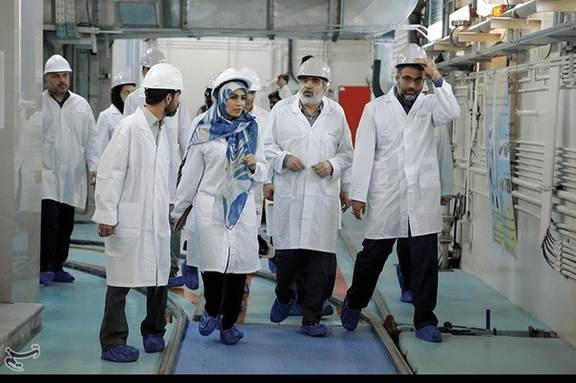
When Israel’s attacks on Iran began before dawn on June 13, 2025 explosions shattered the homes of some of Iran’s top scientists… All nine were killed in near-simultaneous attacks to prevent them from going into hiding…The attack on the scientists was considered so fantastical by even its planners that it was called “Operation Narnia,” after the fictional C.S. Lewis series…A week after the June 13 attacks, Israel used a drone to kill another scientist who was being kept in what was supposed to be a safe house in Tehran. The person hasn’t been named…The deadly airstrikes were the first to target Iran’s nuclear scientists since 2020, when Mohsen Fakhrizadeh was gunned down with a remote-controlled weapon. Israel has never denied or confirmed its role in the deaths of five Iranian scientists between 2010 and 2020.

Among the most important targets was Fereydoon Abbasi-Devani, the former head of the Atomic Agency of Iran and one of the founders of Iran’s nuclear weapons-related work…Another killed scientist was Mohammad Mehdi Teranchi, who led a unit under Fakhrizadeh focusing on high explosives, which are needed to detonate a nuclear weapon…

Iran has used universities like Shahid Beheshti, the Sharif University of Technology and Malek Ashtar University to keep alive its nuclear-weapons expertise over the past two decades….At these universities, Iran often matches up its nuclear scientists on experiments and other studies with younger students. Two of the scientists killed on June 13, Ahmadreza Zolfaghari and Abdulhamid Minouchehr, published an article in the Annals of Nuclear Energy in June 2024 that used advanced computer modeling to show how neutron sources behave in a chain reaction. That information can be used for civilian purposes, like building a nuclear reactor, or to help trigger a chain reaction in a nuclear weapon. 

Excerpt from Laurence Norman, How Israel Killed Iran’s Top Nuclear Scientists, WSJ, June 29, 2025

When a State Collapses, Who Survives: the case of Iran

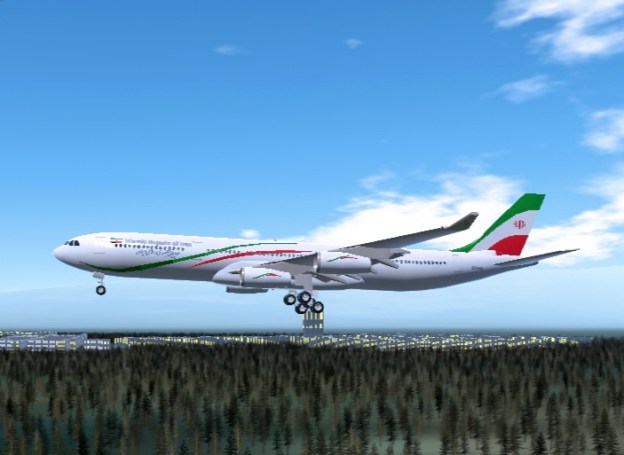
In mid-June 2025, Iran flew at least four civilian aircraft to the Omani capital of Muscat for safekeeping. One of the planes included Iran’s presidential Airbus A340, which landed in Muscat on June 18, 2025 according to flight trackers. 

Arab officials were surprised to learn the planes were empty of passengers. Instead, they said, they carried cash and assets, which Iranians weren’t allowed to offload because of sanctions. The planes themselves were also valuable as emergency exits for top officials. The precautions show the level of pressure on Iran’s rulers during the war (Israel-Iran war of 2025). They had to find a way forward with no control of their own airspace and no help from their militias

Excerpt from S. Raghavan et al., Life in Iran After the Strikes: Executions, Arrests and Paranoia, WSJ, June 28, 2025

The Unintentional Making of a Global Power: Iran

In 2024, Iran, under Supreme Leader Ali Khamenei’s leadership, thwarted decades of U.S. pressure and emerged from years of isolation largely by aligning itself with Russia and China…Iran’s economy remains battered by U.S. sanctions, but oil sales to China and weapons deals with Russia have offered financial and diplomatic lifelines…Today, Tehran poses a greater threat to American allies and interests in the Middle East than at any point since the Islamic Republic was founded in 1979. 

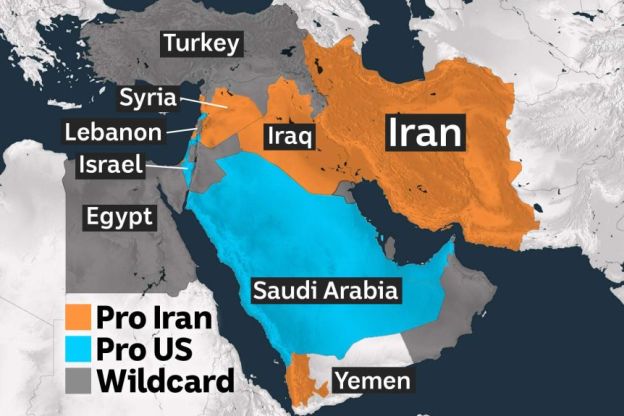
Iran’s military footprint reaches wider and deeper than ever. Iranian-backed armed groups have hit Saudi oil facilities with missiles and paralyzed global shipping in the Red Sea. They have dominated politics in Iraq, Lebanon, Yemen and Syria, and launched the most devastating strike on Israel in decades, when Hamas attacked in October. Iran launched its first direct military attack from its soil on Israel in April 2024. It has also orchestrated attacks on opponents in Europe and beyond, Western officials say. 

“In many respects, Iran is stronger, more influential, more dangerous, more threatening than it was 45 years ago,” said Suzanne Maloney, director of the foreign-policy program at the Brookings Institution, who advised Democratic and Republican administrations on Iran policy. 

U.S. policy has at times unintentionally contributed to Iran’s strength. The 2003 toppling of Saddam Hussein removed a sworn enemy from Iran’s borders. Washington’s failure to stabilize postwar Iraq bolstered Tehran’s influence…

Excerpts from Sune Engel Rasmussen and Laurence Norman, How Iran Defied the U.S. to Become an International Power, WSJ, July 2, 2024

A War Like No Other: the Covert Invasion of Iran

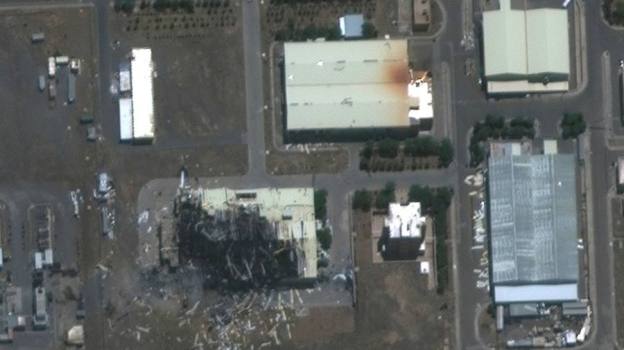
Within hours of Iran proudly announcing the launch of its latest centrifuges, on April 10, 2021, a power blackout damaged some of the precious machines at its site in Natanz…One thing reports seem to agree on is that an “incident” affected the power distribution network at Natanz.

Natanz is critical to Iran’s nuclear program. The heavily secured site is protected by anti-aircraft guns and has two large centrifuge halls buried more than 50 feet underground to protect them from airstrikes. Despite the conflicting reports, it appears the facility’s main power distribution equipment — Natanz has its own grid — was taken out with explosives. Backup emergency electricity also was taken down, and power cut out across the multibuilding compound, Behrouz Kamalvandi, spokesperson for Iran’s Atomic Energy Organization, told Iran’s state-run TV.

A blackout may not sound that serious, but it can be at an enrichment plant. Centrifuges are slender machines linked up in what are called cascades which enrich uranium gas by spinning it at incredibly high speeds using rotors. The stress on the advanced materials involved is intense and the process is technically immensely challenging. A small problem can send a centrifuge spinning out of control, with parts smashing into each other and damaging a whole cascade.

The question is: what caused the blackout – a cyber-attack or a physical act of sabotage, like a bomb?

Israel has a long history of sabotaging nuclear facilities in Iraq, Syria, and Iran, both through cyber means — including the sophisticated Stuxnet attack against Iran, which Israel conducted with U.S. and Dutch intelligence agencies — and with conventional bombs and explosives. Israel is also reportedly behind a number of assassinations of Iranian nuclear scientists and officials over the last decade. The Stuxnet attack was particularly significant because it launched the era of cyberwarfare, as it was the first cyberattack known to use a digital weapon that could leap into the physical realm to cause actual destruction of equipment. The highly skilled covert operation was conducted in lieu of a kinetic attack to avoid attribution and an escalation in hostilities with Iran; it remained undetected for three years..

Excerpts from Gordon Corera, Iran nuclear attack: Mystery surrounds nuclear sabotage at Natanz, BBC, Apr. 12, 2021, Kim Zetter, Israel may have Destroyed Iran Centrifuges Simply by Cutting Power, Intercept, Apr. 13, 2021

By Hook or By Crook (or Both): How Iran Beats US Sanctions

Persian Gulf waters off Iraq have become a new, important waypoint for Iranian oil smugglers looking to avoid U.S. sanctions…Iranian tankers now regularly transfer crude to other ships just miles offshore the major Iraqi port of Al Faw, according to the officials. The oil is then mixed with cargoes from other places to disguise its origin, and it eventually ends up on sale in world markets, they say.


In one example from March 2020,  according to a shipping manifest reviewed by The Wall Street Journal, 230,000 barrels of oil from the state-run National Iranian Oil Co. were transferred to a vessel moored in Iraqi waters. The cargo was blended with Iraqi oil and passed to other ships, according to people familiar with the operation. The ultimate destination of the oil wasn’t clear.

The people familiar with the transfer said the operation was part of an increasingly common and lucrative business that involves transferring and mixing cargoes with other vessels multiple times and then selling the oil with documents that declare it is as Iraqi. Iraqi oil can be sold at a significant premium to oil of Iranian origin.

Iran has increasingly tried to find ways to get its crude to market despite the U.S. sanctions. Iran’s daily crude and condensates exports averaged 827,000 barrels a day in the first six months of this year, according to U.S. shipping-information company TankerTrackers.com. That is up 28% from the previous six months, but far below the level of 2.7 million barrels a day in May 2018 before the sanctions.

“We While some of Iran’s oil exports go to countries not aligned with the U.S., such as Syria and China, they often pass through allies such as the United Arab Emirates or Iraq, where their origin is being concealed, according to U.S. officials.

Excerpt from Sarah McFarlane and Benoit Faucon, Iraq Emerges as Hurdle to Enforcing Iran Oil Sanctions, WSJ, Oct. 24, 2020

Strangling China with Hong Kong: the Politics of Fear

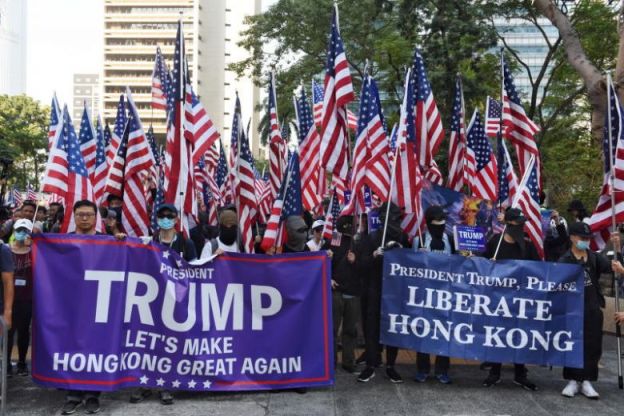
The U.S. determination  that Hong Kong is no longer autonomous from mainland China, under the Hong Kong Policy Act of 1992, will have significant implications for the city’s exporters and businesses.  Sensitive U.S. technologies could no longer be imported into Hong Kong, and the city’s exports might be hit with the same tariffs levied on Chinese trade.

But the act doesn’t cover the far more extensive role Hong Kong plays as China’s main point of access to global finance.  As of 2019, mainland Chinese banks held 8,816 trillion Hong Kong dollars ($1.137 trillion) in assets in the semiautonomous city, an amount that has risen 373% in the last decade…. China’s banks do much of their international business, mostly conducted in U.S. dollars, from Hong Kong. With Shanghai inside China’s walled garden of capital controls, there is no obvious replacement.

While the U.S. doesn’t directly control Hong Kong’s status as a financial center, Washington has demonstrated its extensive reach over the dollar system, with penalties against Korean, French and Lebanese financiers for dealing with sanctioned parties. The U.S. recently threatened Iraq’s access to the New York Federal Reserve, demonstrating a growing willingness to use financial infrastructure as a tool of foreign policy.  Even though the U.S. can’t legislate Hong Kong’s ability to support Chinese banks out of existence, the role of an international funding hub is greatly reduced if your counterparties are too fearful to do business with you.

Putting the ability of Chinese banks to conduct dollar-denominated activities at risk would be deleterious to China’s ability to operate financially overseas, posing a challenge for the largely dollar-denominated Belt and Road global infrastructure initiative. It would also put the more financially fragile parts of the country, like its debt-laden property developers, under strain.  China’s hope to develop yuan into an influential currency also centers on Hong Kong’s remaining a viable global financial center—more than 70% of international trade in the yuan is done in the city.

Excerpts from Mike Bird, How the US Could Really Hurt China, WSJ, May 290, 2020

The Sanctions Busters: Iran and Friends

The past 15 months have been grim for Iranian businesses which trade with the outside world. America has tightened sanctions against Iran’s financial system; the European Union has put an embargo on its oil; and international traders are wary of dealing with the country.Iranian businesses are used to fighting for survival. The Islamic Republic has faced sanctions of one sort or another since its creation in 1979. Parts for Iran’s ageing civilian airliners trickle in from the black market. A host of sanctioned products, from industrial chemicals to anti-aircraft missiles, come from China. Almost any good can be found in Iran, at a price.  Amir, a manager in a mining business, says he regularly meets British and German suppliers in Turkey, to obtain the most advanced equipment to tap Iran’s mineral wealth. “Foreign firms are terrified of doing something illegal, but in the end they are businessmen,” he says. “The Europeans send our cargoes to Dubai, documented as the final destination. From there we are in charge.” Amir uses Gulf middlemen to change the documents, for a fee of 3-5%, before the goods are shipped to Bandar Abbas, Iran’s largest port.

Because few international banks deal with sanctioned Iranian institutions, Iranian importers have to find roundabout ways of paying suppliers. Amir uses a network of Iranian go-betweens who own companies in South Africa and Malaysia to pay his suppliers’ Western banks. He says 30% of his revenues are spent on avoiding sanctions—not counting the time involved.

The sanctions have hit Iran’s oil industry the hardest. Iran’s government depends on oil for more than half of its revenue, but exports have fallen and grown more volatile. The country’s total production is a quarter less than the 3.6m barrels per day it pumped in 2011.  One way of keeping sales going is to dress up Iranian oil as Iraqi. Another trick is to move Iranian oil onto foreign tankers on the open sea. Once crews have switched off their ships’ tracking beacons, this is all but undetectable. The oil is sold at a discount. Fujairah, in the United Arab Emirates (UAE), is a big market for Iranian oil. Business is down, says Sajad, but European firms still trade with Iran, using Swiss subsidiaries which broker deals with the Iranians and collect the crude using tankers under the flag of a third country.

The sanctions have been a fillip for the few institutions still handling Iranian money. One foreign bank charges 5% on cash moving in or out of Iran, says an Iranian shipping source. Normal business rates are a fraction of a percent, but Iranian firms have little choice.

Sometimes the fear of sanctions is more effective than the sanctions themselves. A customer in the UAE owed $1.3m to Sajad’s shipping firm but would only send it in costly small instalments. Sajad flew to the Gulf to pick up the balance in cash. “I was nervous about what I would say to customs from either country if they checked my suitcase,” he says. “I decided I would tell the truth. I am not a criminal.” But no one did.

Dodging sanctions in Iran: Around the block, Economist, Mar. 3, 2013, at 68